Auto body shop marketing means being the shop a driver finds and trusts in the hour after a crash. Get your Google Business Profile right, collect reviews every week, add a photo estimate form and a plain page on insurance and the driver’s right to choose a shop, and build referrals with tow companies, dealers and agents.
I build websites for auto repair and service businesses, and collision shops are a different animal from mechanical shops. Nobody plans a repair. Many jobs arrive through an insurance company, and a driver may need a body shop once every few years. That changes what marketing has to do. This guide uses fresh data from page one of Google in 12 US cities. For the general repair-shop side, see my guide to SEO for auto repair shops, and for the site itself, auto repair website design.
Who Picks the Body Shop Now
For years, a big share of collision work came through insurers. A driver files a claim, the adjuster suggests a shop in the insurer’s direct repair program (DRP), and the driver says yes because it’s easy. If you’re on those programs, cars arrive whatever your marketing does. If you’re not, you have to win the driver before that suggestion lands.
Two things have shifted the balance toward the driver:
- More people pay themselves. CCC Intelligent Solutions, whose software handles a large share of US repair estimates, reported in its Crash Course 2026 mid-year update that self-pay jobs made up 26% of repair orders in the first half of 2026, and more than 71% of those were under $2,000. These drivers never talk to an adjuster. They search.
- Deductibles are higher. The same update reported that 28.4% of repairable collision claims carried a deductible of $1,000 or more, up from 25.7% a year earlier. When the driver pays the first $1,000, they shop around for that $1,000.
The catch is frequency. Shop owners often quote seven to eight years between a driver’s accidents (Daniel Burkholder, a former shop owner, put it that way in an Autobody News piece). You won’t stay in someone’s head for seven years with a fridge magnet. You have to be easy to find on the day it happens, and that means Google.
What Drivers Search For
Here is what US drivers type when they need body work, from Ahrefs (US monthly searches, November 2026):
| Search | Monthly searches |
|---|---|
| body shop near me | 53,000 |
| collision repair near me | 37,000 |
| auto body shop near me | 34,000 |
| dent repair near me | 12,000 |
| auto body repair near me | 9,300 |
| how much does it cost to paint a car | 8,700 |
| paintless dent repair near me | 6,200 |
| diminished value claim | 4,800 |
| collision center near me | 4,400 |
| car paint shop near me | 3,300 |
| hail damage repair near me | 2,400 |
| bumper repair near me | 2,300 |
| car scratch repair near me | 1,100 |
| frame repair near me | 700 |
| how much does it cost to fix a bumper | 350 |
| collision repair estimate | 300 |
Three things stand out. “Near me” searches dominate, so the map results decide most of it. People search by the damage they have (bumper, dent, scratch, hail, frame), so each of those deserves its own page. And cost questions are big: 8,700 people a month ask what painting a car costs. A shop that answers that honestly on its site gets those visitors.
What Page One Looks Like in 12 Cities
I looked at the first page of Google for “auto body shop” plus a city name in 12 mid-size US cities: Columbus, Tucson, Raleigh, Omaha, Knoxville, Boise, Richmond, Tulsa, San Antonio, Spokane, Albuquerque and Des Moines (Ahrefs data, 14 November 2026). Every city showed a map pack of three shops at the top, then 8 to 10 regular results. Across the 96 regular results:
| Who ranks | Results | Share |
|---|---|---|
| Independent shops | 35 | 36% |
| Directories (Yelp, Carwise, BBB and others) | 25 | 26% |
| Chains (Caliber, Maaco, Crash Champions, ABRA, Gerber and others) | 18 | 19% |
| Reddit and Facebook discussions | 13 | 14% |
| Dealership body shops | 5 | 5% |
Reddit and Yelp were on page one in all 12 cities. People ask “anyone know an honest body shop?” on their city’s subreddit, and Google shows those threads. That matters for marketing: your shop’s name coming up in those threads, and your Yelp page looking cared for, are part of how you get chosen.
The other good news: independent shops hold more page-one spots than the chains, and many of them do it with weak websites in SEO terms. Several ranking shop sites had an Ahrefs Domain Rating between 0 and 13, which means almost no links from other sites. Being local, relevant and reviewed still wins.
The People Also Ask boxes under these searches were consumer questions, again and again: what’s the difference between an auto body shop and a collision center (9 of 12 cities), how much body work costs or what shops charge per hour (10 of 12), and how to negotiate with an auto body shop (7 of 12). Those are the questions your website should answer.
What the Ranking Shop Pages Have, and What They Miss
Next I opened the page that ranked for each shop, chain and dealer, and checked what was on it. 46 of the 58 pages could be read (the rest blocked automated visits or loaded everything with scripts). Here’s what the 26 independent shop pages had, with the chain pages for comparison:
| On the ranking page | Independent shops (26) | Chain pages (17) |
|---|---|---|
| Phone number you can tap to call | 22 (85%) | |
| Reviews or testimonials | 23 (88%) | |
| Insurance mentioned | 21 (81%) | |
| Free estimate offered | 15 (58%) | |
| Before-and-after photos or a gallery | 15 (58%) | |
| Lifetime warranty | 13 (50%) | |
| Online booking or appointment request | 11 (42%) | 14 (82%) |
| Online or photo estimate | 10 (38%) | 13 (76%) |
| Factory (OEM) certification | 9 (35%) | 6 (35%) |
| What to do after an accident | 9 (35%) | 5 (29%) |
| ADAS calibration mentioned | 6 (23%) | |
| Financing | 3 (12%) | 11 (65%) |
| Spanish | 2 (8%) | |
| The driver’s right to choose a shop | 1 (4%) | 1 (6%) |
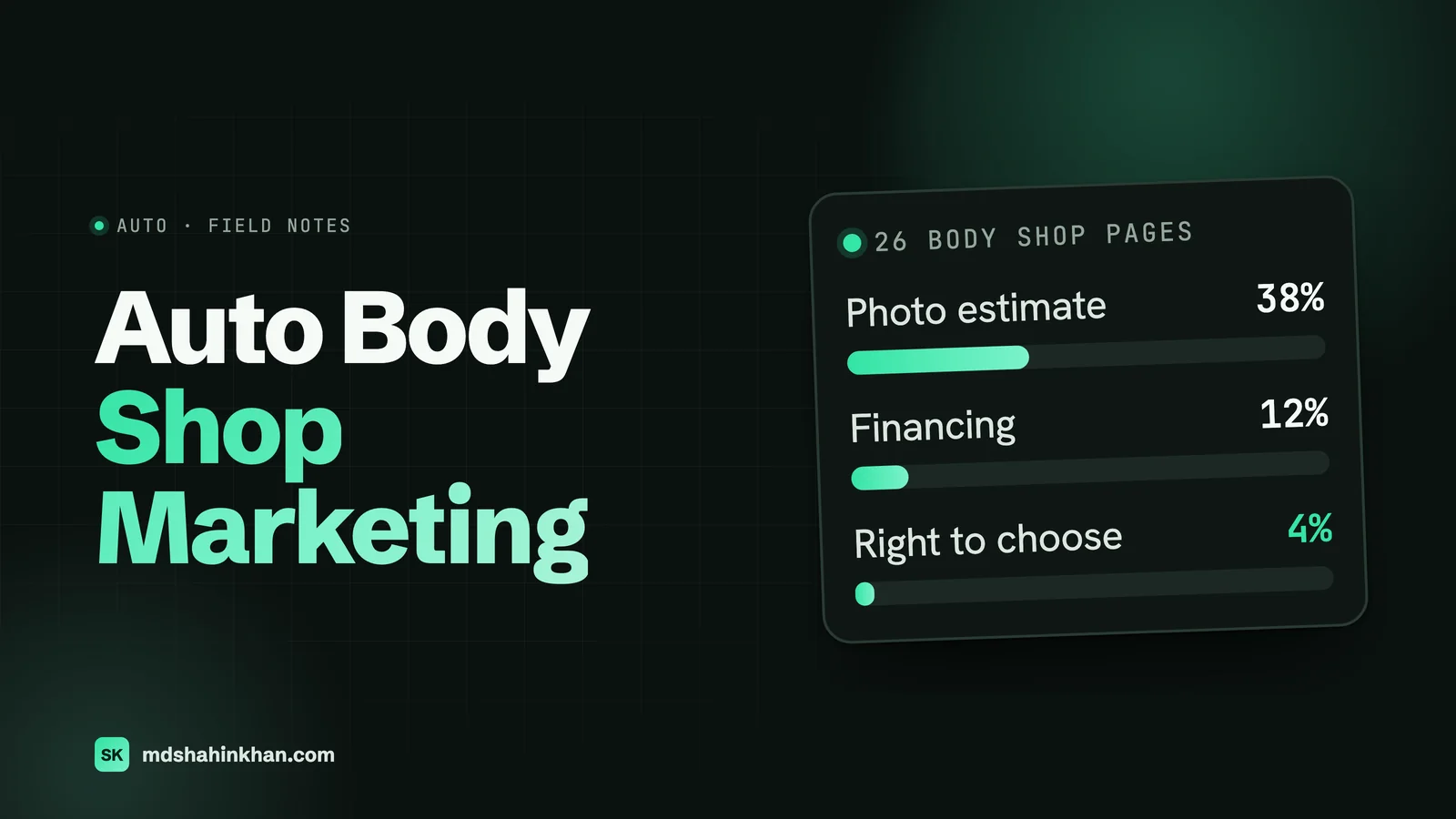
The pattern is clear. Independent shops are good at the trust signals: reviews, insurance, warranty, “family owned since 1987”. They fall behind the chains on the things that make it easy to act: sending photos for an estimate, booking online, paying over time. And almost nobody tells the driver the one thing that most helps an independent shop, which is that the driver, not the insurer, chooses where the car is fixed.
These gaps are where an independent shop can pull ahead without spending more on ads.
Your Google Business Profile Comes First
Most “near me” searches end in the map pack, so the profile is your main shop window. Micki Woods, a former shop owner who now runs a marketing firm, told Autobody News that Google ads, the Google profile and organic search are the three biggest channels for collision shops, citing a CallRail study in which 80% of inbound conversations across 1.1 million small business leads came from them.
What to set up:
| Profile item | What to do |
|---|---|
| Primary category | Auto body shop. Not “Auto repair shop”, which reads as a mechanic |
| Secondary categories | Only what you really do, such as auto dent removal service, auto painting, auto glass shop |
| Services | One line per service: collision repair, frame straightening, paint and refinishing, paintless dent repair, hail repair, bumper repair, ADAS calibration |
| Photos | The building from the street, the front office, the paint booth, the frame machine, finished cars, the team. Add a few every month |
| Hours | Include Saturday if you open, and set holiday hours |
| Attributes and links | Your appointment or estimate link, so the “Book” button goes to your photo estimate form |
| Q&A and posts | Answer the questions drivers ask (insurance, rental cars, how long repairs take) |
Name, address and phone must match your website and your Yelp, BBB and Carwise listings exactly. For a full walkthrough, my local SEO guide for small businesses covers the profile step by step.
Reviews, Reddit and Yelp
A collision customer is nervous: the car is damaged, often new, and they’ve never met you. Reviews are how they decide. Ask every customer at pick-up, when the car looks its best, and send a text with the review link the same day. A steady few reviews a week beats a burst of 50 and then nothing.
Reply to every review, good or bad, in a calm and short way. On a bad one, say what you’ll do and take it offline. A reasonable reply to a complaint often wins more trust than ten five-star reviews.
Because Reddit and Yelp show up in every city I checked, look after them too:
- Yelp: claim the page, add the same photos and hours, and answer reviews there as well. Don’t ask customers for Yelp reviews specifically (Yelp’s rules discourage it), just make sure the page is complete.
- Reddit: you can’t control it, and you shouldn’t post fake recommendations. What you can do is give people a reason to name you: fair estimates, honest answers when someone asks whether a repair is worth it, and good work that customers talk about. If someone mentions your shop with a question, a short, helpful reply from the owner reads well.
The Website: Pages a Body Shop Needs
Your website doesn’t need to be large. It needs to answer the questions a stressed driver has and make the next step easy. Ten to fifteen pages usually covers it.
1. A photo estimate form. Three photos of the damage, the year, make and model, a name and phone number, and a promise of when you’ll reply (“within two business hours”). Only 10 of the 26 shop pages I checked offered anything like it, against 13 of 17 chain pages. Many drivers want a ballpark before they take time off work to drive over.
2. Insurance and your right to choose. A plain page: which insurers you work with, whether you’re on any DRPs, how a claim works with you, who pays the deductible, and the fact that in most states the driver chooses the shop. More on the law below. This page answers the question that loses independent shops the most work: “My insurance said to go to their shop. Do I have to?”
3. What to do after an accident. A short checklist: safety, photos, police report, exchanging details, calling the insurer, getting the car towed. 9 of 26 shops had something like it. It’s the page people bookmark, share with family and find through search.
4. One page per kind of damage. Bumper repair, dent repair and paintless dent repair, scratch and paint, frame repair, hail damage. Each needs real photos from your shop, the usual time the repair takes, and how insurance applies.
5. Certifications and equipment. If you hold factory certifications or I-CAR Gold Class, say what that means for the driver in plain words: the right repair procedures for their car, the right equipment, and in some cases a repair that protects their warranty. Newer cars matter here: CCC’s 2026 report found 28.3% of repairable estimates included a calibration of driver-assist sensors. If you do ADAS calibration in-house, say so.
6. Costs, honestly. You can’t price a repair without seeing it, but you can give ranges and explain what moves the price. Ten of the twelve city searches showed a cost question in People Also Ask. A page that answers it gets read.
7. Warranty, financing and rental cars. Half of the shops mentioned a lifetime warranty; only 3 offered financing, against 11 of 17 chain pages. For self-pay customers with a $1,500 bumper and paint job, “pay over time” can decide it. If you arrange rental cars or towing, say how.
8. Reviews and before-and-after photos. Real cars from your shop, with the customer’s permission and the plates hidden.
Put the phone number at the top of every page so it can be tapped on a phone, and make the photo estimate button visible without scrolling. If Spanish is common in your area, a Spanish version of the estimate page is cheap and almost nobody does it (2 of 26).
My guide to auto repair website design covers layout, speed and the booking flow in more detail.
Insurance Companies, DRPs and the Right to Choose
This is where independent shops lose the most work without a fight. An adjuster suggests a shop, and the driver assumes they have to go there. In most states they don’t.
Two examples of the law in plain text:
- Texas Insurance Code §1952.301 says an insurer may not limit coverage by “limiting the beneficiary of the policy from selecting a repair person or facility”, and in third-party claims may not require the claimant “to have repairs made by a particular repair person or facility”.
- California Insurance Code §758.5 says “No insurer shall require that an automobile be repaired at a specific automotive repair dealer”, and an insurer may only suggest one if the claimant asked or has been told in writing about their right to choose.
The rules differ from state to state. Some ban insurers from even recommending a shop without being asked, others only ban requiring one. A 1997 Connecticut legislative report counted 33 states with some form of anti-steering law, and newer sources say more. Before you write your page, read your own state’s rule on your insurance department’s website, quote it accurately, and keep the tone helpful rather than angry at insurers. Many of your customers’ insurers are also your business partners.
A good insurance page says: you can choose any licensed shop; here’s how we work with your insurer; here’s what happens with the estimate, supplements and parts; and here’s who to call. Then put a short version of that on your homepage and estimate form.
If you’re on DRPs, that work is valuable. Just don’t let it be the only source. Programs change, and the self-pay and higher-deductible drivers are searching for you directly.
Deductible Offers: Check Before You Advertise
One shop in my sample advertised “Save $250 toward your deductible”. Offers like this are popular, and they can get a shop in trouble. Whether a shop may waive, pay or discount a deductible depends on the state, and the clear line everywhere is that inflating the bill to the insurer to cover the deductible is fraud. Some states treat deductible waivers themselves as a problem.
Before putting a deductible offer on your website, check your state’s insurance fraud rules or ask your attorney. A safer message is the one drivers care about anyway: honest estimates, quality repairs and help with the claim.
Referral Partners
Referrals matter more for body shops than for almost any other local business, because the people who meet a driver right after a crash aren’t the driver’s friends:
| Partner | Why they refer | What to offer them |
|---|---|---|
| Tow companies | They choose where an undecided driver’s car goes | Fast drop-off, quick payment of tow bills, a friendly contact person |
| Mechanical repair shops | They send collision work they don’t do | You send them mechanical work you don’t do |
| Car dealers without a body shop | Customers ask them who to trust | Factory-correct repairs, updates on the car |
| Independent insurance agents | Their clients call them first after a crash | Help with claims, clear communication |
| Glass shops, detailers, wrap shops | Overlapping customers | Mutual referrals |
Keep a simple list of who sent each job. After three months you’ll know which relationships to invest in.
Paid Ads
Google search ads for “collision repair near me”, “bumper repair [city]” and similar terms work well when they land on the photo estimate form, not the homepage. Set a radius of the area you really serve, and run ads during your opening hours or when someone can call back fast.
Local Services Ads (the “Google Guaranteed” or “Google Screened” ads at the very top) charge per lead rather than per click. Google’s own help pages list auto body shops as a category, but one list limits “vehicle body shop” to California and Florida, so check eligibility for your area in the Local Services account before you count on it.
Social media works better as proof than as advertising: before-and-after videos, a paint match, the team. It rarely brings the call on its own, but it helps the driver who’s comparing you with a chain.
Local Marketing Still Works
The Autobody News piece had good examples from smaller towns: a rural Illinois shop ran a “ladies’ night” with a tire technician and an insurance agent talking about what to do after an accident, and got a pizza place to tape its fliers to delivery boxes. Another owner was quoted on local TV about bad-weather driving and car theft. In a small market, sponsoring the youth soccer team and putting your name on the banner still works. In a big city, spend that effort on the profile, reviews and website first.
Hail is the other local factor. If your area gets hail, have a hail repair page ready before the season, add paintless dent repair to your profile, and run ads for a few weeks after a storm. 9 of the 26 shop pages mentioned hail; in hail country, the others are leaving money on the table.
What to Measure
You don’t need a complex dashboard. Track these monthly:
| Measure | Where to find it |
|---|---|
| Calls, website clicks and direction requests | Google Business Profile performance |
| Photo estimate requests | Your form emails or your website’s analytics |
| Estimates written and estimates won | Your shop management system |
| Where each job came from | Ask every customer and note it (Google, referral partner, insurer, repeat) |
| New reviews and average rating | Google profile and Yelp |
| Self-pay share | Your repair orders |
Estimates won divided by estimates written is the number that tells you whether marketing or the front counter is the problem. If plenty of people request estimates and few book, work on follow-up and price explanations, not more ads.
A 90-Day Plan for an Independent Body Shop
Weeks 1 to 2
- Set the profile’s primary category to Auto body shop, list every service, and add 15 to 20 real photos
- Make name, address and phone match on the website, Yelp, BBB and Carwise
- Start asking every customer for a review at pick-up, with a text link sent the same day
Weeks 3 to 6
- Add a photo estimate form with a reply-time promise, linked from the profile and every page
- Write the insurance page with your state’s right-to-choose rule quoted accurately
- Add an “after an accident” checklist page
Weeks 7 to 10
- Build one page per damage type (bumper, dent and PDR, paint and scratch, frame, hail)
- Add certifications, ADAS calibration, warranty, financing and rental car details if you offer them
- Visit five tow companies, two dealers without a body shop and three insurance agents
Weeks 11 to 13
- Test Google search ads aimed at the estimate form, if the profile and site are in shape
- Check Local Services Ads eligibility for your area
- Review the numbers: calls, estimate requests, close rate and where jobs came from
Frequently Asked Questions
What Is the 300% Rule for Auto Shops?
It comes from dealership finance offices: present 100% of the options to 100% of customers, 100% of the time. Repair shops borrowed it for inspections, meaning every finding gets estimated and shown to every customer, usually with photos. Used honestly, it helps customers decide. Used as pressure, it costs you trust, which is the thing a body shop can least afford to lose.
What Is the 3-3-3 Rule for Marketing?
It’s an informal planning idea, not an official rule, and people define it differently. The most common version is three messages, three audiences and three channels. For a body shop that could mean: honest estimates, insurance help and certified repairs; self-pay drivers, insured drivers and referral partners; Google, reviews and referrals.
What Are the Best Marketing Strategies for an Auto Repair Shop?
For a collision shop: a complete Google Business Profile, steady reviews, a website with a photo estimate form and a clear insurance page, and referral relationships with tow companies, dealers and agents. Add Google ads once those are in place. For mechanical repair shops, my guide to SEO for auto repair shops covers the differences.
What Are the 3 C’s in Automotive Repair?
Concern, cause and correction. The repair order records what the customer reported (the concern or complaint), what the technician found (the cause) and what was done (the correction). It keeps the record clear for the customer, the insurer and any warranty claim.
What Is the Difference Between an Auto Body Shop and a Collision Center?
Most drivers use the two names for the same thing. “Collision center” is often used by larger shops that handle structural and frame repairs, insurance work and sensor calibration, while “body shop” can also mean a smaller shop doing paint, dents and cosmetic work. On your website, use the words your customers search, which in my data means both.
Do I Need a Marketing Agency for My Body Shop?
Not to start. The profile, review requests, the insurance page and referral visits are things an owner or office manager can do. An agency or a developer is worth it for the website, ads management and anything that needs regular technical work. Ask any agency to show you the calls and estimate requests it produced. Rankings on their own prove little.
If you’d like a body shop website with a photo estimate form, a clear insurance page and the speed that phones need, my page on websites for auto service centers shows how I build them. For the wider picture, start with my local SEO guide for small businesses.
If you’d like me to look at your shop’s website and Google profile and tell you what I’d fix first, book a free 30-minute call and I’ll go through it with you, whether or not we work together.