A driver with a warning light picks a repair shop in three searches, on a phone, usually within an hour. To be the shop they pick, you need a Google Business Profile that is complete, open, and rated well by recent reviews; service pages that name a price; a website with a phone number and a booking button that work with a thumb; and a review routine that adds a few new reviews every week. That is the whole of SEO and marketing for a repair shop, and none of it needs an agency retainer. Everything else, from postcards to Facebook ads, is optional and comes after.
I build websites for auto repair shops and service centers as a freelance WordPress developer, and the shops that stay busy online are rarely the ones with the biggest budget. They are the ones whose profile says “Open now”, whose brake page says “from $189”, and whose owner asks every happy customer for a review. This guide is that pattern, in the order it pays: how drivers choose, the profile, service pages with prices, reviews, the website basics, local SEO, what ads really cost, a one-page plan, and a table of advertising ideas ranked by cost, with a section for body shops at the end.
How Drivers Pick a Shop
Nobody browses for a mechanic. Something breaks, and the search happens in the car park, at the kitchen table, or at the side of the road. Three searches cover almost every new customer a shop gets online:
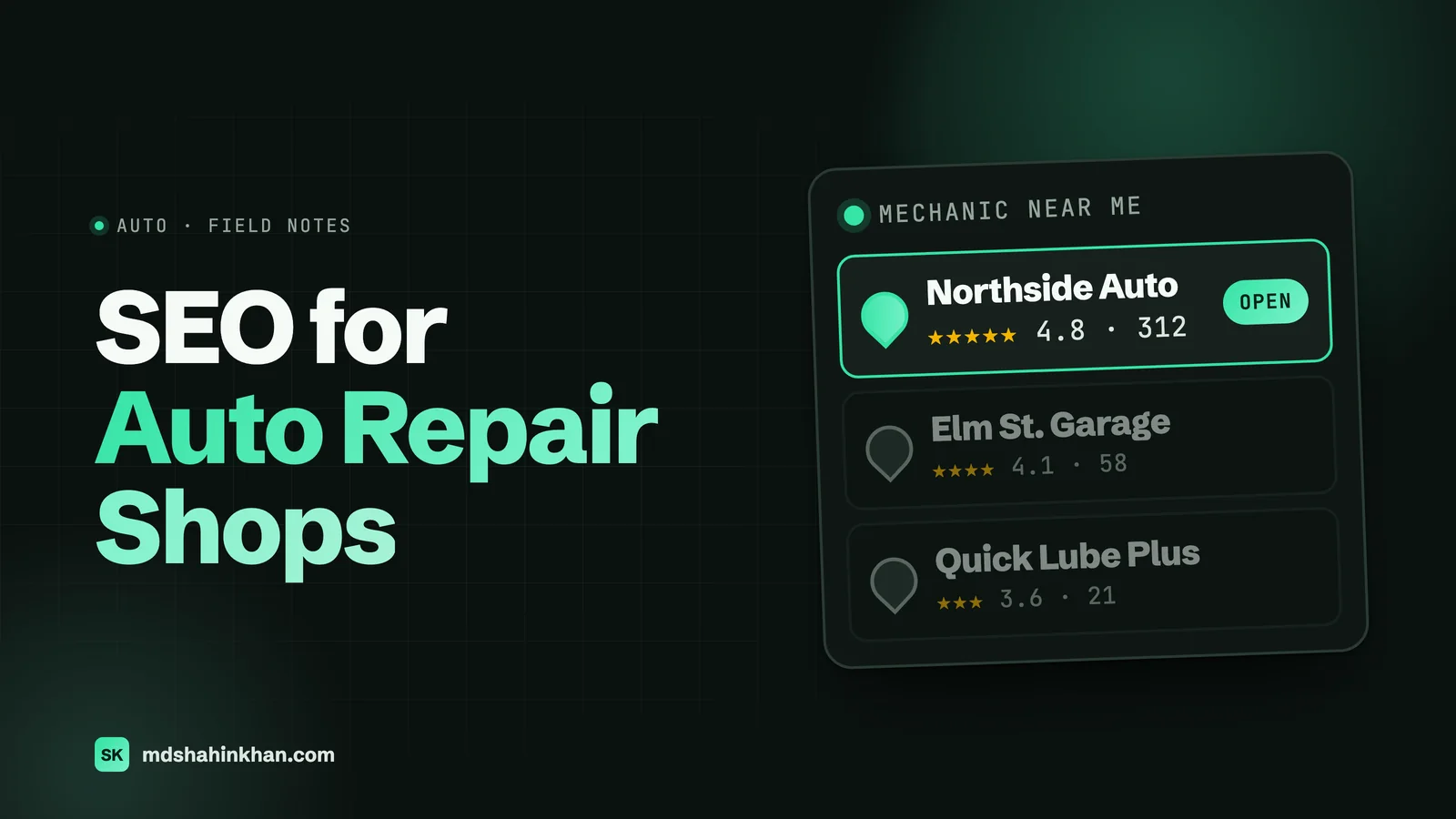
- “mechanic near me” or “auto repair near me” (or “brake repair near me”, “check engine light near me”). The result is the map with three shops. The driver looks at the rating, the review count, whether it says Open, and how far. They tap the phone icon or “Directions”. Most never reach a website.
- “[shop name] reviews” once a friend or a neighbour has suggested a shop. They read the three newest reviews and the owner’s replies, and they look for anything about being overcharged.
- “how much does [repair] cost” for a bigger job: brakes, an alternator, a timing belt, a transmission. They want a number before they call anyone, and the shop that gives a range gets the call.
Every item below serves one of those three moments. The map result is the Google Business Profile, so that is where a shop’s marketing starts, not the website.
Your Google Business Profile Is Your Real Homepage
For a repair shop, the profile does more work than the website, and most profiles are half empty. Go through it field by field.
- Categories. Primary “Auto repair shop”; secondaries for what you actually do: Brake shop, Oil change service, Tire shop, Auto electrical service, Car inspection station, Transmission shop, Auto air conditioning service. Each secondary category is a set of searches you become eligible for.
- Hours, including holiday hours and “open now”. The map shows “Open” or “Closes soon” beside the name. A profile with no hours, or stale hours, loses the driver at a glance. Set special hours for every public holiday a year ahead; Google prompts you, and drivers search on holidays.
- Services with prices. Google’s services section lets you list services under each category with a price or a range. Fill it: “Brake pads and rotors, from $189”, “Diagnostic, $95, applied to the repair”, “Synthetic oil change, $79”. These show in the profile and feed the “how much” search.
- Photos that show the bays. The building from the street (so the driver recognises it), the reception, the bays with the lifts, the team in uniform, a few finished jobs. Twenty real photos, taken on a phone in daylight, replace any stock image. Add a few every month; the profile shows the most recent ones.
- The description. Two hundred words in plain language: what you fix, which makes, since when, the warranty on parts and labour, and the neighbourhoods you serve. No slogans.
- Attributes. Wheelchair accessible, women-owned if it applies, payment types, “Onsite services”, appointments required or not. Drivers filter on these.
- Questions and answers. Seed it with the ten questions the front desk answers every day (Do I need an appointment? Do you do state inspections? Do you work on European cars? Do you offer a courtesy car?) and answer them yourself. Anyone can post an answer to a question on your profile, so you want yours there first.
- Messaging and the booking link. Turn on messaging if someone will answer it within an hour; otherwise leave it off, because an unanswered message is worse than none. Add your booking page as the appointment link.
- Posts. One a week is enough: a seasonal service, a photo of a job, holiday hours. They keep the profile looking alive.
One rule ties it together: the name, address and phone on the profile must match the website and every directory character for character. A different suite number or a tracking phone number on the profile confuses the matching and costs ranking.
Service Pages With Prices
The website’s job is to answer the “how much” search and to convert the driver who wants more than a map pin. One page per service, each with a price or a range, does both.
A service page that works, in order:
- The answer. “Brake pads and rotors on most cars run $189 to $420 per axle at our shop, parts and labour, with a two-year warranty. The diagnostic is free with the repair.” Two sentences, above the fold.
- What moves the price. Vehicle make, ceramic versus semi-metallic pads, whether the rotors can be machined, calipers. Three or four bullet points.
- Symptoms and what happens if you wait. The reason the driver searched. Plain words, no scare tactics.
- How long it takes and whether they can wait. Same day, two hours, courtesy car, ride home.
- Proof. Two reviews that mention this service, pulled live from Google.
- Book or call. The phone number as a tap target, a booking button, and the address with a map.
The pages to write first: brakes, oil change, check engine light diagnostic, tires and alignment, battery and starter, AC service, timing belt, transmission, state inspection, and one page for each make you specialise in (Subaru, Toyota, European). Each 600 to 1,000 words. The make pages are quiet gold in most cities: “Subaru mechanic [city]” has little competition and a driver who has already decided to pay for expertise.
On publishing prices: shops worry about being undercut, and in practice a range with “what moves it” does the opposite. It filters out the price shoppers who were never going to come in, and the driver who calls already trusts you. “Call for a quote” on every page is read as “expensive” by the person comparing three tabs.
Reviews: The Routine That Compounds
Reviews are the second thing the driver looks at on the map and the thing they read before calling a shop a friend recommended. Whitespark’s annual survey of local SEO practitioners puts the Google Business Profile itself as the biggest local pack factor, with reviews and the website’s own signals next; in my experience the review count and how recent they are decide the map result between shops that are otherwise similar.
The routine that works at a shop:
- Ask at pickup, every time. The service writer says “If everything went well today, a Google review helps us more than anything. I’ll text you the link.” That sentence, said out loud, doubles the rate compared with a sign on the counter.
- Text the direct link within an hour. Most shop management systems (Tekmetric, Shop-Ware, AutoLeap, Mitchell 1) can send it automatically when the invoice closes. If yours cannot, a saved text on the front desk phone does the job.
- Reply to every review within a day. Thank the good ones by name and mention the car. On the bad ones, be calm, factual, and offer to talk in person; the reply is for the next reader, not the reviewer. Never argue about money in public.
- Never gate. Sending happy customers to Google and unhappy ones to a private form breaks Google’s policy and can get reviews removed.
- Watch the velocity as well as the score. A shop at 4.6 with 300 reviews and five new ones a week beats a shop at 4.9 with 60 reviews from two years ago. Aim for three to five new reviews a week; a shop that turns 40 cars a week can do that with the routine above.
Put the live Google reviews on the website too: the total near the header, three recent ones on every service page next to the booking button.
The Website Basics: Tap to Call, Book, Directions
The site does not need to be big. It needs to do six things on a phone, quickly.
- Phone number in the header on every page, as a
tel:link at least 44 pixels tall, and a bar pinned to the bottom of the screen on phones with Call, Book, and Directions. - Booking that works. Either a real scheduler from the shop system (most have one) or a four-field request form: name, phone, vehicle, what is wrong, with a promise of a callback within the hour during opening times. Nothing longer.
- Hours and address on every page, matching the profile, with a map link that opens navigation.
- Service pages with prices, as above, and a page per make you specialise in.
- Speed that passes Google’s Core Web Vitals on a phone: the main content painted inside 2.5 seconds, taps answered inside 200 milliseconds, nothing shifting as it loads. In practice: photos exported at the size they display, no video background, one font, caching at the host. A driver at the side of the road does not wait for a slider.
- Proof near every button: the review total, the warranty, the certifications (ASE, AAA Approved, manufacturer programmes), the years in business.
That is eight to fifteen pages on WordPress. What I build for shops is described on the auto service centers page.
Local SEO Beyond the Profile
Once the profile and the service pages exist, three things move the map ranking further.
- Consistent listings. Yelp, Apple Maps, Bing Places, the Better Business Bureau, CarFax’s shop directory, RepairPal if you qualify, and the local chamber. Same name, address, phone, hours. Fix the old address on any listing from a move; conflicting data is the most common reason a good shop sits in position five.
- Location signals on the site. The city in the title of the home page and service pages, the address in the footer on every page, a page for each neighbourhood you draw from if the shop is in a metro (the neighbourhood pages must be genuinely about the place: the roads, the parking, the makes common there, reviews from customers there).
- A few local links. The chamber, a sponsored youth team, the local newspaper’s business page, a supplier’s dealer locator, a community college’s automotive programme. Five real local links do more than five hundred bought ones.
The full mechanics, from citations to the map grid, are in local SEO for small business; shops need the same list with the categories above.
Paid Ads: What They Cost for a Shop, and a $300 Test
Auto repair is one of the cheapest categories in paid search. WordStream’s 2026 benchmarks, drawn from more than 13,000 campaigns, put automotive repair, service and parts at an average of $3.90 per click, a 15.5 percent conversion rate, and $28.50 per lead, among the lowest cost per lead of any industry. The catch is that most shop campaigns are set up badly: broad match on “auto repair”, sending clicks to the homepage, no call tracking, no negative keywords.
| Channel | What you pay for | Typical 2026 cost | Best use for a shop |
|---|---|---|---|
| Google Local Services Ads | A lead (call or message), after Google verifies the business | Roughly $20 to $60 per lead for auto services depending on the market | First paid channel to try; sits above the map with the Google Guaranteed badge; cap the weekly budget |
| Google Search ads | A click | About $3.90 average (WordStream 2026); $6 to $15 on high-intent terms in big metros | “brake repair [city]”, “check engine light [city]”, “[make] mechanic [city]” with a matching service page |
| Facebook and Instagram ads | Impressions or clicks | $5 to $15 per thousand impressions locally | Seasonal offers to a five-mile radius; retargeting site visitors |
| Direct mail to new movers | A postcard | $0.50 to $1.20 each including postage | A first-visit offer to households that moved in this month |
| Yelp ads | A click or a monthly package | Expensive per click in most markets | Only if Yelp already sends you calls organically |
A $300 test a shop can run itself in month one: one Google Search campaign, exact and phrase match on ten terms (brakes, check engine, oil change, AC, tires, plus your two specialist makes, each with the city), each ad pointing at the matching service page, a call-tracking number on the ads, $10 a day, and a negative keyword list that starts with “jobs”, “salary”, “DIY”, “parts”, “how to”. After thirty days you know the cost per call and can decide. Local Services Ads run alongside once Google’s verification is through, usually two to three weeks.
The One-Page Marketing Plan
The plan an owner can print and pin above the desk. Numbers assume a shop doing 30 to 60 cars a week; scale to yours.
| Area | This week | Every week | Every month | Budget |
|---|---|---|---|---|
| Google Business Profile | Complete every field above; add 20 photos; seed 10 Q&As | One post; add 3 photos; reply to every review | Check hours and categories; update services and prices | Time |
| Reviews | Set up the review text in the shop system | Ask at every pickup; text the link; reply within a day | Count new reviews; aim for 12 to 20 a month | Time |
| Website | Fix the header phone, the booking route, and speed | Publish one service or make page | $1,000 to $4,000 once for a rebuild, then $50 to $150 a month hosting and care | |
| Local SEO | Fix name, address, phone on the ten main directories | One local link or sponsorship | $0 to $200 | |
| Paid | Apply for Local Services Ads; set up the $300 Search test | Check cost per call | Review, cut what does not call, scale what does | $300 to $1,500 |
| Retention | Load customer emails and phones into the shop system | Service reminders by text; one seasonal email | $30 to $100 for the tool | |
| Measurement | Call tracking on ads and the website; GA4 events on Call and Book | One sheet: calls, bookings, cars, average ticket, by source | $50 to $150 |
Total for a small shop: $400 to $2,000 a month after the website is right, most of it Local Services Ads, and about three hours a week of the service writer’s time, mostly spent asking for reviews.
Advertising Ideas Ranked by Cost
For the question “how to advertise for an auto repair shop”, ranked from free to expensive, with what each one is good for.
| Idea | Cost | Worth it when |
|---|---|---|
| Complete Google Business Profile with services, prices, photos | Free | Always; it is the map result |
| Review routine at pickup | Free | Always |
| Service reminder texts to existing customers | $30 to $100 a month | Always; the cheapest new work is a returning car |
| Neighbourhood and make pages on the website | Time, or $150 to $400 a page | Metro shops with clear specialities |
| Google Local Services Ads | $20 to $60 a lead | Once the profile and reviews are in order |
| Google Search ads on service terms | About $4 a click | With service pages that name prices |
| Fleet and business accounts | A morning of visits | Shops near industrial estates; steady weekday work |
| New-mover postcards | $0.50 to $1.20 each | Suburbs with turnover; pair with a first-visit offer |
| Facebook and Instagram seasonal ads | $150 to $500 a campaign | Before winter and summer; AC, tires, batteries |
| Sponsorship of a local team or event | $250 to $2,000 | Long-standing shops wanting the name seen; also a local link |
| Radio, billboards, TV | $1,500 and up a month | Multi-location groups only |
The first three cost nothing and produce most of a shop’s new customers. The last row is where the large groups spend, and where a single shop should not.
Social Media: What Is Worth a Shop’s Time
Most of it is not. A shop’s customers are not scrolling for a mechanic; they search when something breaks. Social media for a shop has two jobs and they both fit in an hour a week:
- Proof that you are real and busy. A photo or a short video from the bay twice a week on Facebook and Instagram: a seized caliper, a before-and-after on a brake job, a customer’s classic car with permission, the team on a Friday. Reuse the same photos on the Google profile. This is what a driver sees when they check you out after a recommendation.
- Seasonal reminders and offers to people who already know you. Winter tires, AC before summer, a “back to school” check for the family car. Boost the post for $30 to a five-mile radius if you want it seen beyond your followers.
Skip daily posting schedules, TikTok trends, and anything that needs a content calendar. Reviews and photos on Google do more for a shop than any amount of social content.
Body Shops: What Is Different
Collision repair follows the same rules with three differences.
- The insurer decides a large share of the work. Direct repair programme (DRP) relationships bring cars regardless of marketing, and drivers often search “[insurer] approved body shop near me”. List the insurers you work with on the profile and the site, and write a page that explains, plainly, that the driver has the right to choose the shop in most states and how the claim process works with you.
- Before-and-after photos are the proof. Paint match, panel gaps, a wrecked quarter panel next to the finished car. Ten strong pairs on the site and the profile do what reviews do for a mechanical shop. Get the customer’s permission and never show a licence plate.
- The estimate is the conversion. Drivers want to send photos and get a rough figure before they come in. A photo-estimate form (three photos, the make and model, a phone number) with a promise of a reply inside a few hours beats “bring it in for a free estimate”. Tie it to the calendar so the visit is booked in the same reply.
Categories for the profile: Auto body shop primary, then Auto dent removal service, Auto painting, Auto glass shop if you do it. Everything else in this guide applies unchanged.
Frequently Asked Questions
What Are the Best Marketing Strategies for an Auto Repair Shop?
In order of return: a complete Google Business Profile with categories, hours, services with prices, and real photos; a review routine that asks at every pickup and replies within a day; service pages on the website that name a price range; service reminders by text to existing customers; and, once those are done, Google Local Services Ads with a capped budget. Everything else, from social media to postcards, is a second-tier addition.
How Do I Get More Customers in My Auto Repair Shop?
Win the “near me” search and the “how much” search. Make sure the profile shows Open, a strong recent rating, and prices; make sure the site has a phone number and a booking button that work with a thumb; ask every happy customer for a review. Then bring back the customers you already have with service reminders; a returning car is the cheapest new job there is. A shop that does those four things well usually has more work than bays within a few months.
How to Advertise for an Auto Repair Shop?
Start with the free channels: the Google Business Profile and reviews. Then Google Local Services Ads, which charge per lead (roughly $20 to $60 for auto services in 2026) and show the Google Guaranteed badge above the map. Then a small Google Search campaign, about $4 a click on average for auto repair, on exact service terms pointing at service pages that name prices. Facebook and postcards work for seasonal offers and new movers. Radio and billboards are for multi-location groups.
Is SEO Still Worth It in 2026?
For a repair shop, yes, because the search that brings the customer is local and the result is the map, not a page of blue links. AI Overviews have taken clicks from informational searches, but “mechanic near me” and “brake repair [city]” still resolve to three shops on a map with a phone icon. The work is the profile, reviews, service pages with prices, and consistent listings, and it compounds for years at almost no cost.
What Is Automotive SEO?
The set of things that make a shop, a dealer, or a parts business show up when someone nearby searches for what it does: a complete Google Business Profile, service pages that answer specific searches, reviews, consistent business listings, a fast mobile website, and a few local links. For a single repair shop it is mostly local SEO; for a dealer or a parts retailer it extends to inventory and product pages.
What Software Do Auto Repair Shops Use?
Shop management systems such as Tekmetric, Shop-Ware, AutoLeap, Mitchell 1 and Shopmonkey handle estimates, invoices, digital vehicle inspections, texting, reminders, and review requests. For marketing, the shop system’s texting and reminders do most of the work; add Google Business Profile, Google Ads with call tracking (CallRail or the ads platform’s own numbers), and GA4 on the website. A shop does not need a separate marketing platform until it has several locations.
What Are the Three C’s of Auto Repair?
Concern (sometimes written Complaint or Condition), Cause, and Correction: the three parts of a well-written repair order. The concern is what the customer reported, the cause is what the technician found, and the correction is what was done. Shops that write all three clearly on the invoice get fewer disputes and better reviews, and the same three lines make a good structure for a service page.
What Is the $3000 Rule for Car Repairs?
An informal rule of thumb for drivers: when a repair, or a year’s repairs, approaches $3,000, compare it with what the car is worth and what a replacement would cost before deciding. It is not a rule shops follow; it is what your customer is weighing when they ask for a quote on a big job. A shop that helps the customer make that decision honestly on the phone, and explains the “three C’s” on the estimate, gets the job when it is worth doing and the referral when it is not.
If you want your shop’s profile, site and review routine checked against this plan, book a free 30-minute call. You leave with a written three-step plan, whether or not we work together. Related: local SEO for small business, what I build for auto service centers.