Law firm website content is the writing on your practice area pages, attorney bios, answers to client questions and homepage. Write one page for each kind of case you take, answer the questions people ask before they call, keep every claim inside your state’s advertising rules, and have a lawyer check every page before it goes live.
I build websites for law firms, and the content is where most of them fall short. The design is usually fine. The words are thin, copied from another firm, or written for other lawyers. This guide covers what to write, page by page, with example copy you can adapt. For the design side, see my guide to law firm website design, and for rankings, SEO for lawyers.
Where Law Firm Traffic Actually Comes From
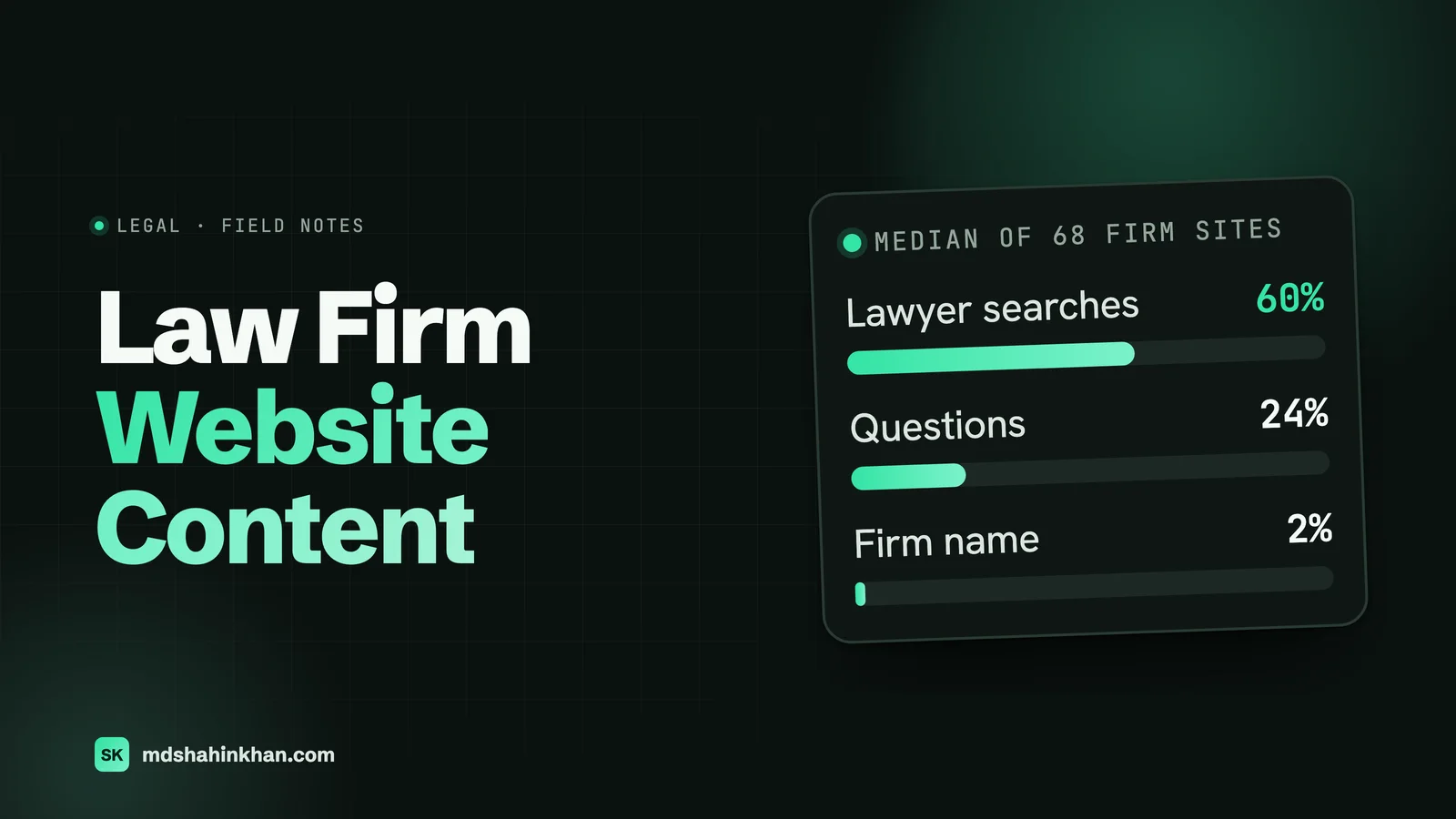
Before deciding what to write, I wanted to know which pages actually bring visitors to a law firm site. So I took 68 firm websites that ranked on the first page for “criminal defense lawyer” or “divorce lawyer” in 12 US cities in my earlier studies this month, and pulled each site’s 50 strongest pages from Ahrefs (US data, November 2026). Then I sorted every page by the search that sends it the most visits: someone looking for a lawyer, someone looking up the firm by name, or someone asking a question.
| What brought the visit | The typical firm (median) | All 68 firms together |
|---|---|---|
| A search for a lawyer (“divorce lawyer raleigh”, “dui attorney near me”) | 60% | 48% |
| A question or look-up (“what is a bench trial”, “is weed legal in texas”) | 24% | 45% |
| The firm’s or a lawyer’s name | 2% | 8% |
Ahrefs traffic figures are estimates, not analytics, but the pattern is clear enough to plan around:
- 90% of the visits from lawyer searches land on inner pages, mostly practice area and location pages. Only 10% land on the homepage.
- 22 of the 68 firms get more visits from questions than from lawyer searches. For 16 of them, the single busiest page answers a question.
- A few pages carry each site. For the typical firm, the busiest page alone brings 45% of all search visits.
- 13 of the 68 firms get fewer than 100 search visits a month, even though they ranked on page one for their main search. One good ranking isn’t a content strategy.
So the order is simple. Practice area pages first, because that’s where people looking to hire land. Answers to real client questions second, because they bring in the people who aren’t ready to call yet. The homepage matters, but it’s rarely the first page a new client sees.
The Pages to Write First
Most small firms need fewer pages than they think. This is the order I’d write them in, and how long each one usually needs to be.
| Order | Page | Why it comes here | Usual length |
|---|---|---|---|
| 1 | One practice area page for each kind of case | This is where people looking for a lawyer land | 1,000 to 2,000 words |
| 2 | Answers to the questions clients ask before calling | Brings in people who are still researching | 800 to 1,500 words |
| 3 | A bio for each attorney | The page people read just before they call | 300 to 600 words |
| 4 | Homepage | Sends visitors to the right practice page | 400 to 800 words |
| 5 | Fees and what happens next | Answers the two questions people are afraid to ask | 400 to 800 words |
| 6 | Reviews and results | Proof, written within the rules | As long as the proof is |
The lengths are my working ranges, not a rule. For a reference point: the criminal defense pages that ranked on page one in my nine-city study had a median of 2,189 words of visible text, counting the menu and footer, and the middle half ran from 1,135 to 3,030. Long enough to answer the question properly, short enough to read on a phone.
If your site lists all your practice areas on one page, splitting them is the first job. For which pages a firm needs and what each one is for, the page-by-page table in my law firm website design guide covers it. Here we’re on the words.
How to Write a Practice Area Page
A practice area page has one job: help someone with this kind of problem decide that you’re the right lawyer to call. Most of the ones I review open with the firm’s history. The visitor doesn’t care yet.
This is the structure I use:
- Opening (40 to 60 words): what you handle, where, and the next step. This is also the paragraph Google and AI answers are most likely to quote.
- Who this page is for: the situations you see most, in the client’s words.
- What happens next: the process, step by step, with realistic timelines for your court or county.
- What it costs: how you charge for this kind of matter, even if it’s a range or “it depends on these three things”.
- What to do right now: the two or three things that protect the reader today.
- Local detail: the courthouse, the local procedure, anything that proves you work there.
- Questions people ask: four to six short answers.
- Who will handle it: a short intro to the attorney, with a link to their bio.
- The call to action: phone number, form, and what happens after they get in touch.
Here’s what the change looks like on a typical opening. The first version is the kind I see on most sites. The second is what I’d write instead.
Before: “Smith & Partners is a full-service law firm dedicated to providing aggressive, results-driven representation. With decades of combined experience, our skilled attorneys fight tirelessly for the rights of our clients.”
After: “If you’ve been charged with DUI in Wake County, we can help you keep your license and fight the charge. We handle first and repeat DUI cases in Raleigh district court. Call (919) 555-0100 for a free 20-minute review of your case, usually the same day.”
The second version names the charge, the place, the court and the next step. Each “after” detail has to be true for your firm, of course: if you don’t offer same-day calls, don’t promise them.
Three habits make practice pages better:
- Write each page for one kind of case. “DUI” and “Domestic Violence” are separate pages, because the person searching is in a different situation and is asking different questions.
- Use the words clients use. People search “DUI lawyer”, “OVI lawyer” in Ohio, “DWI lawyer” in Texas. Use the local term in the title and opening.
- Never copy another firm’s page or recycle your own across cities. Duplicate text helps nobody, and the location pages section below covers why Google treats it as a problem.

Attorney Bios People Actually Read
The bio is often the last page someone reads before calling. Most bios are written for a hiring committee: law school, bar admissions, honors, memberships. Put those at the bottom. Lead with who the lawyer helps and how they work.
Before: “Jane Doe received her J.D. from State University School of Law in 2009, where she served on the Law Review. She is admitted to practice in all state and federal courts in North Carolina.”
After: “Jane handles divorce and custody cases for parents in Wake and Durham counties. Most of her clients have never been to court before, so she explains every step in plain terms and returns calls the same day. She’s practiced family law since 2009.”
A good bio has:
- A real photo taken recently, in your office if possible.
- What they handle, in the first sentence, with links to those practice pages.
- A paragraph in their own voice: why they do this work and how they treat clients.
- Credentials at the bottom: education, bar admissions, certifications.
- Reviews that name them, if your state’s rules allow it (see the rules section below).
Be careful with “specialist” and “expert”. Under New York’s rule, which follows the ABA model, a lawyer can only say they’re certified as a specialist when an approved or ABA-accredited organization certified them, and the page names that organization. Other states have their own versions. Some states are stricter still: Minnesota requires a lawyer who isn’t certified by a Board-accredited organization to say so, in the same paragraph as the claim.
Answers and Guides That Bring In Visits
In my sample, the question pages that earned the most traffic were simple, specific and local: “is weed legal in texas” (about 8,700 visits a month to one firm’s page), “ovi” (the Ohio name for DUI, about 3,800), “age of consent in texas” (about 2,400), “what is a bench trial” (about 800), “detained vs arrested” (about 660) and “how to tell if the police are investigating you” (about 660). A Texas child support calculator brought one family law firm about 1,500 visits a month.
Not all of that traffic is worth having. Some of the busiest question pages in the sample ranked for searches like “subway guy”, “steve nash divorce” or “is san antonio safe”. Those visits come from curiosity, not from people who need a lawyer. Pick questions that sit close to hiring:
- What happens next? “What happens at a first DUI court date in Ohio”
- What will it cost or risk? “How long does a DUI stay on your record in Arizona”
- Do I need a lawyer? “Should I hire a lawyer instead of keeping my public defender”
- What does this term mean? “Detained vs arrested”, “what is a bench trial”
Answer the question in the first two sentences, then explain. End each guide with one link to the matching practice page, because that’s where a reader goes when they decide to call. The law firm marketing plan I wrote covers this as “ten guides, not a weekly blog”: the plan is here.
One rule catches firms out: writing about real cases. The ABA’s Formal Opinion 480 (2018) says lawyers who blog “may not reveal information relating to a representation, including information contained in a public record,” unless the rules allow it. Calling the story a hypothetical doesn’t help “if there is a reasonable likelihood that a third party may ascertain the identity or situation of the client.” Your state’s rules are the ones that apply, but the safe habit is to write about the law and the process, not about your clients, unless a client has agreed.
The Homepage: Short, Clear, and Not the Main Event
In the sample, only 10% of visits from lawyer searches landed on the homepage. Most new clients find a practice page first. The homepage still matters for people who search your name, click your Google Business Profile, or come from a referral, so write it to route them quickly:
- One sentence that says who you help and where: “Divorce and custody lawyers for families in Raleigh and Wake County.”
- The phone number and one button, visible without scrolling.
- A short list of practice areas, each with one line and a link.
- Two or three reviews, the attorneys’ photos and the office address.
- What happens when someone calls, in three steps.
That’s 400 to 800 words. Anything more belongs on a practice page.
Location Pages Without Doorways
Firms that serve several towns often make one page per town with the same text and a new city name. Google’s spam policies call this doorway abuse. One of its examples is “having multiple domain names or pages targeted at specific regions or cities that funnel users to one page.”
Write a location page only where you have something real to say: an office, a courthouse you appear in regularly, local procedures that differ. A good one names the courthouse and its address, explains how cases move through that court, says who from your firm handles them, and gives directions or parking details if you meet clients there. If a town page would only change the name, leave it out and mention the town on the main practice page instead. My guide to local SEO for lawyers covers the map side of this.
Write for a Worried Reader
People reading a law firm site are often stressed, reading on a phone, and unfamiliar with legal words. Many also find reading hard: in the US government’s latest adult skills survey, 28% of adults aged 16 to 65 scored at the lowest literacy level, up from 19% in 2017. And almost everyone scans. Nielsen Norman Group has said since 1997 that people rarely read web pages word by word, and its 2020 update found that still holds: “Scanning all of the text on a page, or even a majority, is still extremely rare.”
What helps, in practice:
- Short sentences, one idea each.
- The answer first, then the detail.
- Plain words for legal ones, or a short definition the first time a legal term appears.
- Headings that are questions people actually ask, so they can find their part.
| Instead of | Write |
|---|---|
| “Retain counsel” | “Hire a lawyer” |
| “Dissolution of marriage” | “Divorce” (then explain the legal term once if your state uses it) |
| “Pursuant to statute” | “Under [state] law” |
| “Adjudication” | “The judge’s decision” |
| “We zealously advocate for our clients” | Say what you actually do: “We go to every hearing with you” |
Spanish and Other Languages
About 45 million people age 5 and older speak Spanish at home in the US, and about 17.3 million of them speak English less than “very well”, according to the Census Bureau’s 2025 American Community Survey. If your staff can serve clients in Spanish, say so on every page, and give those clients pages written for them.
A few practical rules:
- Translate the pages that matter, starting with your main practice pages and the contact page, not the whole site.
- Have a person fluent in legal Spanish write or check them. Machine translation gets legal terms wrong.
- Give each language its own address, such as /es/, and mark the page language so browsers and search engines read it correctly.
- Only promise what the phone can deliver. If nobody answers in Spanish after 5pm, say when they can.
What the Bar Rules Mean for Your Copy
Every word on the site is lawyer advertising, so your state’s version of Rule 7.1 applies to all of it. The New York version, which follows the ABA’s, says a communication is misleading “if it contains a material misrepresentation of fact or law, or omits a fact necessary to make the statement considered as a whole not materially misleading.”
The parts that affect everyday writing:
- Past results. The comment to Rule 7.1 warns that a true report of a past result “may be misleading if presented so as to lead a reasonable person to form an unjustified expectation” of the same result. It adds that “the inclusion of an appropriate disclaimer or qualifying language may preclude a finding” that it misleads. Give the facts that mattered, not just the dollar figure.
- Testimonials and reviews. Same standard. Don’t edit a review to make it stronger, and check whether your state has its own rules.
- “Specialist” and “expert”. See the bios section above. Names of certifying organizations have to be shown.
- Who is responsible. New York’s version requires the name and contact information of at least one lawyer or law firm responsible for the content.
- State differences. States change these rules. New York, for example, stopped requiring the “Prior results do not guarantee a similar outcome” line and the “Attorney Advertising” label in 2026, though its bar still suggests using the disclaimer. Check your own state’s current rules before you publish, not a marketing blog’s summary of them.
For the disclaimer itself, see the FAQ at the end. I’m not a lawyer, and nothing here is legal advice: your bar’s ethics hotline is the place to settle a specific question.

Using AI to Draft Law Firm Content
AI tools can help with law firm content, as long as a lawyer checks every word. Google’s position is that it rewards helpful content “however it is produced”, and that “appropriate use of AI or automation is not against our guidelines” (Google, 2023). Its current guidance adds two warnings that matter for law firms (Google Search Central):
- Mass-produced pages are spam. Using AI “to generate many pages without adding value for users may violate Google’s spam policy on scaled content abuse.” Fifty city pages written by a tool, each with the same advice and a new place name, is exactly that.
- AI gets facts wrong. Generative models “don’t retrieve facts, but predict a likely sequence of words,” so “it is critical to manually factcheck and review all AI-generated content for accuracy and trustworthiness before publishing.”
On a law firm site, a wrong fact is a deadline, a penalty or a statute number that misleads a reader. That’s both a Rule 7.1 problem and a client who trusted you and got it wrong.
The ABA’s Formal Opinion 512 (2024) on generative AI is about client work, not marketing: a footnote notes that advertising questions under Rule 7.1 are outside its scope. Its point about protecting client information still applies to content work. Don’t paste a client’s details into an AI tool to “make the blog post more real”.
How I’d use AI on a law firm site:
- The lawyer gives the substance: the questions clients ask, the local process, the fees, the mistakes people make.
- AI helps with structure: an outline, a first draft of plain-language explanations, headings phrased as questions.
- A person rewrites it in the firm’s voice and adds what only the firm knows: the courthouse, the timelines, the examples.
- A lawyer checks every fact, every rule and every number against the source before it goes live, and the page names that lawyer as the reviewer.
Bylines, Dates and Schema
Legal pages can affect a reader’s money, freedom and safety. Google’s quality rater guidelines call topics like that “Your Money or Your Life” (YMYL): content that “could significantly impact the health, financial stability, or safety of people”. The current edition doesn’t list legal topics by name, but legal advice fits that description, and readers look for the same signals of trust that raters are told to look for.
On every guide and practice page, show:
- Who wrote or reviewed it, linked to that lawyer’s bio.
- When it was last reviewed, so readers can see the information is current.
- Sources for anything specific: link the statute, the court rule or the agency page.
For structured data (the code that describes the page to search engines), use LegalService for the firm. Schema.org now marks the older Attorney type as deprecated because “LegalService is more inclusive and less ambiguous” (schema.org). Add Person markup for each lawyer on their bio page.
One change many guides haven’t caught up with: Google stopped showing FAQ rich results in search on May 7, 2026, for every site. Questions and answers on your pages are still worth writing, because they help readers and are easy for AI answers to quote, but FAQ markup no longer earns the expandable questions under your listing.
Who Should Write It
There are three workable ways to get the words written:
| Who writes | Works when | The catch |
|---|---|---|
| The lawyer | They enjoy writing and can give it a few hours a week | It rarely happens; drafts sit for months |
| A writer, with the lawyer reviewing | The lawyer gives a 30-minute interview per page, then reviews the draft | Needs a writer who asks good questions, and a lawyer who reviews quickly |
| A writer using AI for the first draft, with the lawyer reviewing | Volume is high and the lawyer checks every fact | Every fact, rule and citation has to be checked; see the AI section |
I like the second one. The lawyer knows the answers; a writer knows how to put them in order and in plain words. Whichever you pick, one lawyer has to read and approve every page before it goes live. Their name goes on the page as the reviewer.
Keeping It Current
Law changes, fees change, attorneys leave. A page that was right two years ago can be wrong today, and wrong legal information on your own site is worse than none. Keep a simple list of every page with the date a lawyer last reviewed it.
| What | When to check it |
|---|---|
| Fees, phone numbers, office hours, staff | Every time something changes, plus a quarterly check |
| Pages that cite a statute, a deadline or a dollar limit | When the law changes, and at least once a year |
| Attorney bios | When someone joins, leaves or adds a certification |
| Your busiest 10 pages | Every six months |
| Pages with no visits in a year | Once a year: improve, merge or remove |
If you redesign the site, keep the addresses of pages that already get traffic, or redirect them. My guide to website redesign SEO covers how.
Frequently Asked Questions
What Makes a Good Law Firm Website?
A good law firm website tells visitors in a few seconds what kind of cases the firm takes and where, then makes it easy to call. It has a clear page for each kind of case, honest bios, answers to the questions clients ask, and a phone number that works with one tap on a phone. The words matter more than the design.
What Is the 80/20 Rule for Lawyers?
It’s the idea that roughly 80% of results come from 20% of the work, or the clients. Website traffic works the same way. In my sample of 68 firm sites, the busiest single page brought the typical firm 45% of its search visits. Find your best pages and improve them before writing new ones.
What Is a Good Legal Disclaimer to Include on a Website?
A simple one says the site gives general information, not legal advice; that reading it or contacting the firm doesn’t create an attorney-client relationship; that people shouldn’t send confidential details until the firm confirms it can take their case; and, where you describe past results, that every case is different. Put it in the footer and near your contact form. Check whether your state requires specific wording.
Can a Law Firm Use AI to Write Website Content?
Yes, if a lawyer checks every fact before it’s published. Google says appropriate use of AI isn’t against its guidelines, but mass-producing pages that add nothing can break its spam policy on scaled content, and AI tools invent facts. Use AI for outlines and first drafts, never paste client details into it, and have a lawyer review the final page.
How Long Should a Practice Area Page Be?
Long enough to answer what a client wants to know: what happens, how long it takes, what it costs and what to do now. That usually takes 1,000 to 2,000 words. The page-one criminal defense pages I checked had a median of about 2,200 words of visible text, but a shorter page that answers the question beats a longer one that doesn’t.
Should Lawyers Write Their Own Website Content?
They should provide the substance and approve every page, but they don’t have to write it. A 30-minute interview with the lawyer, written up by a good writer and then reviewed by the lawyer, usually gives clearer pages than a lawyer writing alone, and it actually gets finished.
If you’d like your practice pages, bios and homepage rewritten on a site that’s built for the way clients search, my page on websites for law firms shows how I work with firms. For the rest of the marketing picture, start with my local SEO guide for small businesses.
If you’d like me to look at your practice pages and tell you what I’d change first, book a free 30-minute call and I’ll go through them with you, whether or not we work together.