SEO for lawyers is the work of making your firm the answer when someone nearby searches for the kind of help you give: “car accident lawyer in Tampa”, “how much does a divorce cost in Texas”, “estate planning attorney near me”. For a small firm it comes down to five things: one strong page per practice area, attorney bio pages that prove the people are real, a Google Business Profile that wins the map pack, a site that loads fast on a phone, and a steady trickle of reviews and local links. This guide covers all five, what each costs, and the order to do them in.
I am not an agency. I am a freelance developer who has built and rebuilt more than 100 sites through a US agency partner, a good number of them for law firms and medical practices, and I do the technical SEO on most of them. That is the angle here: what actually has to exist on the site, what you can do yourself, and where paying someone is worth it.
What Legal SEO Looks Like in 2026
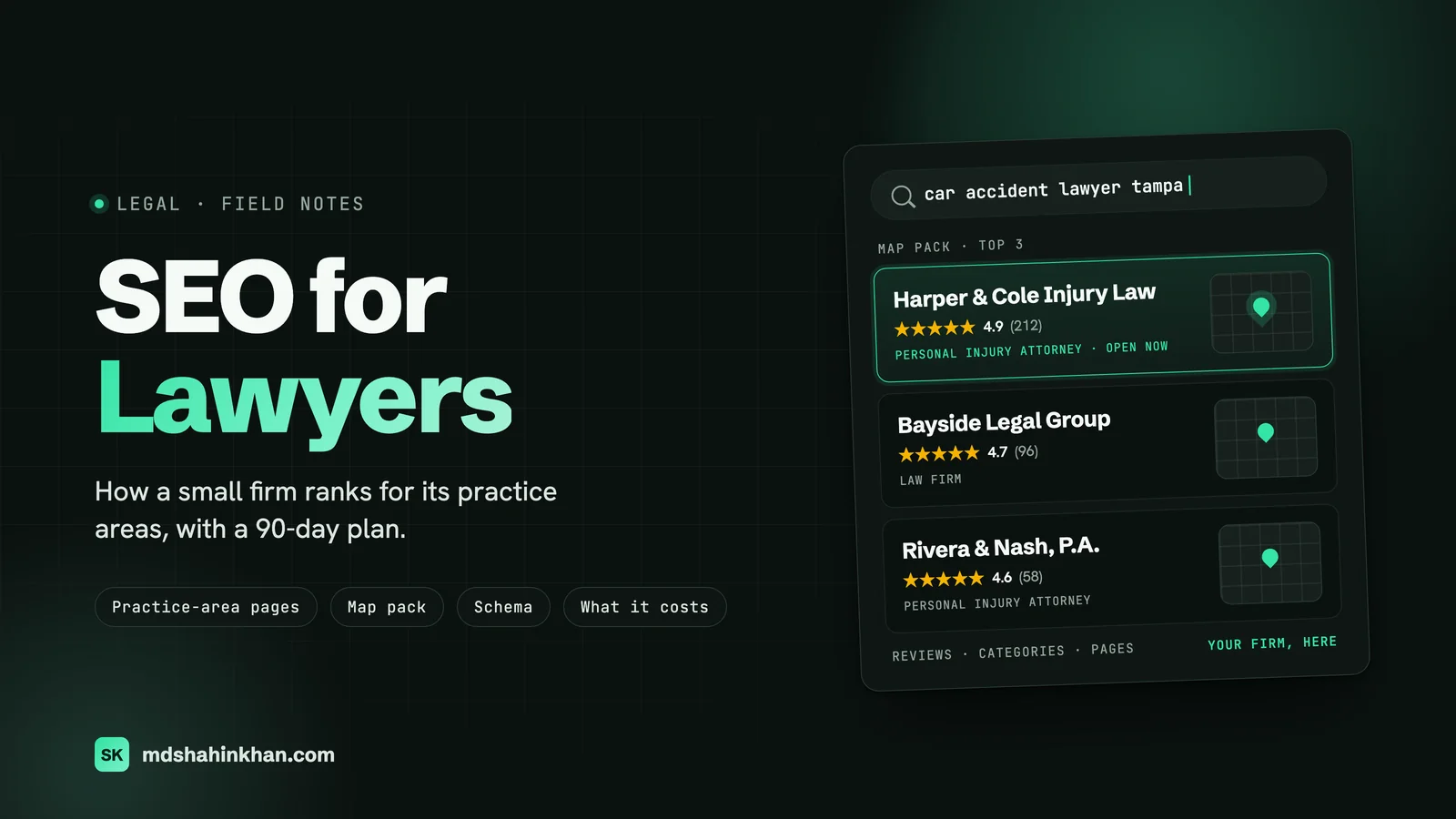
Two things changed the picture. Google now shows an AI Overview on almost every general legal query (“what is a contingency fee”, “how long do I have to file a personal injury claim”), and it answers the question itself. And the map pack, the three firms with stars and a map at the top, takes most of the clicks on any query with a city in it or a “near me” on the end.
So the traffic that reaches a law firm’s website has shifted toward searches with real intent behind them. Someone who types “workers comp lawyer Fresno free consultation” is not reading; they are choosing. Those searches are smaller in volume but they are where cases come from, and they are exactly the searches a small firm can win, because the ranking signals are local and specific, not national and expensive.
In practice, a small firm’s SEO in 2026 is made of three layers:
| Layer | What it wins | Who controls it |
|---|---|---|
| Google Business Profile + reviews | The map pack for “practice area + city” and “near me” | You, or your office manager, with a routine |
| Practice-area and location pages on your site | Organic results below the map pack, and the pages Google links from the map pack | Your developer, with your input on the content |
| Attorney bios, guides, and links | Trust signals (E-E-A-T) and the long-tail questions that lead to a call | You write, your developer structures |
Everything below is one of those three layers.
How People Actually Search for a Lawyer
Before you decide what pages to build, look at how the searches are phrased. Across the legal sites I have worked on, the queries that turn into contact form submissions follow four patterns, and each pattern needs a different page.
| Pattern | Example | The page that should rank | Intent |
|---|---|---|---|
| Practice area + city | “personal injury lawyer Columbus” | Practice-area page, or a location page if you have several offices | Ready to call |
| Practice area + qualifier | “best DUI attorney near me”, “cheap divorce lawyer” | Practice-area page, with reviews and pricing clarity | Comparing |
| Question | “how much does a DUI lawyer cost in Ohio” | A guide that answers it and links to the practice-area page | Researching, will call in days or weeks |
| Name | “Harper & Cole law firm reviews” | Your homepage and Google Business Profile | Already decided, checking you |
The mistake most small-firm sites make is having one “Practice Areas” page that lists everything in a paragraph each. Google cannot rank that page for “estate planning attorney Denver” because it is not about estate planning; it is about the firm. Each practice area needs its own page, and that is the single biggest change I make on most law firm rebuilds.
The Site Structure That Ranks
Here is the structure I build for a firm with, say, four practice areas and one office. It is not clever. It is the structure Google’s results already reward, and it keeps the site small enough that a two-partner firm can maintain it.
/                              Home: who you help, where, and the three ways to reach you
/practice-areas/               Hub: one card per area, linking down
/personal-injury/              Practice-area page (the money page)
/personal-injury/car-accidents/    Sub-page for a case type worth its own page
/personal-injury/slip-and-fall/
/family-law/
/family-law/divorce/
/estate-planning/
/criminal-defense/
/attorneys/                    Team hub
/attorneys/jane-harper/        Attorney bio page (a real entity with schema)
/case-results/                 Proof, with the numbers you are allowed to publish
/reviews/                      Testimonials, pulled from Google where possible
/blog/                         Guides, one per question clients ask
/contact/                      Form, phone, map, hours, parking
Three rules make this work:
- Practice-area pages sit one level below the home page (
/personal-injury/, not/practice-areas/personal-injury/). Shorter URLs, and the page inherits authority directly from the home page. - Sub-pages only where a case type has its own search demand. “Car accident lawyer” and “truck accident lawyer” are different searches with different volumes; “slip and fall” in a small city may not be worth a page. Check the numbers before you build.
- Every practice-area page links to the bios of the attorneys who handle it, and every bio links back to the practice areas. That internal loop is how Google connects the expertise to the service.
If you have more than one office, add a location layer: /locations/tampa/ with the office details, the attorneys based there, and a paragraph per practice area that links to the main practice-area page. Do not clone the whole practice-area page per city; that is the “doorway page” pattern Google has been filtering for years.
What Goes on a Practice-Area Page
This is the page that earns the case, so it gets the most attention. The template below is what I hand to the attorney to fill in. Word counts are guidance, not law; a competitive personal-injury page in a big metro runs 2,000 words, an estate-planning page in a town of 40,000 can rank at 800.
| Section | What it does | Notes |
|---|---|---|
| H1: “[Practice area] lawyer in [City]” | Matches the query pattern | One H1. “Tampa Personal Injury Lawyer” reads better than “Personal Injury” |
| Opening: who this is for, in 60 words | Feeds the AI Overview and the featured snippet | Plain language, no “we are committed to excellence” |
| Call to action: phone, form, hours | People on this page are ready | Repeat it after the second section and at the end |
| What we handle | The case types, each linking to a sub-page if one exists | This is where “car accident”, “motorcycle accident”, “wrongful death” get their mentions |
| How it works: the first call, the fee, the timeline | Answers the questions people are too polite to ask | Contingency fee? Say so. Free consultation? Say so |
| Attorney(s) for this area | Photo, one-line bio, link to the full bio | Ties the page to real people (E-E-A-T) |
| Results and reviews | Two or three case results (where bar rules allow), three reviews | Numbers and names beat adjectives |
| FAQ: 4 to 6 real questions | Each answer is two to four sentences | Use the questions clients actually ask on the phone. Mark up with FAQPage schema |
| Local proof | Courthouse you appear in, neighbourhoods you serve, parking | This is the content a doorway page cannot fake |
Two things attorneys often push back on. First, pricing clarity: you do not have to publish a rate, but “most family law matters are billed hourly at rates between $X and $Y, and we quote a range after the first call” turns a hesitant reader into a caller. Second, length: nobody reads 2,000 words top to bottom, but Google does, and a reader scans for the section that answers their question. Structure it so that scanning works.
Attorney Bio Pages and E-E-A-T
Legal is a “your money or your life” category. Google holds it to a higher standard of expertise and trust, and it evaluates that partly through the people behind the content. That makes attorney bio pages the most underused asset on most firm sites.
A bio page that carries weight has:
- A real photo and a real name in the URL (
/attorneys/jane-harper/), not a team collage. - Bar admissions, education, years practising, and the practice areas handled, as text on the page, not in a PDF.
- Person schema with
jobTitle,worksForpointing at the firm’sLegalServiceentity,alumniOf,memberOf(the bar), andsameAslinks to the state bar listing, Avvo, LinkedIn. - Links from the bio to the practice-area pages that attorney handles, and from those pages back to the bio.
- A voice. One paragraph in the first person about why they practise this kind of law does more for conversion than a list of awards.
On the sites where I added proper bio pages and Person schema to an existing firm site, the bio pages themselves started ranking for “[attorney name]” within weeks, which matters because that is the search a referred client makes before calling. The practice-area pages that linked to those bios moved too, though slowly, over the following months. I cannot separate the effect of the bios from the other work on those sites, so treat that as an observation, not a controlled result.
Local SEO for Lawyers: Winning the Map Pack
For any query with a city in it, the map pack is the prize. It is also the part of law firm SEO a small firm can do almost entirely in-house.
Google Business Profile, in Order
- Claim and verify the profile at the office address. A P.O. box or a virtual office does not qualify; if that is your situation, you need a service-area business setup, which is a different conversation.
- Primary category: the most specific one that fits. “Personal injury attorney” beats “Law firm” if that is 80% of your work. Add secondary categories for the other practice areas.
- Services: add each practice area as a service, with a two-sentence description. This is one of the few text fields Google reads for relevance.
- Hours, phone, website: the phone number and the website URL must match the site exactly (same number, same format). Point the website field at the practice-area page if the profile is for a single-practice firm; otherwise the home page.
- Photos: the office exterior (people check it is real), reception, each attorney. Ten to twenty photos, real ones, no stock.
- Attributes: “Free consultation”, languages spoken, wheelchair access. Fill in whatever applies.
- Q&A: seed it yourself with the five questions you get on the phone, and answer them. Anyone can post there otherwise.
- Posts: optional. A monthly post about a result or a guide keeps the profile active, but it is a small signal.
Reviews: A System, Not a Request
Reviews are the biggest prominence signal in the map pack and the biggest conversion signal on the page. The firms I have seen climb the pack did one boring thing: they asked every satisfied client at the moment the matter closed, by text, with a direct link to the review form, and someone at the front desk owned the routine.
Bar rules on soliciting reviews vary by state. Asking is generally fine; offering anything in return, or drafting the review for the client, generally is not. Check your state’s rules and then set up the routine. Reply to every review, including the bad ones, in a calm sentence or two.
Citations and the NAP
Your name, address, and phone number should appear identically on your site, your Google Business Profile, your state bar listing, Avvo, FindLaw, Justia, Yelp, Apple Maps, and Bing Places. Inconsistency here does not sink you, but consistency is cheap and it removes a doubt. Do it once, keep a spreadsheet, and check it once a year.
On-Site Local Signals
The site has to say where you are, in text Google can read:
- Full address and phone in the footer of every page, marked up with
LegalServiceschema (address,telephone,areaServed,openingHoursSpecification). - The city in the H1 and the first paragraph of each practice-area page.
- An embedded map and driving directions on the contact page.
- If you serve surrounding towns, name them, in a sentence, with a reason (“we appear in the Hillsborough and Pinellas county courts”).
Content That Earns Links and Answers Questions
You do not need a blog that posts weekly. You need a small set of guides, each answering one question a client asks, each linking to the practice-area page that handles it. Ten good guides beat a hundred posts nobody reads.
The guides that work for law firms:
- Cost questions. “How much does a DUI lawyer cost in [state]?” Nobody wants to answer this, which is why the firm that does gets the click.
- Process questions. “What happens after a car accident claim is filed?” Step by step, with realistic timelines.
- Deadline questions. “How long do I have to file a [claim type] in [state]?” Cite the statute. Keep it updated.
- Local questions. “What to expect at the [County] courthouse for a first hearing.” No national site can write this.
- Comparison questions. “Mediation vs litigation for a divorce in [state].” Balanced, not a sales pitch.
Each guide follows the same shape: the direct answer in the first 60 words, then the detail, then a “when to call a lawyer” section that links to the practice-area page. That first-60-words rule is what gets the guide quoted in an AI Overview, and the quote carries your firm name.
Links come from being useful and local. The sources that have worked for firms I have built for: the state and county bar association directories, sponsoring a local event or a scholarship (which comes with a page and a link), being quoted by a local reporter (they need a lawyer to explain a case in the news), and a guide so good that other local sites reference it. Buying links from directories with no real audience does nothing.
Technical SEO for a Law Firm Site
This is the part I actually do for a living, so I will be specific.
Speed. A law firm site should load in under two seconds on a phone on mobile data. The usual reasons it does not: a page builder loaded with plugins, uncompressed hero images, and three tracking scripts loading before the content. The fixes are ordinary: compress and resize images, lazy-load anything below the fold, load scripts after the content, and use a host that is not sharing your server with 400 other sites. I check Core Web Vitals in Search Console after every launch; “good” on all three is the target, and it is achievable on WordPress without exotic work.
Mobile. More than half of legal searches are on a phone, and many of those calls happen from a car park or a hospital corridor. Click-to-call phone numbers, a form that works with one thumb, no pop-ups covering the phone number.
Schema. The markup that matters for a firm:
| Schema type | Where | Why |
|---|---|---|
LegalService (or Attorney for a solo) |
Site-wide, in the footer or the home page | Tells Google the entity, address, phone, hours, service area |
Person |
Each attorney bio | Connects the expertise to a real person |
FAQPage |
Practice-area pages and guides with an FAQ | Eligible for rich results and easy for AI to lift |
BreadcrumbList |
Every page | Shows the hierarchy in results |
Article |
Guides | Author, dates, publisher |
I write schema into the templates once, so every new practice-area page or bio gets it automatically. Adding it page by page with a plugin’s manual fields is how it ends up wrong on half the site.
Indexing hygiene. One clean XML sitemap submitted in Search Console. No “practice areas” pages that are just tag archives. No staging site left indexable. Redirects set up before any URL changes, and checked afterwards; I have inherited more than one firm site that lost half its rankings in a redesign because nobody mapped the old URLs.
HTTPS, obviously, and a privacy policy page. Both are trust signals in a category Google treats as high stakes.
What Law Firm SEO Costs
The honest answer is that it depends on your market and your practice area, and that most of the value is front-loaded. Across published 2026 pricing guides, most independent firms spend between $2,000 and $5,000 a month with an agency, solo and very small firms are often quoted $1,500 to $4,000, and competitive personal-injury markets run $5,000 a month and up (OnTheMap, JurisPage, SEOProfy).
Here is how I would think about it for a small firm instead:
| Stage | What it is | Typical cost | Who |
|---|---|---|---|
| Foundation (one-off) | Site structure, practice-area and bio pages built properly, schema, speed, Google Business Profile set up, citations cleaned | A fixed project fee. The range is wide, but it is a one-time cost and it is where most of the ranking comes from | Developer |
| Content (ongoing, light) | One practice-area page or guide a month, written by you, structured and published by your developer | A few hours of your time and a small monthly fee | You + developer |
| Reviews and profile (ongoing, in-house) | The review routine, replying, monthly photos or a post | Front desk, one hour a week | You |
| Links (ongoing, optional) | Bar directories, sponsorships, local press | Mostly your time and some sponsorship money | You |
| Monitoring (monthly) | Search Console, rankings for your 20 target queries, call and form tracking | Small monthly fee | Developer |
A small firm that gets the foundation right and runs the review routine can rank for its practice areas in its city without a $4,000 monthly retainer. What the retainer buys, in a competitive metro, is the link building and the content volume needed to compete with firms that have been doing this for a decade. Start with the foundation, measure for three months, and decide about the retainer with data.
Measuring: What to Look at Each Month
Rankings are the vanity number. The numbers that tell you SEO is working:
- Calls and form submissions from organic search, by page. Set up call tracking that swaps the number for organic visitors, and make sure form submissions fire an event in GA4. If you cannot attribute a case to a page, you cannot decide what to build next.
- Search Console clicks and impressions for each practice-area page, month over month. Impressions rising before clicks is normal; it means you are appearing, and the clicks follow as you move up.
- Map pack position for your five most important “practice area + city” queries, checked from a phone in your city, or with a local rank tracker. Rankings differ by where the searcher stands, so a single number is an approximation.
- Review count and average rating against the two firms above you in the pack.
- Core Web Vitals in Search Console, once a month, to catch a plugin update that slowed the site.
Ignore domain authority scores, keyword counts, and any report that shows a green arrow without a call attached to it.
A 90-Day Plan for a Small Firm
This is the order I run when a firm hires me, adjusted for a firm doing most of it in-house.
| Weeks | Do | Outcome |
|---|---|---|
| 1 to 2 | Claim and complete Google Business Profile. Fix the NAP everywhere. Start the review routine. | Map pack movement starts here; it is the fastest signal |
| 2 to 4 | Decide the practice-area list (one page each). Write the pages with the template above. | The money pages exist |
| 3 to 5 | Build or rebuild the site structure: practice-area pages, bio pages, contact page, schema, speed, redirects from old URLs. | Foundation done |
| 5 to 6 | Submit the sitemap, set up Search Console, GA4, call tracking. Baseline every number. | You can measure |
| 6 to 10 | Write four guides, one per week, on the cost, process, and deadline questions for your top practice area. | Long-tail traffic and AI Overview citations begin |
| 8 to 12 | Bar directory listings, one sponsorship, one local press contact. | First real links |
| 12 | Review the numbers: calls by page, map pack positions, Search Console. Decide the next quarter. | Data for the retainer decision |
Local and map pack results typically show inside the first 90 days. Page-one organic rankings for a competitive practice area in a metro take six to twelve months; in a smaller market, often less. Anyone promising page one in 30 days is describing a search nobody makes.
Frequently Asked Questions
Does SEO Work for Law Firms?
Yes, and it is one of the few marketing channels where the cost falls over time: a practice-area page that ranks keeps producing calls for years with light upkeep. It works best for firms in a defined area with a defined practice mix, because the map pack and “practice area + city” searches reward exactly that. It works worst as a national campaign for a generic “lawyer” query, which a small firm should not attempt.
How Much Does SEO Cost for a Small Law Firm?
Published 2026 guides put most firms between $2,000 and $5,000 a month with an agency, and solo or small firms at $1,500 to $4,000. A small firm can spend considerably less by paying once for the foundation (site structure, practice-area and bio pages, schema, speed, Google Business Profile) and running reviews and content in-house, then deciding about a retainer after three months of data.
How Long Does Law Firm SEO Take to Work?
Map pack improvements usually show within 60 to 90 days of completing the Google Business Profile and starting a review routine. Organic page-one rankings for a competitive practice area in a large metro take six to twelve months; smaller markets and less competitive areas move faster. The foundation work (structure, pages, technical) is what those timelines depend on.
Can I Do Law Firm SEO Myself?
Most of it, yes: Google Business Profile, reviews, citations, and the writing. The parts worth paying a developer for are the site structure, page templates, schema, speed, and redirects, because mistakes there are invisible until rankings drop. The parts worth paying an agency for, in a competitive metro, are link building and content volume. Start with what you can do yourself and buy the rest with data in hand.
What Is the 80/20 of SEO for Lawyers?
One good page per practice area with the city in the title, a complete Google Business Profile with a steady flow of reviews, and a site that loads fast on a phone. Those three produce most of the results for a small firm. Everything else, guides, links, schema, is what separates you from the competitor who also did those three.
Do AI Overviews Hurt Law Firm SEO?
They take clicks from general question searches, so a guide that only answers “what is a contingency fee” will get fewer visits than it did in 2023. They do not take clicks from “practice area + city” searches, where people are choosing a firm, and they cite sources, so a guide with a clear 60-word answer at the top can appear inside the Overview with your firm’s name. Write the money pages for people choosing and the guides for being quoted.
If you want a second pair of eyes on your firm’s site structure before you rebuild, book a free 30-minute call. I will look at the site, the profile, and your top five queries, and you leave with a written plan whether or not we work together. See also what I build for law firms, and the local SEO guide for small businesses this article leans on.