
A law firm marketing plan for a small firm fits on one page: who you want as a client, the three channels that bring them (referrals, Google, reviews), what you will spend each month, and the five numbers you check to see if it is working. Everything else, the social calendars, the branding decks, the twelve-channel strategies, is what firms buy when they do not have the one page. This article is the page, with the numbers filled in from what I have seen work for small firms, and a scorecard to run it.
I build and fix websites for law firms as a freelance developer, mostly through a US agency partner, and I sit at the point where the marketing plan meets reality: the site, the profile, the tracking. That is the angle here. I am not selling a retainer, and I will tell you which parts of this you should not pay anyone for.
The One-Page Plan
Fill in the blanks. If a line takes more than a sentence, you are overthinking it.
| Line | What to write | Example for a two-partner family law firm |
|---|---|---|
| Who | The client you want more of: matter type, where they live, how they find a lawyer | Divorce and custody clients within 30 minutes of the office who search on a phone and read reviews first |
| Where they come from | Your three sources, in order, with last year’s share if you know it | Referrals 50% · Google (map pack + practice pages) 35% · Reviews / word of mouth 15% |
| The hub | The one place every channel points to | The practice-area pages on the website, with a phone number and a form on each |
| This quarter’s three moves | Three things, each with an owner and a date | 1) Complete Google Business Profile, ask every closed client for a review (office manager, by week 2) · 2) Rebuild the divorce and custody pages (developer, by week 6) · 3) Coffee with the five accountants and therapists who refer to us (partner, monthly) |
| Budget | One monthly number and what it buys | $2,000: developer retainer for the site and tracking, review software, one sponsorship |
| Scorecard | The five numbers, checked monthly | Calls + forms from the website · Google Business Profile calls and direction requests · New reviews and rating · Consultations booked · Signed matters and where each came from |
| Not doing | What you are consciously skipping this quarter | Paid social, the newsletter, the podcast |
That is the plan. The rest of this article explains each line and gives you the numbers to fill it in with.
Where Small-Firm Clients Actually Come From
Every marketing article for lawyers lists ten channels as if they were equal. They are not, and the firms that grow tend to know their real mix. In the r/LawFirm threads where owners compare notes, the same three sources come up over and over: referrals from other professionals and past clients, Google (mostly the map pack), and reviews. Paid ads come up too, usually with a caveat about the price.
Here is how I would rank the channels for a small firm, by what a new client costs and how long the channel keeps working:
| Channel | Cost per new client | Time to first result | Keeps working after you stop paying? | Verdict for a small firm |
|---|---|---|---|---|
| Referrals from professionals and past clients | Lowest: your time, a coffee, a thank-you note | Weeks | Yes, for years | The first thing to systemise |
| Google map pack (Google Business Profile + reviews) | Low: a review routine and an afternoon of setup | 60 to 90 days | Yes, with the routine | Second |
| Practice-area pages on your site (organic search) | Medium, front-loaded: a proper build, then light upkeep | 3 to 12 months depending on the market | Yes | Third, and it multiplies the first two |
| Directories (Avvo, Justia, FindLaw, state bar) | Low for the free listings; the paid tiers are rarely worth it | Weeks | Free listings, yes | Do the free ones once |
| Paid search (Google Ads) | High: legal clicks run $50 to $300+ and leads $300 to $500 in 2026 benchmarks | Days | No, it stops the day you stop | Only with a defined case type and intake that answers in minutes |
| Paid social | High and hard to attribute for legal | Weeks | No | Skip until the first three are working |
| Content and guides | Medium: your time to write, a developer to structure | 3 to 6 months | Yes | Yes, but ten good pages, not a weekly blog |
| Email newsletter | Low cost, low return for most small firms | Months | Partly | Only if you already have a list of past clients and referrers |
The cost-per-lead and click figures are from 2026 industry benchmarks (Taqtics, GavelGrow); your market will differ, and personal injury runs far above the rest.
The pattern to notice: the cheap channels compound and the expensive ones do not. A review you earn this month is still bringing clients in three years. An ad click is gone in a second. A small firm should build the compounding channels first and buy the expensive one only to fill a specific gap.
Budget: What $500, $2,000 and $5,000 a Month Buy
Industry guides put law firm marketing at 2 to 10 percent of gross revenue, with solo and boutique firms at the lower end and small growing firms at 7 to 10 percent (Grow Law, LEXGRO). Percentages are not much use when you are deciding what to actually pay for, so here are three bands and what each one should buy.
| Monthly budget | What it buys | What it does not buy | Who does the work |
|---|---|---|---|
| $500 | Review software or a simple text-message routine · the free directory listings, cleaned up · a developer on call for the site’s practice-area pages (a few hours) · Google Business Profile done properly, once | An agency, ads, or new content every week | Mostly you and your office manager |
| $2,000 | Everything above · a developer retainer for pages, speed, tracking and a monthly report · one or two written guides a month (you write, they structure) · one sponsorship or bar event a quarter | Paid search at a level that works in most markets | You, plus one developer or small studio |
| $5,000 | Everything above · a defined paid-search campaign for one case type in one city, with call tracking · link building or PR in a competitive metro · a videographer once a quarter | A national campaign or a competitive personal-injury market (that starts higher) | You, a developer, and an ads specialist or agency |
The mistake I see most is spending the $2,000 band on ads before the $500 band is done. Ads send people to a site and a profile; if the profile has four reviews and the site takes five seconds to load on a phone, the ad money is paying to show people a reason not to call.
The Website Is the Hub, Not the Brochure
Every channel in the table above ends at the website. A referral looks you up before calling. A map-pack click lands on a page. An ad has to send people somewhere. So the site has one job: turn that visit into a call or a form, and it has to do it on a phone, because that is where most of these visits happen.
What that means in practice, from the sites I build and repair:
- One page per practice area, with the city in the title, a plain explanation of who it is for, the fee model, and the phone number repeated. A single “Practice Areas” page with a paragraph each cannot rank and does not convert.
- Attorney bio pages that look like real people: a photo, admissions, the practice areas each attorney handles, and a paragraph in the first person.
- A contact path that works with one thumb: click-to-call, a short form (name, phone, matter type, message), and an honest line about when you reply.
- Speed: under two seconds on a phone on mobile data. A page builder with twenty plugins and uncompressed photos will not get there; a disciplined build will.
- Tracking that tells the truth: call tracking that swaps the number for website visitors, a form event in GA4, and a monthly look at which pages produced calls.
If you want the structure and page templates in detail, I wrote them up in SEO for lawyers. If you want to know what a rebuild costs and what it should include, what I build for law firms covers it.
Google Business Profile: The Highest-Return Hour of the Quarter
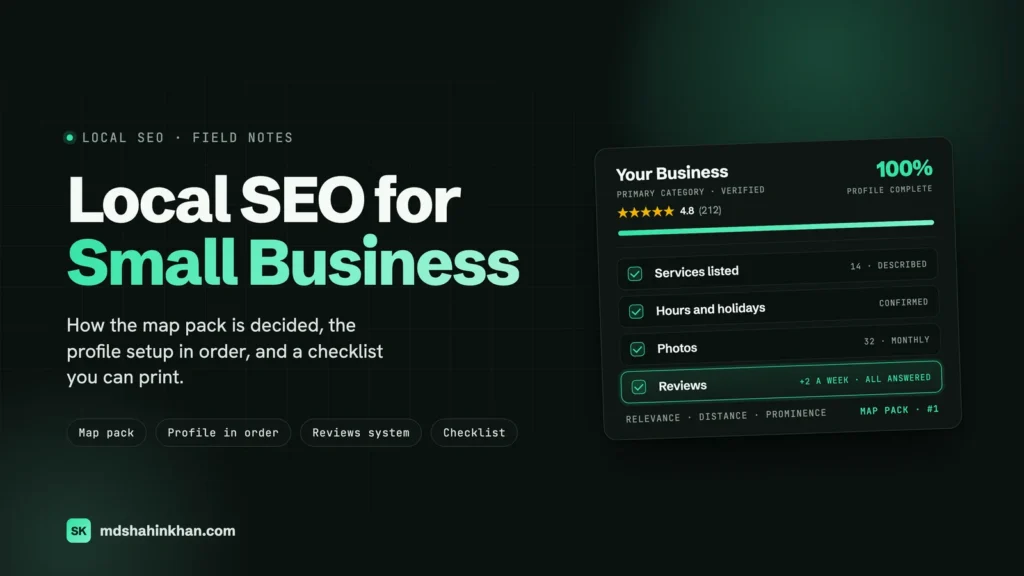
For any search with a city in it or “near me” on the end, the map pack takes most of the clicks, and the map pack is decided largely by your Google Business Profile and your reviews. It is also entirely in-house work.
Do it in this order, once, then maintain it monthly:
- Claim and verify the profile at your office address.
- Pick the most specific primary category for your main practice (“Family law attorney”, not “Law firm”), and add secondary categories for the rest.
- Add each practice area as a service with two sentences.
- Match the phone number and website URL exactly to the site.
- Upload real photos: exterior, reception, each attorney. Ten to twenty.
- Fill the attributes: free consultation, languages, accessibility.
- Seed the Q&A with the five questions you get on the phone.
- Reply to every review, in a calm sentence or two, including the bad ones.
The full step-by-step, including the on-site local signals that support it, is in the local SEO guide for small businesses; the version for law firms specifically is in the SEO for lawyers guide.
A Reviews System the Front Desk Can Run
Reviews are the biggest prominence signal in the map pack and the biggest trust signal on the page, and they are the channel small firms most consistently neglect. Not because they do not want reviews, but because nobody owns the routine.
The routine that works:
- The trigger: the matter closes, or the client sends a thank-you.
- The ask: a text message from the office manager the same day, with a direct link to the Google review form. One sentence, no script.
- The owner: one named person. If it is “everyone”, it is no one.
- The follow-up: one reminder a week later, then stop.
- The reply: every review gets a response within a few days.
Check your state bar’s rules first. Asking is generally fine; incentives and drafting the review for the client generally are not. A firm that runs this routine typically adds a review or two a month, which over a year is the difference between a profile with nine reviews and one with thirty.
Content: Ten Guides, Not a Weekly Blog
Small firms are told to blog. Most produce thin posts nobody reads, then stop. The content that works for a law firm is a small set of guides, each answering one question a client asks before calling, each linking to the practice-area page that handles it:
- “How much does a [matter type] cost in [state]?” (the question nobody wants to answer, which is why answering it wins)
- “What happens after [the first step] in a [matter type] case?”
- “How long do I have to file [claim type] in [state]?”
- “What to expect at the [county] courthouse for a first hearing”
- “[Option A] vs [option B] for [matter type]”
Ten of these, written by the attorney and structured by a developer, outperform a hundred posts. They rank for the long, specific questions, they get quoted in AI Overviews, and they give the referrer something to send.
Paid Search: When It Pays and When It Burns Money
Google Ads works for law firms, and it is expensive. In 2026 benchmarks, high-intent legal keywords cost $50 to $300 or more per click and $300 to $500 per lead, with small-firm campaigns typically starting at $2,500 to $15,000 a month in ad spend plus $1,500 to $5,000 in management (NavThemes, Taqtics). At those prices, the arithmetic only works when three things are true:
- One defined case type with a known value. You know what an average matter is worth and can say what a lead is worth to you.
- Intake that answers in minutes, not hours. A paid lead who gets voicemail calls the next firm. If you cannot answer, do not buy the click.
- A landing page built for the click. The practice-area page, not the home page, with the phone number above the fold and the form short.
If any of the three is missing, put the money into the $500 and $2,000 bands first. Ads amplify whatever is already there.
How the Plan Changes by City
Google treats “lawyer marketing” as a partly local query, and the plan should be local too. Roughly:
- Big metro (New York, Los Angeles, Houston, Chicago). The map pack is crowded and the organic results for head terms belong to firms with a decade of links. Win on the specific: case-type pages, neighbourhood and courthouse pages, a review count that stands out, and paid search only for narrowly defined case types. Expect the organic timeline to run twelve months.
- Mid-size city (Tampa, Columbus, Sacramento, Raleigh). The map pack is winnable in a quarter with a complete profile and a review routine. Practice-area pages can reach page one in six months. This is where the $2,000 band produces the most.
- Small market (a county seat, a town of 40,000). The map pack and organic are both winnable quickly, often with little more than the $500 band done well. Referrals and local reputation carry more weight than anything online, so spend the time there.
What to Stop Doing
Nobody publishes this section, so here it is. If you are paying for these and cannot point to a client they produced, stop:
- Paid directory tiers. The free listings are useful for consistency. The premium placements rarely produce a client you can name.
- A social media schedule. Unless you enjoy it and it brings referrals, three posts a week to two hundred followers is a cost with no return.
- The newsletter to people who are not clients or referrers. Email works for a list that knows you; it does not build one.
- Anything with a “brand awareness” report and no calls attached.
- A second agency for the same thing. If the first one cannot show calls by source, the answer is tracking, not a second retainer.
- Rebuilding the website every two years. A well-built site should last five or more; what needs renewing is the content and the speed.
The Monthly Scorecard
Five numbers, one page, ten minutes on the first of the month. If a number is not on this list, it is not the reason you did or did not get clients.
| Number | Where to find it | What a good month looks like |
|---|---|---|
| Calls and forms from the website | Call tracking + GA4 form event, by page | Up on last month; the practice-area pages produce most of it |
| Google Business Profile calls, direction requests, website clicks | The profile’s Performance tab | Rising quarter on quarter |
| New reviews and average rating | The profile | One or two new reviews, rating held or improved |
| Consultations booked | Your calendar or intake log | Consistent with the calls; if calls rise and consults do not, intake is the problem |
| Signed matters, with the source of each | Your practice management system, source asked at intake | You can name where each new client came from |
Ask every new client how they found you and write it down. Six months of that answer is worth more than any report an agency will send you.
Frequently Asked Questions
What Is Marketing in a Law Firm?
For a small firm, it is the set of routines that bring in the next client: being referred by people who know your work, being found on Google when someone nearby searches for what you do, and being trusted because of your reviews and your website. It is not advertising by default. Advertising is one channel, and for most small firms it is the last one worth adding.
What Are Some Effective Marketing Ideas for a Law Firm?
The ones with a measurable return: a review routine the office manager owns, a complete Google Business Profile, one page per practice area with the city in the title, ten guides that answer the questions clients ask before calling, and a monthly coffee with the professionals who refer to you. Paid search for a single defined case type once intake can answer in minutes. Everything else is optional.
What Is the 80/20 Rule for Lawyers?
Most of a small firm’s new clients come from a few sources, usually referrals, the Google map pack, and reviews, while most of the marketing time and money goes elsewhere. The 80/20 move is to find your real top three sources by asking every new client how they found you, then put most of the effort there and cut the rest.
How Much Should a Small Law Firm Spend on Marketing?
Industry benchmarks put it at 2 to 10 percent of gross revenue, with solo and boutique firms at 5 to 7 percent and growing small firms at 7 to 10 percent. In practice, a small firm can run the whole plan above for $500 to $2,000 a month if it does the reviews and the profile in-house, and should only move to $5,000 or more when paid search for a defined case type is justified by known matter values.
How Do I Get More Clients as a Lawyer Without Paying for Ads?
Systemise referrals (a named list of referrers, a monthly touch, a thank-you when one lands), complete your Google Business Profile and run a review routine, and give each practice area its own page on a fast site. Those three produce most of a small firm’s clients and keep working after the work is done, which ads never do.
If you want the plan pressure-tested against your firm’s site and profile, book a free 30-minute call. You leave with a written version of the one page, whether or not we work together. Related: SEO for lawyers, what I build for law firms.