Dental SEO is the work of making your practice the answer when someone nearby searches for a procedure, a price, or “dentist near me”. For a practice it comes down to four things: a Google Business Profile that wins the map pack, one page per procedure written for the way patients search, a cost and financing page that answers the price question honestly, and a site that loads fast on a phone. This guide shows how patients search (with real monthly volumes), the page structure that ranks, and the numbers from a dental implant practice I rebuilt that went from 98 to 7,344 organic visits a month.
I am a freelance developer, not an agency. I build and repair WordPress sites for dental practices through a US agency partner and directly, and I run the technical SEO on most of them. The implant case study below is one of those projects; I cannot name the practice, so I will describe exactly what was done and what the numbers did.
How Patients Search for a Dentist
Before deciding what pages to build, look at how patients phrase the search. Two patterns cover most of it. “Near me” and “[procedure] + city” searches show a map pack, and the map pack is decided by your Google Business Profile and reviews. “Cost” and “how much” searches show organic results and, increasingly, an AI Overview, and they are won by a page that answers the price question.
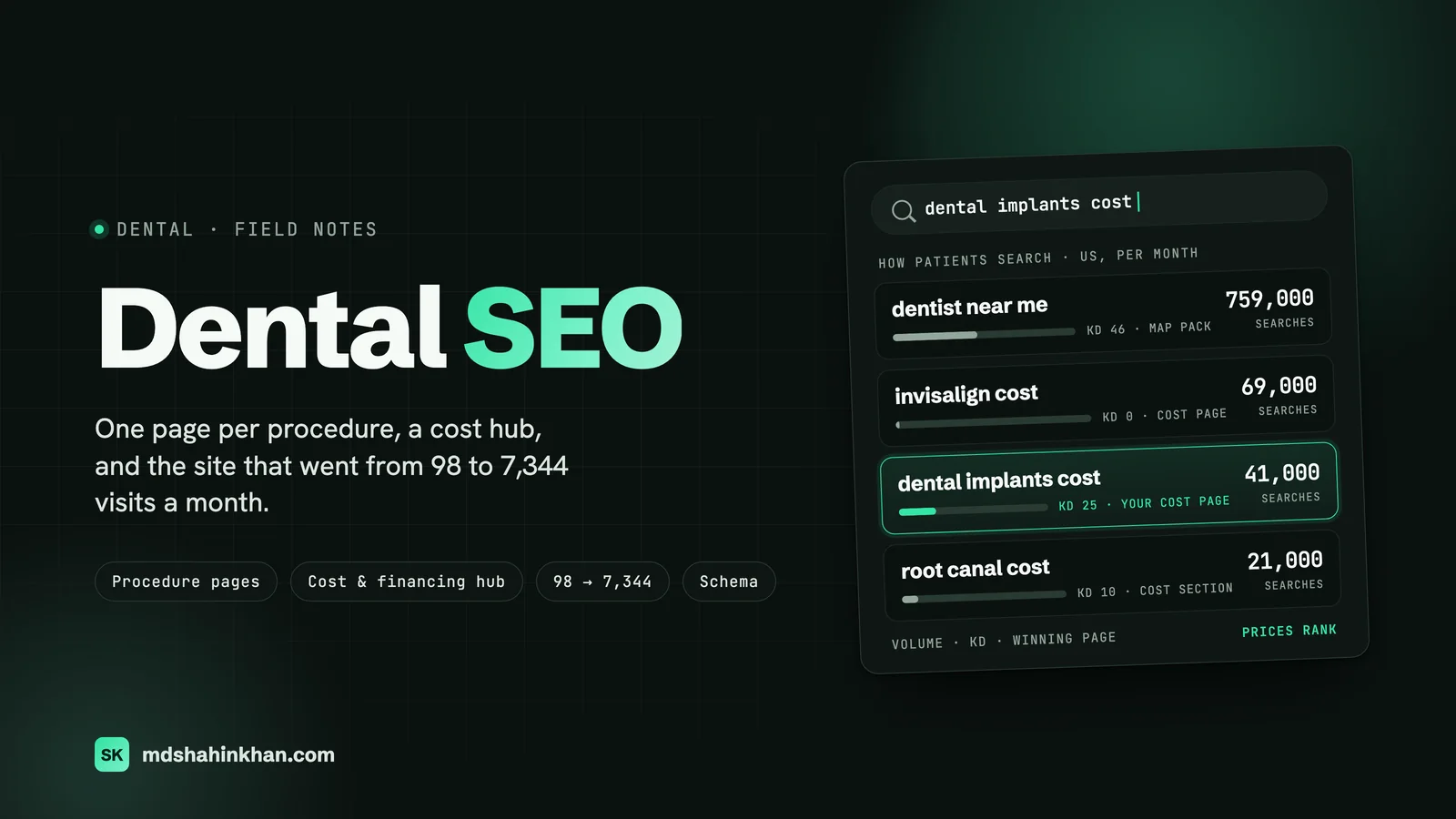
Here are the US monthly volumes for the searches that matter to a general or implant practice, from Ahrefs in September 2026:
| What the patient types | Searches a month (US) | Difficulty (0 to 100) | What Google shows | Which page wins it |
|---|---|---|---|---|
| dentist near me | 759,000 | 46 | Map pack | Google Business Profile |
| dental implants near me | 87,000 | 39 | Map pack | Google Business Profile + implant page |
| pediatric dentist near me | 81,000 | 57 | Map pack | Google Business Profile (category matters) |
| invisalign cost | 69,000 | 0 | Organic, discussions | A cost page with real ranges |
| orthodontist near me | 65,000 | 56 | Map pack | Google Business Profile |
| teeth whitening near me | 60,000 | 0 | Map pack | Profile + whitening page |
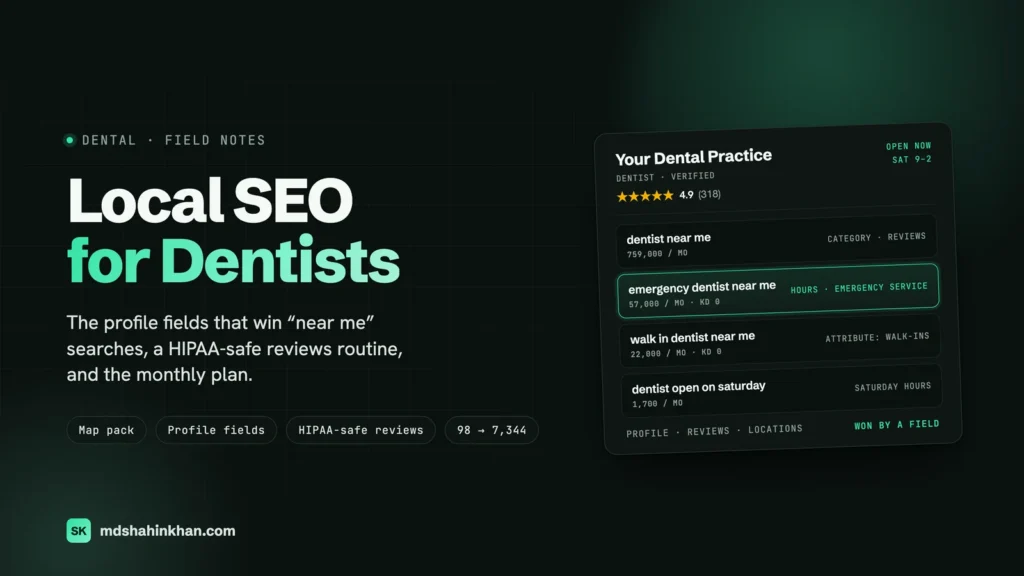
| emergency dentist near me | 57,000 | 0 | Map pack, discussions | Profile with hours + an emergency page |
| dental implants cost | 41,000 | 25 | AI Overview, organic | Implant cost page |
| cosmetic dentist near me | 39,000 | 64 | Map pack | Google Business Profile |
| veneers cost | 34,000 | 5 | Organic | Veneers cost page |
| invisalign near me | 25,000 | 0 | Map pack | Profile + Invisalign page |
| root canal cost | 21,000 | 10 | AI Overview | Root canal page with cost section |
| wisdom teeth removal cost | 12,000 | 0 | AI Overview | Extraction page with cost section |
| dentures cost | 9,500 | 13 | AI Overview | Dentures page with cost section |
| tooth extraction cost | 8,500 | 0 | Organic, map pack | Extraction page |
| same day dental implants | 3,200 | 36 | AI Overview, map pack | Implant sub-page |
| all on 4 dental implants cost | 2,700 | 2 | AI Overview | Full-arch page with cost section |
| dental crown cost | 2,500 | 44 | AI Overview | Crown page |
| dental implant financing | 600 | 26 | Map pack | Financing page |
| dentist that accepts medicaid near me | 400 | 8 | Map pack | Profile attributes + insurance page |
Three things stand out. First, the biggest numbers are “near me” searches that your website cannot win on its own; the profile wins them. Second, the “cost” searches are enormous and many have a difficulty near zero, because practices avoid publishing prices. Third, the searches are procedure by procedure, which is why a site with one “Services” page cannot rank for any of them.
One Page per Procedure
This is the structural change that produced most of the result in every dental site I have rebuilt. A practice that offers fifteen procedures needs fifteen pages, each one written for the patient who is searching that procedure, not a services page with fifteen paragraphs.
The structure I build:
/                                Home: who you treat, where, book online, call
/services/                       Hub: one card per procedure, linking down
/dental-implants/                Procedure page (the page that brings implant patients)
/dental-implants/all-on-4/           Sub-page where a variant has its own searches
/dental-implants/same-day/
/invisalign/
/teeth-whitening/
/root-canal/
/tooth-extraction/
/emergency-dentist/              Written for "emergency dentist near me": hours, what to do now, call
/cost-and-financing/             The price hub (see the next section)
/insurance/                      Plans accepted, Medicaid, membership plan
/about/ and /team/dr-name/       Dentist pages with credentials (E-E-A-T)
/locations/city/                 Only if you have more than one office or serve distinct towns
/reviews/
/contact/                        Book, call, map, parking, hours
Each procedure page carries the same skeleton, which I hand to the practice to fill in:
| Section | What it does | Notes |
|---|---|---|
| H1: “[Procedure] in [City]” | Matches how patients search | “Dental Implants in Austin, TX”, one H1 |
| Opening: who this is for, in 60 words | Feeds the AI Overview and the snippet | Plain language; a patient, not a dentist, is reading |
| Book / call | The patient on this page is deciding | Online booking that works on a phone, repeated at the end |
| Am I a candidate? | The question behind most procedure searches | Honest criteria; link to the consultation |
| What happens: the visits, the timeline, the recovery | Answers the fear questions | Step by step, with realistic timelines |
| What it costs | The section that wins the “cost” searches | A real range, what changes it, financing options, link to the cost hub |
| The dentist who does it | Photo, credentials, link to the bio | Ties the procedure to a person (E-E-A-T) |
| Before and after, reviews | Proof | Three reviews that mention this procedure beat ten generic ones |
| FAQ: 4 to 6 real questions | The People Also Ask questions for this procedure | FAQPage schema on the page |
A competitive implant page in a big metro runs 1,500 to 2,500 words; a whitening page in a small town can rank at 600. Length follows the competition for that procedure, not a rule.
The Cost and Financing Hub
Practices do not like publishing prices, and that is exactly why the page that does ranks. “Dental implants cost” gets 41,000 searches a month, “invisalign cost” 69,000, “root canal cost” 21,000, and most of the practices competing for those patients have no page that answers them.
The hub I build is one page (/cost-and-financing/) with a section per procedure: a realistic range for your practice, the three things that move a patient up or down the range, what insurance typically covers, and the financing options with a real example (“a single implant at $X is about $Y a month over 24 months with [provider]”). Each procedure page links to its section of the hub and repeats a one-line version of the range.
Two rules make this work without creating a pricing problem for the front desk:
- Ranges, not quotes. “Most single implants at our practice are between $3,500 and $5,500, including the crown” is a range. Patients understand that a consultation sets the number.
- Say what changes it. Bone grafting, the type of crown, sedation. Naming the variables is what makes the range credible and what the AI Overview quotes.
On the implant site below, the cost pages were the second-largest source of organic visits after the main implant page, and they were the pages patients had most often read before booking.
Dental Implant SEO: What a Rebuild Did in Two Years
This is the project I get asked about most, so here is the method, with the numbers.
The practice. A US dental implant practice. When I was brought in through my agency partner, the site was a designed brochure: one implants page, a services page, a contact page, and a few dozen organic visits a month. Ahrefs estimated 98 monthly organic visits at the start.
What was rebuilt. The site was rebuilt in WordPress around the structure above: a main implants page, sub-pages for the variants patients search (full-arch, same-day, implant-supported dentures, bone grafting), a cost and financing hub, an eligibility quiz that fed GA4 events, and location pages for ten surrounding communities, each with genuinely local content rather than a swapped city name. Schema for the practice, the dentist and each procedure was written into the templates. Speed work brought the pages under two seconds on a phone. Redirects were mapped before the old pages were removed.
What happened. Over roughly two years, Ahrefs’ estimate of monthly organic visits went from 98 to 7,344, a 75× increase, with more than 30 pages ranking for their target procedure and cost terms. Organic search became the practice’s main source of new patient enquiries. These are third-party estimates, not the practice’s analytics, and I am not able to share the practice’s own numbers; the shape of the curve, flat for the first months, then compounding as the procedure and cost pages ranked, is the part that repeats on other dental sites.
What mattered most, in order. The page-per-procedure structure; the cost pages; the location pages with real content; speed on mobile; and reviews on the profile, which the practice ran itself. Link building was minimal. Dental is a niche where doing the structural work properly is still a competitive advantage, because most practices have not.
The full write-up is in the dental implant case study.
Local Signals for a Practice
The map pack is won by the profile, but the site has to support it.
Google Business Profile, in order: claim and verify at the practice address; primary category “Dentist” or the specialty that describes most of your work (“Pediatric dentist”, “Cosmetic dentist”, “Dental implants provider” where it exists); every procedure added as a service with a two-sentence description; hours that are actually right, including holiday hours; photos of the exterior, the reception, the treatment rooms and each dentist; attributes for insurance, languages and accessibility; the booking link filled in.
Reviews. The front desk asks every patient at checkout, by text, with a direct link. One named owner of the routine, a reply to every review. Reviews that mention the procedure (“my implant”) help the procedure pages as well as the profile.
Location pages. Only where you genuinely serve distinct towns. A location page for a community you draw patients from should carry directions from that town, the dentist who sees those patients, the insurance common there, and the procedures those patients book most. A page that only swaps the city name is the doorway-page pattern Google filters.
On-site signals. Address and phone in the footer of every page, marked up as Dentist schema; the city in each procedure page’s title; an embedded map and parking notes on the contact page; a sentence naming the neighbourhoods you serve.
The full local checklist, for any local business, is in the local SEO guide for small businesses; the practice-specific version is in local SEO for dentists.
Schema for a Dental Site
The markup that earns its place, written once into the templates so every new page gets it:
| Schema type | Where | Why |
|---|---|---|
Dentist (a MedicalBusiness) |
Site-wide | The entity: name, address, phone, hours, medicalSpecialty, paymentAccepted, availableService |
Person with jobTitle and medicalSpecialty |
Each dentist’s page | Connects credentials to the procedures (E-E-A-T) |
MedicalProcedure |
Each procedure page | Names the procedure and its bodyLocation; links to the practice |
FAQPage |
Procedure pages and the cost hub | Rich results and clean extraction into AI answers |
BreadcrumbList |
Every page | Shows the hierarchy in results |
Offer or a plain cost table |
Cost hub | Google reads price ranges from structured content; keep the numbers in a real table too |
Adding schema page by page in a plugin’s manual fields is how half the pages end up without it. Put it in the templates.
Speed on a Phone
Dental sites are visited from phones, often in a waiting room or a car, and a slow site loses the booking. The targets I hold every dental build to: under two seconds on a phone on mobile data, “good” on all three Core Web Vitals in Search Console, and no layout shift when the booking widget loads.
The usual causes of a slow dental site, in order: the before-and-after gallery shipping full-resolution photos; a page builder with a plugin for every widget; three tracking scripts and a chat widget loading before the content; a shared host. The fixes are ordinary: compressed and resized images, lazy loading below the fold, scripts loaded after the content, a booking widget that loads on click, and a host that is not sharing the server with a few hundred other sites. None of this needs a redesign.
Measuring
Rankings are the number agencies report and the number that matters least. What tells you dental SEO is working:
- Bookings and calls from organic search, by page. The booking widget should fire an event; call tracking should swap the number for organic visitors.
- Search Console clicks and impressions per procedure page, month over month.
- Map pack position for your five most important “procedure + city” searches, checked from a phone in your city.
- Review count and rating against the two practices above you in the pack.
- Core Web Vitals in Search Console, monthly.
Ask every new patient how they found you and log it. That one habit tells you more than any dashboard.
What Dental SEO Costs
The honest answer: most of the value is front-loaded, and the ongoing part is smaller than agencies suggest. The structure of the cost for a practice:
| Stage | What it is | Who |
|---|---|---|
| Foundation (one-off) | The procedure pages, the cost hub, dentist pages, schema in the templates, speed, redirects, the profile set up properly | Developer |
| Content (light, ongoing) | A new procedure or cost page when you add a service; a guide when patients keep asking the same question | You write, the developer structures |
| Profile and reviews (in-house) | The review routine, replies, monthly photos | Front desk |
| Monitoring (monthly) | Search Console, the five map-pack queries, bookings by page | Developer, a small monthly fee |
Agency dental SEO retainers commonly run from around a thousand dollars a month to several thousand. A practice that gets the foundation right and runs the reviews itself can rank for its procedures in its city without a large retainer; what a retainer buys in a competitive metro is content volume and links. Do the foundation, measure for three months, then decide with data.
Frequently Asked Questions
What Is SEO in Dentistry?
Dental SEO is the work of making a practice appear when a nearby patient searches for a procedure, a price, or “dentist near me”: a complete Google Business Profile with reviews for the map pack, one page per procedure written the way patients search, a cost and financing page for the price searches, and a fast site that turns the visit into a booking. It is local and procedure-specific, not a national campaign.
How Much Does Dental SEO Cost?
Agency retainers commonly run from around a thousand to several thousand dollars a month. A small practice can spend far less by paying once for the foundation (procedure pages, cost hub, schema, speed, profile setup) and running reviews and the profile in-house, then deciding about ongoing work after three months of data. The foundation is where most of the ranking comes from.
How to Choose a Dental SEO Company?
Ask three things. Can they show you a practice site they built, with the procedure pages and cost pages, and what happened to its organic traffic? Will your practice own the website, the profile, and the analytics accounts? And will their monthly report show bookings and calls by page rather than rankings? A yes to all three is rare, and it is the bar. Be wary of guarantees; nobody controls Google’s results.
How Long Does Dental SEO Take?
Map pack improvements usually show within 60 to 90 days of completing the profile and starting a review routine. Procedure pages in a mid-size city typically reach page one in three to six months; competitive procedures in a big metro can take a year. On the implant practice above, the curve was flat for the first few months and compounded over two years.
What Are the Best Keywords for a Dental Website?
The ones in the table above, applied to your procedures and your city: “[procedure] near me” and “[procedure] + city” for the map pack and the procedure pages, “[procedure] cost” for the cost hub, and “emergency dentist near me” for an emergency page with real hours. Skip “dentist” on its own; nobody who is ready to book searches that.
If you want a second opinion on your practice’s site structure, profile, or the pages that should be bringing patients and are not, book a free 30-minute call. You leave with a written plan whether or not we work together. Related: what I build for dental practices, the dental implant case study, local SEO for dentists.