Local SEO for dentists is the work of making your practice the one Google shows when someone nearby searches for a dentist, a procedure, or an urgent problem. Most of that visibility is decided in the map pack, and the map pack is decided by four things: a complete Google Business Profile with the right categories and hours, a steady flow of reviews, a website with a page per procedure and per community you serve, and consistent practice details everywhere else. This guide covers each in the order that pays fastest, with the routine a front desk can run and the numbers from a practice I rebuilt.
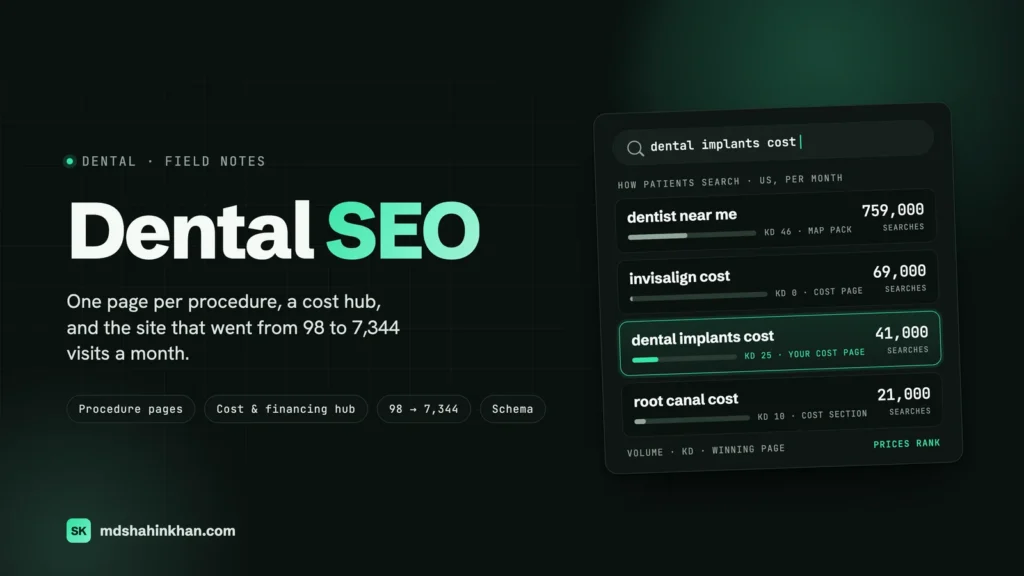
I am a freelance web developer, not a dental marketing agency. I build and rebuild WordPress sites for dental practices through a US agency partner and directly, and I run the local SEO on most of them. The dental SEO guide covers the website side, procedure pages and the cost hub; this one is about the map pack, the profile, reviews and location pages. The local SEO hub for small businesses has the general method; here it is applied to a practice.
Why the Map Pack Decides Most New-Patient Searches
Type “dentist near me” into a phone and the first thing on the screen is a map with three practices under it: rating, review count, “open now”, a call button, and directions. That is the map pack, and for a dental practice it is where new-patient calls come from, because most people choose from those three without scrolling to the websites below.
The map pack and the organic results below it are ranked differently. The map pack is decided by your Google Business Profile and reviews (relevance, distance and prominence, in Google’s words). The organic results are decided by your website. A practice with a beautiful site and a half-finished profile loses the map to a competitor with a worse site and 200 more reviews. That is why this article starts with the profile and only gets to the website in the second half.
What Patients Type, and Which Profile Field Wins It
Before spending an hour on anything, look at what patients actually search and what Google shows for it. These are US monthly volumes from Ahrefs, September 2026:
| What the patient types | Searches a month (US) | Difficulty | What decides it |
|---|---|---|---|
| dentist near me | 759,000 | 46 | Primary category “Dentist”, reviews, distance |
| dental implants near me | 87,000 | 39 | Implant category or service + an implant page |
| pediatric dentist near me | 81,000 | 57 | Category “Pediatric dentist” |
| orthodontist near me | 65,000 | 56 | Category “Orthodontist” |
| emergency dentist near me | 57,000 | 0 | Emergency service listed, hours, a phone number that answers |
| dental office near me | 54,000 | 47 | Same as “dentist near me” |
| teeth cleaning near me | 40,000 | 25 | “Teeth cleaning” in services |
| invisalign near me | 25,000 | 0 | Invisalign in services, an Invisalign page |
| walk in dentist near me | 22,000 | 0 | Attribute “Walk-ins welcome” |
| dentist open on saturday near me | 1,700 | 18 | Saturday hours on the profile |
| dentist that accepts medicaid near me | 400 | 8 | Insurance attributes and an insurance page |
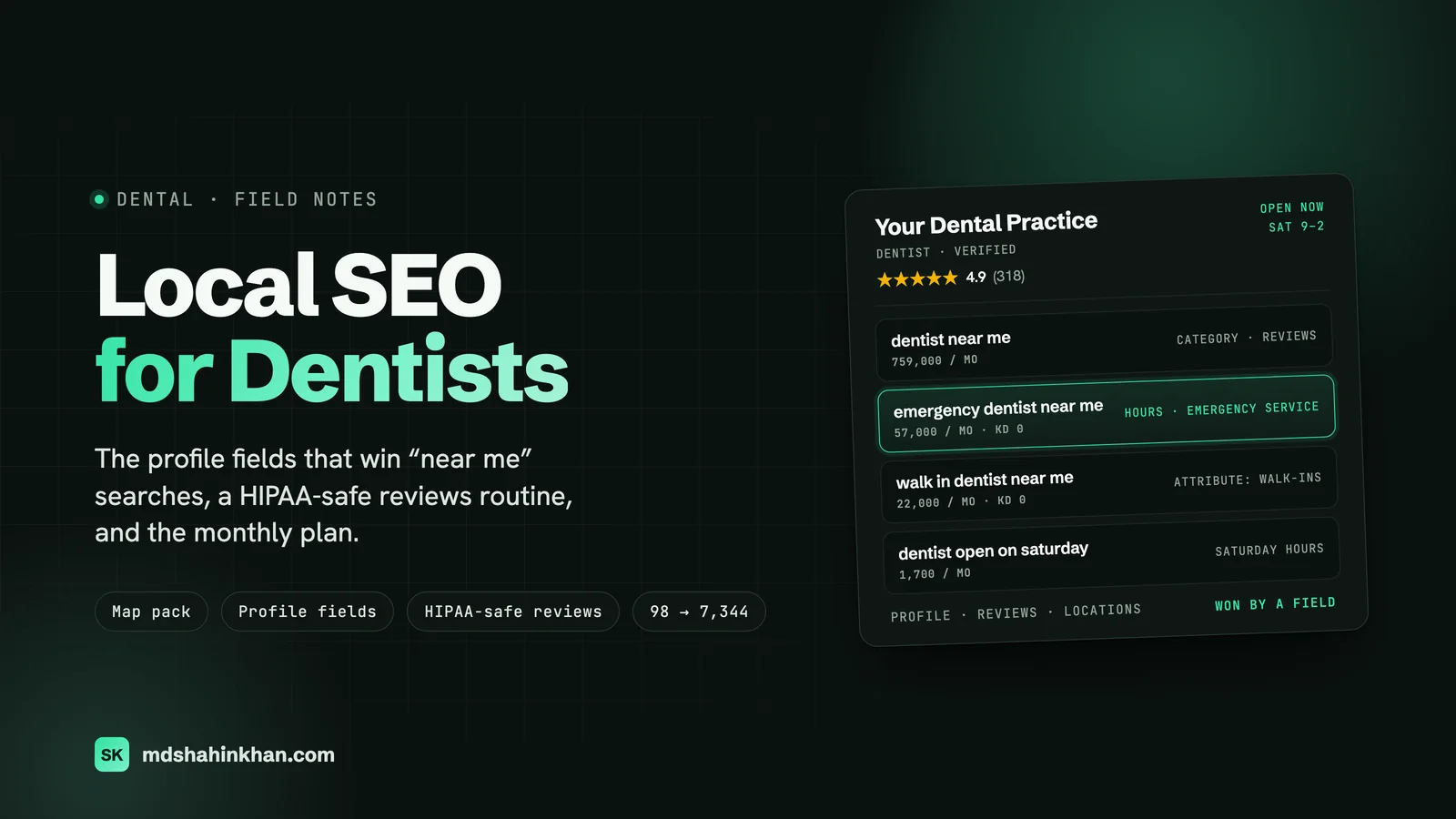
Look at the difficulty column. “Emergency dentist near me” (57,000 searches) and “walk in dentist near me” (22,000) have a difficulty of zero because there is nothing to write: they are won by a profile field. A practice that takes emergencies and walk-ins and has not said so on its profile is invisible for 79,000 searches a month it could be winning. That is the single cheapest fix in dental marketing.
Google Business Profile Setup for a Dental Practice
Do these in order. Each step is worth more than everything after it.
- Claim and verify. Until the profile is verified nothing else counts. Video verification is the usual route now: have the signage, the reception, a treatment room and a piece of practice mail ready.
- Primary category by revenue. “Dentist” for a general practice. If most of your revenue is one specialty, use it: “Cosmetic dentist”, “Pediatric dentist”, “Orthodontist”, “Periodontist”, “Dental implants provider” where Google offers it. Add the rest as secondary categories. The primary category is the strongest relevance signal on the profile.
- Name, address, phone exactly as on the sign and the website. No “Best Dentist in Plano” in the name; it gets reported and suspensions take weeks.
- Hours that are true, including Saturday and holidays. “Dentist open on Saturday near me” is decided here. If you take emergencies after hours, add “More hours” for it.
- Every procedure as a service, with a two-sentence description. Cleanings, fillings, crowns, implants, Invisalign, whitening, root canals, extractions, dentures, emergency care. This is where “teeth cleaning near me” and “invisalign near me” relevance comes from.
- Attributes. Walk-ins welcome, appointments required, wheelchair access, languages spoken, LGBTQ+ friendly, and every insurance you accept. Some of these are Maps filters.
- Photos: the exterior so patients recognise the building, reception, a treatment room, the team, and the dentist. Minimum 720 by 720 pixels. Add a few every month.
- Description (750 characters) written for a nervous patient: who you treat, where, insurance and financing, parking, how to book.
- Booking link to your online scheduler, and the website link to the right page (a specialty practice should point at the specialty page, not the home page).
- Questions and answers. Seed the five questions the front desk hears most (insurance, cost, first visit, sedation, parking) and answer them yourself.
Then the two ongoing parts: reviews and posts. A short post with a photo every couple of weeks is a small signal, but it shows Google and patients the practice is alive.
A Reviews System the Front Desk Can Run (HIPAA-Safe)
Reviews are about a fifth of what decides the map pack, and dentistry has a rule other businesses do not: HIPAA. A review routine for a practice has to produce steady reviews without the practice ever confirming who is a patient. This is the routine I set up:
The ask
- One named owner: the office manager or the treatment coordinator.
- Ask at checkout, when the patient is happy and the visit is fresh, and send the link by text within the hour. The short review link from the profile, nothing else.
- Ask for a review of the practice, not of a named dentist. Pairing a patient’s name with a provider’s name in a public review request can itself disclose the kind of care they had.
- Two reviews a week is the floor. Steady beats bursts; Google weighs recency.
- Never buy, gate (“how did we do?” funnels that only send happy patients to Google), or offer anything for a review. All three violate Google’s policy and the last can breach healthcare marketing rules too.
The reply, within a working day, to every review
- Good review: thank them by first name only, one specific line, nothing about their treatment. “Thanks, Maria. The team will be glad to hear it.”
- Negative review: never confirm they are a patient, never mention a procedure, never argue. “We take feedback seriously and would like to understand what happened. Please call [office manager] on [number] so we can discuss it directly.” Then resolve it offline.
- Never say “you were never a patient here”. That is also a disclosure, because it means you checked.
Reviews that mention the procedure (“my implant consultation”, “my daughter’s first cleaning”) help the procedure pages rank as well as the profile. You do not ask for keywords; you ask about the visit, and patients describe it.
Location Pages for the Communities You Serve
Patients search with the name of their own town, not yours. A practice in a metro draws from five to ten surrounding communities, and each one is a search you can only win with a page that genuinely serves it.
The test for every location page: would this page exist if Google did not? If the only reason is ranking, it is thin, and Google’s doorway-page filter catches it. A location page that passes has:
| Section | Why it is there |
|---|---|
| “Dentist for [Town] families” heading and an opening naming the town | Matches the search |
| Directions and travel time from that town, parking, the nearest landmark | Useful to a real patient; impossible to fake across ten pages |
| The procedures patients from that town book most | Genuinely different per community, and it links down to the procedure pages |
| Two or three reviews from patients in that town, first names only, with permission | Proof you serve it, HIPAA-safe |
| The dentist or hygienist who sees most patients from there | The human reason to choose you |
| Insurance common in that area, schema with the area served | Practical, and machine-readable |
| Map, click-to-call, online booking | The page’s job is the appointment |
On the implant practice below, ten community pages were built this way in the first phase. They were not ten copies with the city name swapped, and they are a large part of why the practice ranks in neighbourhoods a single address would never reach on distance alone.
Citations and NAP for a Practice
A citation is your practice name, address and phone on another site. Today they matter mostly for consistency: Google cross-checks your details across the web, and a practice with two phone numbers and three spellings of its suite number looks unreliable. Do this once, then stop:
- The general platforms: Apple Business Connect, Bing Places, Yelp, Facebook.
- The dental and healthcare directories: the ADA Find-a-Dentist listing, your state dental association, Healthgrades, Zocdoc if you use it, and the provider directories of every insurance plan you accept (patients search those directly).
- Identical NAP everywhere, character for character, matching the website footer and the profile.
- Duplicates closed. Old profiles from a previous owner or a previous address split your reviews and confuse distance.
Paid submissions to hundreds of directories are not worth the monthly fee. The ten above are.
On-Site Local Signals
The website’s share of the map pack is small; its job is the organic results below the map and turning the visit into an appointment. In order of return:
- One page per procedure with the city in the title. This is the structure that made the difference on every practice site I have rebuilt, and it is the whole subject of the dental SEO guide.
- Practice details in the footer of every page, matching the profile, marked up with
Dentistschema (aMedicalBusinesstype), withavailableServicefor the procedures andareaServedfor the communities. - The profile and the site pointing at each other, with the profile’s website link going to the right page.
- An embedded map, click-to-call and online booking on every screen. Most dental searches are on a phone, often from a car park.
- Speed: under two seconds on mobile, all three Core Web Vitals passing. Heavy templates and before-and-after galleries shipping full-size photos are the usual causes of failure.
- FAQ blocks with
FAQPageschema on procedure pages, written from the front desk’s real questions.
If you are choosing a developer for the site itself, this is what I build for dental practices.
What It Did for an Implant Practice
A US dental implant practice came to me through my agency partner with a brochure site: one implants page, a services page, a contact page, and, by Ahrefs’ estimate, 98 organic visits a month. The rebuild was the method in this article plus the procedure-page structure: a page per procedure with a cost section, a cost and financing hub, ten community pages with real local content, Dentist and procedure schema in the templates, a speed pass, and a profile and review routine the practice ran itself.
Over roughly two years the Ahrefs estimate went from 98 to 7,344 monthly organic visits, a 75× increase, with more than 30 procedure and location pages ranking for their terms, and organic search became the practice’s main source of new patient enquiries. The map pack moved first, within a few months, on the profile and reviews; the procedure and location pages compounded through the second year. The full case study has the chart. These are third-party estimates, not the practice’s own analytics, and I cannot name the practice.
The Monthly Routine
Local SEO for a practice is not a project that ends. It is a short routine, and this is the one I hand over, with who does it:
| When | What | Who |
|---|---|---|
| Every visit | Ask for a review at checkout; text the link within the hour | Front desk |
| Daily | Reply to new reviews (HIPAA-safe wording above); answer new profile questions | Office manager |
| Weekly | One profile post with a photo; check hours are still right | Office manager |
| Monthly | Add 3 to 5 photos; check the map-pack position for your five key searches from a phone in your area; read the profile’s calls, direction requests and bookings | Office manager |
| Monthly | Search Console clicks per procedure page; GA4 calls and bookings by page; Core Web Vitals | Developer |
| Quarterly | Update services and attributes for anything new (a new dentist, a new procedure, a new insurance); refresh the top three procedure pages | Both |
| When it changes | Hours, phone, address, insurance: update the profile, the site footer and the directories the same day | Office manager |
How Long It Takes and What It Costs
Timelines. Map-pack improvements usually show within 60 to 90 days of completing the profile and starting the review routine, faster in smaller markets. Procedure and location pages take three to six months to rank in a mid-size city, longer in a large metro, and they keep improving into the second year. Anyone promising the map pack in 30 days is describing a market with no competition.
Costs. Most of the value is front-loaded and most of the ongoing work is free. The foundation is a one-off developer project: the profile set up properly, a page per procedure, location pages where they are justified, schema in the templates, speed, citations fixed. After that the routine above costs the front desk an hour or two a week and a developer a small monthly fee for monitoring. Published 2026 guides put outsourced local SEO for dentists anywhere from around a hundred dollars a month to several thousand; a single-location practice that does the foundation and runs reviews itself rarely needs the top of that range. What a retainer buys in a competitive metro is content volume and links.
Frequently Asked Questions
What Is Local SEO for Dentists?
Local SEO for dentists is the work of making a practice appear when someone nearby searches for a dentist, a procedure or an urgent problem: a complete Google Business Profile with the right categories, services and hours; a steady flow of reviews; a website with a page per procedure and per community served; and consistent practice details across directories. It is decided mostly in the map pack, and the profile is the biggest lever.
How Much Should I Pay for Local SEO?
For a single-location practice the biggest cost is a one-off: the profile set up properly, a page per procedure, location pages where they are justified, schema and speed. The ongoing part is a review and profile routine the front desk runs for free plus a small monthly monitoring fee. Agency retainers in 2026 guides range from around a hundred dollars a month to several thousand; the higher end makes sense in a competitive metro where you need content volume and links, and rarely for a practice that has done the foundation.
How to Get a Local SEO?
Start with what you control today: verify the profile, pick the most specific primary category, list every procedure as a service, set true hours including Saturday and emergencies, add attributes for walk-ins and insurance, and ask every happy patient for a review by text. Then have a developer build the page-per-procedure structure and location pages, put Dentist schema in the templates, and make the site fast on a phone. The checklist in the local SEO hub is the order to do it in.
How Do I Get More Dental Patients?
Win the map pack for the searches patients actually make: “dentist near me”, “emergency dentist near me”, “[procedure] near me” and “dentist open on Saturday near me” are all decided by the profile’s category, services, hours and attributes plus your reviews. Then make sure each procedure has its own page with a cost section so you also win the “cost” and “how long” searches, and make booking possible from every screen. On the implant practice above, that combination took organic enquiries from a trickle to the practice’s main source of new patients.
How Long Does Local SEO Take for a Dental Practice?
Map-pack improvements usually show within 60 to 90 days of completing the profile and starting a review routine. Procedure and location pages take three to six months in a mid-size city and longer in a large metro, and they compound into the second year: the implant practice in this article went from 98 to 7,344 estimated monthly visits over roughly two years, with most of the growth in the second.
If you want a second opinion on your practice’s profile and site before you spend on marketing, book a free 30-minute call. We look at your profile, your five key searches and the three practices above you, and you leave with a written plan whether or not we work together. Related: what I build for dental practices, the dental SEO guide and the dental implant case study.