Immigration lawyer marketing works when it meets clients where they are: searching by their case type (asylum, green card, citizenship, deportation), often in Spanish or another language, usually on a phone, and wary because someone may already have taken their money. A small firm wins by giving each case type its own page, building real Spanish pages rather than machine translations, making its license and fees obvious, keeping a strong Google Business Profile, and answering enquiries fast on the channels clients use, including text and WhatsApp.
My guides to SEO for lawyers and local SEO for lawyers cover the foundations every firm needs. Immigration is different enough to need its own plan: the clients are often searching in two languages, the stakes are a family’s future, and the practice area has a fraud problem that shapes how people choose a lawyer. This guide covers what immigration clients actually search for, with numbers, and how a small firm turns those searches into consultations.
What Immigration Clients Search For
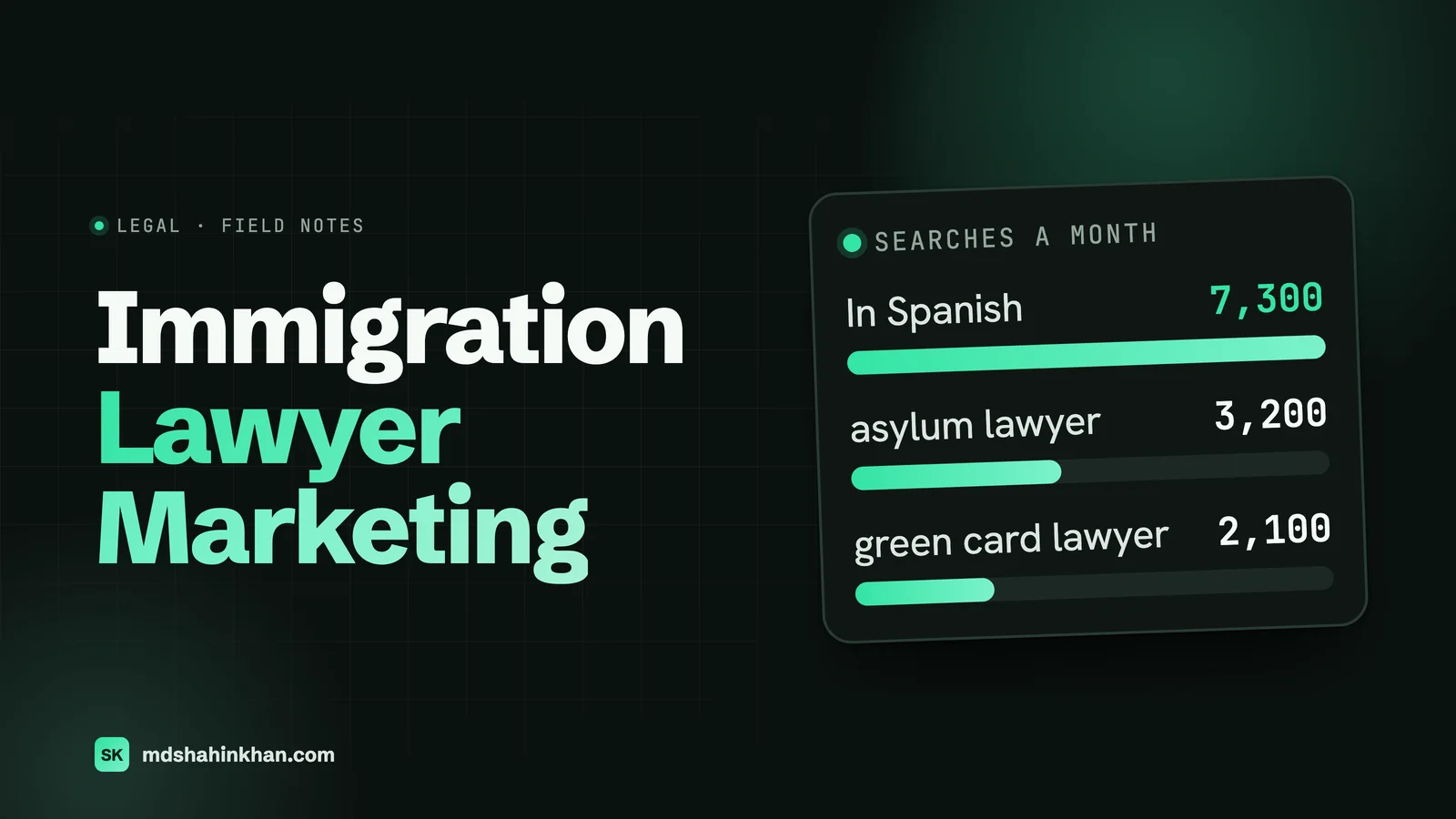
Clients rarely search “immigration law firm”. They search for their situation. Here are US monthly searches for common case-type terms, from Ahrefs data I pulled for this article:
| Search (English) | US searches a month | Difficulty (0 to 100) |
|---|---|---|
| immigration lawyer near me | 16,000 | 61 |
| immigration attorney near me | 7,600 | 50 |
| asylum lawyer | 3,200 | 0 |
| green card lawyer | 2,100 | 0 |
| citizenship lawyer | 1,900 | 8 |
| visa lawyer | 1,600 | 10 |
| work visa lawyer | 900 | 0 |
| family immigration lawyer | 700 | 2 |
| how much does an immigration lawyer cost | 600 | 1 |
| deportation lawyer | 500 | 0 |
| k1 visa lawyer | 450 | 0 |
| h1b lawyer | 300 | 0 |
And the Spanish searches, which most competitors ignore:
| Search (Spanish) | US searches a month | Difficulty |
|---|---|---|
| abogados de inmigración | 3,900 | 0 |
| abogado de inmigración | 2,100 | 31 |
| abogado de inmigración cerca de mí (with and without accents) | 1,100 | 2 to 9 |
| abogado de asilo | 150 | 0 |
| abogado de deportación | 90 | 0 |
Three things stand out. The “near me” terms are big but hard, because the map pack and large firms dominate them. The case-type terms are large and almost uncontested, with difficulty scores of 0 to 10. And Spanish searches add up to more than 7,000 a month on just these five terms, with low competition. A small firm that builds good pages for its case types, in both languages, is competing where the big firms are weakest.
How Immigration Clients Choose a Lawyer
Immigration clients are making one of the biggest decisions of their lives, often under time pressure, sometimes afraid of the government and of strangers. In my experience building for law firms, a few things decide who they call:
- Trust before price. Is this a real, licensed lawyer? Have people like me used them? Do they speak my language?
- Clarity about the first step. What does a consultation cost, how long is it, can I do it by video, what should I bring?
- Speed. Someone facing a deadline or a court date calls the next firm if nobody answers.
- Fear of scams. Many have heard of, or experienced, notario fraud. Anything that looks vague or too good to be true pushes them away.
Every section below is about one of those four.
One Page per Case Type
A single “Immigration Services” page listing ten things cannot rank for “asylum lawyer” and “green card lawyer” at the same time, and it does not reassure a client with one specific problem. Give each case type you want more of its own page:
- Family-based green cards (spouse, parent, sibling)
- Citizenship and naturalization
- Asylum
- Removal defense and deportation
- Work visas (H-1B and others you handle)
- K-1 fiancé visas
- DACA, if you take those cases
Each page should cover, in plain language:
- Who this is for, in the client’s words (“You married a US citizen and want to live here permanently”).
- The process, step by step, with the forms by name and the realistic timeline, linking to USCIS for official processing times.
- What you need to prepare.
- What can go wrong, and when to get a lawyer involved.
- Your fees or fee structure for this case type.
- A short review from a client with a similar case, with written permission.
- How to book a consultation, in both languages.
That structure also suits AI answers, which tend to lift clear, step-by-step explanations. My article on law firm website design covers the rest of what goes on a firm’s site.
Spanish Pages Done Properly
If your firm serves Spanish speakers, your website should too, and properly.
- Build real pages, not a translate button. A browser translation widget creates no pages Google can index in Spanish and often mistranslates legal terms. Each important page needs its own Spanish version, written or reviewed by a fluent speaker who knows immigration terms.
- Give Spanish pages their own addresses, such as
/es/abogado-de-asilo/, and link each English page to its Spanish version and back, with hreflang tags telling search engines they are translations of each other. - Match the search terms people use: “abogado de inmigración”, “abogados de inmigración”, “abogado de asilo”.
- Make Spanish obvious on the homepage and in the header, not hidden in a footer link.
- Add Spanish to your Google Business Profile attributes, and ask Spanish-speaking clients for reviews in Spanish.
- Have Spanish speakers answer the phone and messages, or say clearly when they are available. A Spanish website that leads to an English-only phone line loses the client.
The same applies to any other language your firm serves, such as Portuguese, Haitian Creole, Mandarin or Vietnamese.
Notario Fraud and Your Marketing
Immigration has a specific trust problem. In many Spanish-speaking countries, a “notario” is a lawyer with special training. In the US, a notary public is not a lawyer, and USCIS states that a notario público is not authorized to give immigration legal advice; only an attorney or an accredited representative of a recognized organization can. The FTC warns immigrants about the same scam. Many of your future clients know someone who paid a notario and lost their case or their money.
That shapes your marketing:
- Never describe your firm as “notario” or “notario público” in Spanish advertising or on your site. Use “abogado” and “abogada”.
- Show your license plainly: each attorney’s name, the state bar they belong to, and a link to the bar’s lawyer lookup. Mention AILA membership if you have it.
- Explain what you will and will not do, what the consultation includes, and how you handle clients’ original documents.
- Publish a short “how to spot immigration fraud” page in English and Spanish, linking to the USCIS and FTC warnings. It helps people, earns trust, and is the kind of page community organizations link to.
Your state bar’s advertising rules apply to every language, so a Spanish ad must be as accurate as the English one.
Google Business Profile and Reviews
The map pack matters as much for immigration as for any practice area: “immigration lawyer near me” and “immigration attorney near me” are searched more than 23,000 times a month in the US. My guide to local SEO for lawyers covers the profile in detail. The immigration-specific points:
- Primary category: “Immigration attorney”. Add other genuine practice areas as secondary categories.
- Services: list each case type as a service, in plain words.
- Languages: add every language your team speaks.
- Reviews need extra care. Many immigration clients do not want a public review tied to their name, because of their status or their family’s. Ask, never pressure, accept initials or first names, and never reply with anything about their case. Google’s rules forbid offering anything for a review, and your state bar’s rules apply on top.
Intake: Phone, Text, WhatsApp and Consultations
Immigration enquiries are often urgent: a court date, a detention, a visa deadline. Intake is where marketing money is won or lost.
- Answer the phone during business hours, and use an answering service or call-back promise outside them.
- Offer text and WhatsApp. Many clients already use WhatsApp to stay in touch with family abroad and are more comfortable sending a message than calling a stranger. If you offer it, answer it the same day.
- Make booking a consultation easy, online, with the fee (or “free”) stated clearly, and video consultations for clients who cannot travel.
- Keep intake forms short on the public site: name, phone, language, preferred contact method and case type from a short list. Collect immigration history and documents through your practice management software.
- Track where every client came from, so you know which pages and channels pay.
Content That Builds Trust
Immigration is an area where people search for answers before they search for a lawyer, so helpful content brings in clients months later.
- Process explainers for each case type, in both languages.
- A fees page. “How much does an immigration lawyer cost” is searched 600 times a month. Publishing your flat fees or ranges for common cases answers it directly and filters out mismatched enquiries.
- News explainers when policy changes, written quickly and plainly, with a date. Policy changes bring a surge of anxious searches, and AI assistants favour fresh pages.
- Short videos in which an attorney answers one common question, in English and Spanish. Video is one of the most cited sources in Google’s AI answers.
Paid Search and Local Services Ads
Paid search is the fastest way to appear while your pages build up. Google’s Local Services Ads put a “Google Screened” badge above the map, you pay per lead, and Google checks your license first. For regular search ads:
- Run separate campaigns for each case type and each language, each sending clicks to the matching page.
- Track calls and booked consultations, not clicks, and stop what does not produce clients after a fair test.
- Keep Spanish ads in Spanish, leading to Spanish pages and Spanish-speaking intake.
My article on personal injury lawyer marketing goes deeper into how the paid options compare.
Social Media and Community
Immigration practices grow through communities more than most practice areas.
- Short videos on Facebook, Instagram, TikTok and YouTube answering one question each, in the languages your clients speak.
- Free community talks with churches, community centers, schools and nonprofits, on topics such as “Know your rights” or “Applying for citizenship”.
- Relationships with nonprofits and other lawyers who refer cases they cannot take.
- Local Spanish-language radio and newspapers, which still reach many families.
Keep everything you publish general. Never discuss a specific client’s case, and check your bar’s rules on testimonials and advertising.
What It Costs
A 2026 local SEO pricing guide from SEO.com puts agency retainers at $501 to $3,000 a month and one-off projects at $500 to $5,000. Full law firm SEO retainers commonly run $2,000 to $5,000 a month (sources in my SEO for lawyers guide). For a small immigration firm, the core work is one-off: case-type pages in two languages, a fees page, the Google Business Profile and intake setup. The ongoing work is content, reviews and community, much of which the firm can do in-house. My law firm marketing plan shows how to split a budget across channels.
A 90-Day Plan for a Small Immigration Firm
Month 1: foundations
- Build a page for each case type you want more of, in English.
- Publish a fees page and a consultation page with the fee, length and format.
- Set up the Google Business Profile with “Immigration attorney” as the primary category, services and languages.
- Show each attorney’s bar admission and a link to the bar lookup on the site.
Month 2: Spanish and intake
- Build Spanish versions of the homepage, case-type pages, fees and consultation pages, reviewed by a fluent speaker.
- Add Spanish to the header and link each page to its translation.
- Offer text or WhatsApp, and set a same-day reply rule.
- Start tracking how every new client found you.
Month 3: trust and reach
- Publish a “how to spot immigration fraud” page in both languages.
- Record three short videos answering common questions.
- Ask recent clients for reviews, respecting their privacy.
- Run a small, tracked ad test for one case type in one language.
If you want help building the site side of this, my page on websites for law firms shows what I build, and my local SEO guide for small businesses covers the map pack in more depth.
Frequently Asked Questions
How Do I Market Myself as an Immigration Attorney?
Start with what clients search for: a page for each case type you handle (asylum, green cards, citizenship, deportation, work visas), in English and in the languages your clients speak. Add a clear fees and consultation page, a complete Google Business Profile with “Immigration attorney” as the primary category, and fast intake by phone, text and WhatsApp. Then build trust through reviews, short videos and community talks.
What Is the 80/20 Rule for Lawyers?
In marketing terms, the small share of work that brings most of the results. For an immigration firm, that is usually a page for each main case type, real pages in the languages your clients speak, a strong Google Business Profile with steady reviews, and answering every enquiry quickly. Most of the rest moves the needle much less.
Should an Immigration Law Firm Have a Spanish Website?
If you serve Spanish-speaking clients, yes. Spanish searches such as “abogados de inmigración” and “abogado de inmigración” add up to thousands a month in the US with low competition. Build real Spanish pages with their own addresses, written or reviewed by a fluent speaker, rather than relying on an automatic translation button, and make sure Spanish-speaking clients can reach someone who speaks Spanish.
Can an Immigration Lawyer Advertise as a “Notario”?
No firm should. In the US, a notario or notary public is not a lawyer and cannot give immigration legal advice, which USCIS and the FTC both warn about because of widespread fraud. Using the word in Spanish advertising can mislead clients and may break state rules. Use “abogado” or “abogada” and show your bar admission clearly.
Should Immigration Lawyers Publish Their Fees?
Publishing flat fees or ranges for common case types usually helps. “How much does an immigration lawyer cost” is searched about 600 times a month in the US, so a fees page answers a real question, builds trust in a practice area where clients fear being overcharged, and filters out enquiries that are not a fit. Explain what each fee includes and what government filing fees are separate.
How Do Immigration Lawyers Get Clients Online?
Mostly through Google: the map pack for “immigration lawyer near me” searches, and their own pages for case-type and Spanish searches, which are much less competitive. Reviews, a clear consultation process, fast replies by phone and messaging, and short videos that answer common questions turn those searches into consultations. Local Services Ads and search ads fill the gap while the pages build up.
If you run an immigration practice and want to know where your website and profile stand, book a free 30-minute call and I will look at them with you, whether or not we work together.