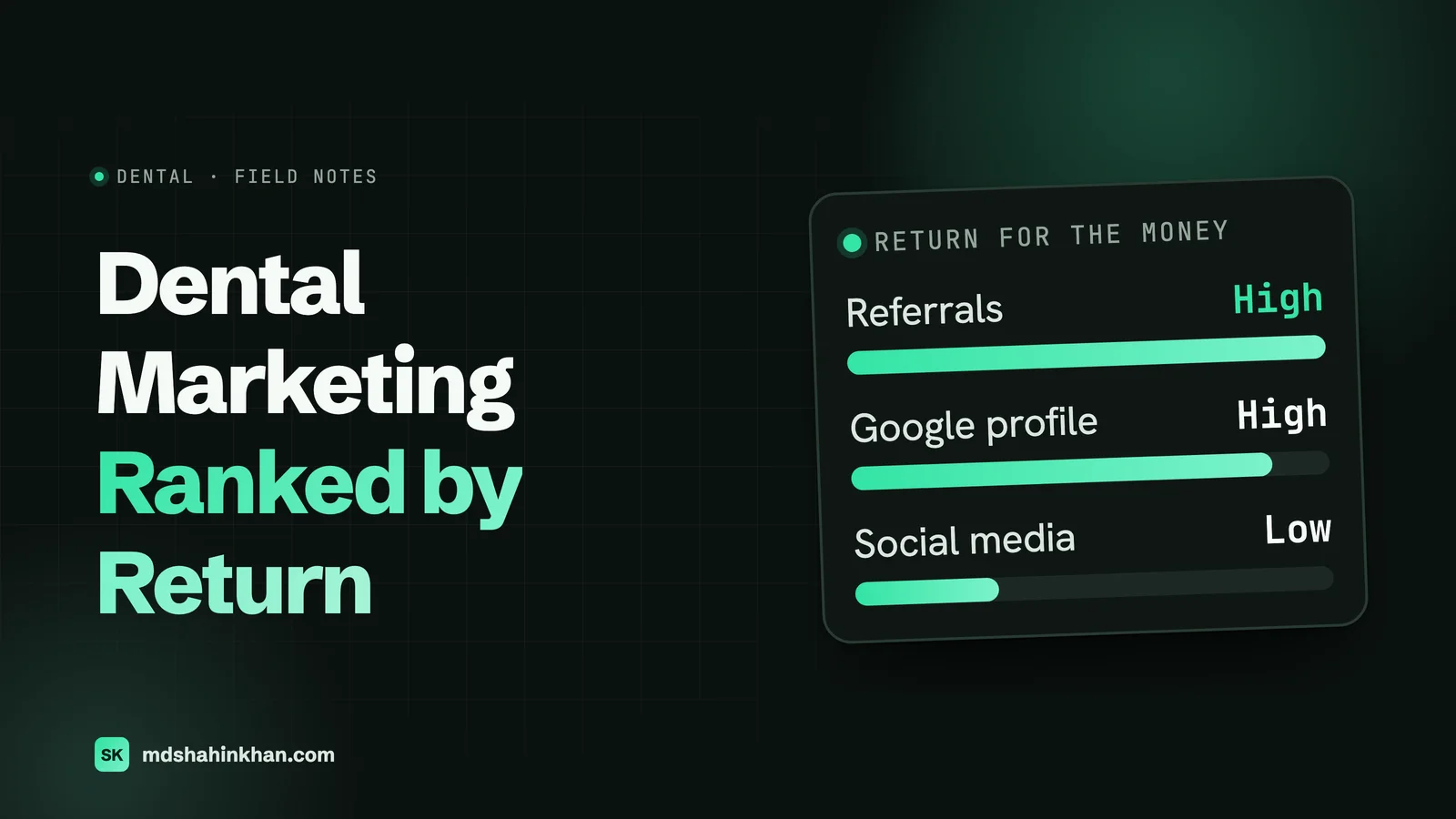
The dental marketing strategies with the best return are the ones that start with patients you already have: answering and following up every enquiry, asking happy patients for referrals and reviews, and bringing overdue patients back. After that come a strong Google Business Profile, a website with a page for each procedure and easy booking, and local SEO. Google Ads work for high-value procedures when they are tracked; social media builds trust but rarely brings new patients on its own; print and discount deals come last.
I build websites for dental practices, and most practice owners who come to me have tried several of the “30 marketing ideas” on the usual lists at once, with no way to tell which worked. The lists are not wrong; they are unranked. This article puts them in the order I would do them for a typical general or implant practice, based on what each costs, how quickly it pays, and how much of it the team can run in-house. It also covers what patients actually search for, the HIPAA mistakes that turn marketing into a fine, how to measure each channel, and what to spend.
The Strategies Ranked by Return
| Rank | Strategy | Cost | Time to results | Who runs it |
|---|---|---|---|---|
| 1 | Answering, following up and booking every enquiry | Staff time | Immediate | Front desk |
| 2 | Referrals, recall and reactivation of existing patients | Staff time, a few texts | Weeks | Front desk |
| 3 | Google Business Profile and reviews | Staff time | Weeks to months | Office manager |
| 4 | Website procedure pages and online booking | A website project | Months | Developer |
| 5 | Local SEO and useful content | Monthly time or fee | Months | You and developer |
| 6 | Google Ads for high-value procedures | Ad spend plus management | Days | Specialist |
| 7 | Email and text to your patient list | Low | Weeks | Front desk |
| 8 | Social media | Staff time or a fee | Slow, indirect | Team |
| 9 | Community, employers and referral partners | Time, small sponsorships | Months | Dentist and manager |
| 10 | Print, mailers and discount deal sites | Printing, postage, deep discounts | Varies | Situational |
The order matters because the early strategies make every later one work better. Ads sending callers to a phone nobody answers waste money; reviews make both the map pack and the ads convert; a good procedure page makes both SEO and ads cheaper per patient.
1. Answer, Follow Up and Book Every Enquiry
The cheapest new patients are the ones already trying to reach you. Before spending anything on marketing, find out how many calls go unanswered, how quickly web form enquiries get a reply, and how many callers who ask about price never book.
- Answer the phone, or route overflow to someone who can book. A missed call from a patient in pain usually becomes an appointment at the next practice on the map.
- Reply to forms and messages within the hour during opening hours.
- Follow up on quotes. An implant or Invisalign consultation that did not book is a warm lead; a call a week later is marketing that costs nothing.
- Let people book online for routine appointments, especially outside hours.
2. Referrals, Recall and Reactivation
The ADA reports that nearly two-thirds (63.7%) of new patients in general dentistry practices are referred by existing patients. Your patient list is your biggest marketing channel whether you manage it or not.
- Ask for referrals at the moment of delight, such as the end of a successful treatment, with a simple card or text a patient can forward. Thank every referrer personally.
- Check your state’s rules before offering any reward for referrals. Anti-kickback rules can apply when patients have government insurance, and state dental boards have their own rules; a handwritten thank-you note is always safe.
- Run recall properly. Patients overdue for a cleaning are the easiest appointments to fill: a text, then a call, then a letter.
- Reactivate old patients who have not been seen in 18 months or more, and review unscheduled treatment plans monthly.
This is the least exciting item on the list and, for most practices, the one with the best return.
3. Google Business Profile and Reviews
When someone searches “dentist near me” or “emergency dentist”, the three practices on the map get most of the calls. Your Google Business Profile decides whether you are one of them.
- Set the primary category to the most specific one that fits most of your work, add your genuine secondary categories, and list each procedure as a service.
- Keep hours accurate, including holidays, and add real photos of the practice, the team and the front of the building.
- Build a steady flow of reviews. Ask every patient after a good visit, by text with a direct link. Google’s rules do not allow incentives for reviews or asking only the patients you expect to be happy.
- Reply to every review, carefully (see the HIPAA section below).
My guide to local SEO for dentists goes through the profile step by step.
4. A Website With Procedure Pages and Easy Booking
Your website is where a patient who found you on the map or in an ad decides whether to call. For most practices it works hardest when it has:
- One page per procedure (implants, Invisalign, crowns, whitening, emergency care), written for how patients search, with who it suits, what happens, how long it takes and what it costs.
- A cost and financing page. “Dental implants cost” alone is searched about 41,000 times a month in the US, according to Ahrefs. Patients want a range and payment options before they call.
- Booking that works on a phone, with the phone number tappable on every page.
- Real photos, real team bios and before-and-after images used with patients’ written permission.
My article on dental website design covers what each of these pages needs.
5. Local SEO and Useful Content
Local SEO and content take months, but once they work they bring patients without paying for each click. On a US dental implant practice I rebuilt with a page per procedure, a cost hub and location pages for the surrounding communities, Ahrefs’ estimate of organic visits went from 98 to 7,344 a month in about two years; the case study shows how.
What works: pages that answer the questions patients ask before they book (cost, pain, recovery, insurance, candidacy), location pages only for communities you genuinely serve, and a steady rhythm rather than a burst. My guide to dental SEO covers the structure in detail.
6. Google Ads for High-Value Procedures
Google Ads are the fastest way to appear for searches you do not rank for yet, and they suit high-value treatments where one new patient covers a lot of clicks: implants, Invisalign, emergency appointments.
- Send each ad group to the matching procedure page, not the homepage.
- Track calls and bookings, not clicks. Use call tracking and form tracking, and ask every new patient how they found you.
- Start narrow: one or two procedures, a tight area around the practice, the hours your phones are answered.
- Set a test budget and a cost-per-patient target before you start, and stop what does not reach it after a fair test.
Ads amplify whatever sits behind them. If items 1 to 4 are weak, ads mainly buy calls that do not book.
7. Email and Text to Your Patient List
Your existing patients read texts from their dentist. Use that for recall reminders, treatment follow-ups, new services, and the occasional short, useful newsletter (seasonal tips, a new team member, whitening before the holidays). Keep it infrequent and relevant, get consent for marketing messages, and include an easy way to opt out.
8. Social Media
Social media for a dental practice builds familiarity and trust: people see the team, the office and the atmosphere before they visit. It rarely brings a steady stream of new patients on its own, which is why it sits in the lower half of this list.
- Show the team and the practice, not stock images of teeth.
- Post consistently rather than often; a few good posts a month beat daily filler.
- Get written consent before showing any patient, their face or their treatment.
- Use paid social ads only for specific offers or procedures, with tracking, like Google Ads.
9. Community, Employers and Referral Partners
Local relationships compound over years: sponsoring a school team, offering talks to local employers, being the practice the pediatrician or the general dentist down the road refers to. For specialists (oral surgeons, orthodontists, periodontists), relationships with referring dentists are usually the main channel and deserve a real plan: regular contact, fast reports back, and making referral easy.
10. What I Would Leave Until Last
- Discount deal sites bring price shoppers who rarely stay for the long term, at deep discounts.
- Mass mailers and print ads can work for a new practice announcing itself in a specific area, but they are hard to track and expensive per patient.
- Paying for “SEO packages” that are mostly directory listings without fixing the website or the profile.
- Chasing every new platform. A practice that runs five channels badly does worse than one that runs two well.
What Patients Search For
Here is how many times a month people in the US search for common dental services with “near me”, from Ahrefs data I pulled for this article:
| Search | US searches a month |
|---|---|
| dentist near me | 759,000 |
| dental implants near me | 89,000 |
| pediatric dentist near me | 81,000 |
| orthodontist near me | 65,000 |
| teeth whitening near me | 60,000 |
| emergency dentist near me | 57,000 |
| cosmetic dentist near me | 39,000 |
| invisalign near me | 25,000 |
| wisdom teeth removal near me | 7,100 |
| root canal near me | 7,000 |
| veneers near me | 6,500 |
Two things follow. The map pack (item 3) is where most of these searches end up, and each procedure you want more of deserves its own page (item 4), because Google needs a page to match “implants near me” to your practice.
Staying Within HIPAA and Review Rules
Marketing mistakes in dentistry can become compliance problems.
- Never confirm someone is a patient in a review reply. In 2019, the HHS Office for Civil Rights settled with a Dallas dental practice for $10,000 and a two-year corrective action plan after its replies to Yelp reviews disclosed patients’ names, treatment plans, insurance and costs. A safe reply thanks the reviewer, says nothing about their care, and invites them to call.
- Get written authorization before using any patient’s photo, name, story or before-and-after images in marketing.
- Be careful with tracking tools on pages where patients book or enter health information, and on patient portals. Ask your compliance adviser which analytics and ad pixels are acceptable where.
- Follow Google’s review rules: no incentives, no asking only happy patients, no reviews written by staff.
How to Measure What Works
Measure each channel by the number of new patients it brings and what they are worth, not by clicks or likes.
- Ask every new patient how they found you, and record it in the practice management software. It is simple and more reliable than most dashboards.
- Track calls and forms by source: call tracking numbers for ads, tracking links on your Google Business Profile, form submissions recorded with the page they came from.
- Calculate cost per new patient for each paid channel: what you spent divided by the new patients it brought.
- Compare it with what a new patient is worth to you, using your own numbers: average first-year production per new patient, and how long patients typically stay. A channel that costs less per patient than one patient’s first-year production is usually worth keeping.
The ADA suggests reviewing marketing results monthly, quarterly and at year-end. Monthly is enough to catch a channel that is not working.
What to Spend
There is no official figure, but dental marketing advisers commonly quote 3 to 5 percent of collections for an established practice and more, often 6 to 10 percent, for a new practice or one in a competitive market. Treat that as a ceiling to justify, not a target to spend: the first three strategies on this list cost mostly staff time. The ADA’s own planning guide suggests the office manager spends about a quarter of their time on marketing, which says a lot about where the return comes from.
A 90-Day Order of Work
Month 1: inside the practice
- Measure missed calls and enquiry response times, and fix both.
- Start recall and reactivation for overdue patients.
- Start asking every happy patient for a review, and set up the referral thank-you.
Month 2: the profile and the website
- Complete the Google Business Profile: categories, services, hours, photos.
- Check the website has a page for each procedure you want more of, a cost page and phone-friendly booking.
- Add tracking to the profile link, forms and phone numbers; start recording how each new patient found you.
Month 3: add one paid channel, carefully
- Choose one high-value procedure and run a small, tracked Google Ads test.
- Review the numbers from months 1 and 2 and decide what to keep.
If you want the wider picture of how dental practices get found online, my local SEO guide for small businesses is the general version, and my page on websites for dental practices shows what I build for practices.
Frequently Asked Questions
What Are the Best Marketing Strategies for Dentists?
For most practices, the best return comes from converting enquiries you already get (answering calls, following up quotes), existing patients (referrals, recall and reactivation), and a strong Google Business Profile with steady reviews. Next come a website with a page for each procedure and online booking, local SEO, and tracked Google Ads for high-value treatments. Social media and print come later.
How Much Should a Dental Practice Spend on Marketing?
Dental marketing advisers commonly quote 3 to 5 percent of collections for an established practice and 6 to 10 percent for a new practice or one growing in a competitive market. It is a rule of thumb, not an ADA standard. Much of the highest-return work costs staff time rather than money, so start there and spend on paid channels only when you can measure cost per new patient.
How Do I Get More Dental Patients?
Start with the patients already trying to reach you: answer every call, reply to forms quickly and follow up on consultations that did not book. Then ask happy patients for referrals and reviews, bring back overdue patients, and make sure your Google Business Profile and website show every procedure you offer. The ADA reports that 63.7% of new patients in general practices are referred by existing patients.
Does Social Media Marketing Work for Dentists?
It works for building trust and familiarity, so patients feel they know the practice before they visit, and for keeping existing patients engaged. It rarely brings a steady flow of new patients on its own. Post consistently about the team and the practice, get written consent before featuring any patient, and use paid social ads only for specific offers that you can track.
Are Google Ads Worth It for Dentists?
Often, for high-value procedures such as implants, Invisalign and emergency care, where one new patient covers a lot of ad spend. They are worth it when each ad leads to a matching procedure page, calls and bookings are tracked, and the phones are answered. Without those, ads mostly buy clicks that never become patients.
Is It HIPAA Compliant to Respond to Online Reviews?
Yes, if the reply reveals nothing about the reviewer’s care or even that they are a patient. In 2019 a Dallas practice paid $10,000 to the HHS Office for Civil Rights after its Yelp replies disclosed patients’ treatment, insurance and cost details. Thank the reviewer in general terms and invite them to call the practice to discuss any concern privately.
If you want a second opinion on where your practice’s marketing money should go, book a free 30-minute call and I will look at your website and Google Business Profile with you and tell you what I would fix first, whether or not we work together.