Personal injury is the most expensive corner of legal marketing, and most of the advice written about it is for firms with television budgets. A small personal injury firm wins online by refusing to fight on the head terms and winning everywhere else: one page for every way a person gets hurt, one page for every city it serves, a steady flow of reviews, Local Services Ads instead of $300 clicks, and an intake process that calls back in minutes rather than hours. None of that needs an agency retainer, and all of it compounds.
I build websites for law firms as a freelance WordPress developer, mostly for US firms through an agency partner, and personal injury sites are the ones where the gap between the marketing that gets sold and the marketing that works is widest. This guide is the practical version: what a small firm is up against, where it can win, how to build the pages that do the work, what paid search really costs, why intake speed matters more than any of it, and a 90-day plan with a budget.
The PI Market Online: What a Small Firm Is Up Against
Three facts set the terms.
The money is enormous. The American Tort Reform Association estimates that about $4 billion was spent on more than 30 million legal services ads across television, radio, print, digital and outdoor in 2025, up roughly 44% on the year before, with television taking the largest share. Most of that is personal injury and mass tort. The firms behind it treat marketing as a fixed cost of doing business and measure it in signed cases per month.
The clicks are the most expensive of any industry. WordStream’s 2026 benchmarks, drawn from more than 13,000 campaigns, put attorneys and legal services at an average of $9.87 per click and $131.63 per lead, the highest of the twenty industries tracked, and that is the blended figure across all of law. Agency benchmark reports for personal injury specifically put “car accident lawyer [city]” and “personal injury lawyer [city]” clicks at $150 to $300 in major metros, with peaks above $400.
The client decides fast. Someone who was rear-ended yesterday calls two or three firms today and signs with the one that answers first and sounds competent. There is no “research phase” like there is for an estate plan. Whoever is visible at the moment of the search and picks up the phone wins the case.
That combination is why the generic advice (“rank for personal injury lawyer in your city”) fails small firms. The head terms belong to whoever spends the most, and on the organic side they belong to firms with hundreds of referring domains and a decade of content. The good news is that the same market has more long-tail demand than any other legal niche, and the big firms are bad at it.
Where a Small PI Firm Wins
Five places, in order of how fast they pay.
- Intake speed. The cheapest improvement in the whole list. A firm that calls every web lead back inside five minutes signs more cases from the same traffic than a firm that calls back the next morning. Section below.
- Case-type pages. “Rideshare accident lawyer”, “dog bite lawyer”, “e-bike accident lawyer”, “nursing home fall attorney”, each with the city in the title. Lower volume, far lower competition, and the searcher is describing exactly what happened to them.
- City and suburb pages. The big firm has one office page for the metro. A small firm can own the suburbs and the neighbouring counties with pages that are genuinely about those places.
- Reviews. Personal injury clients read reviews more than any other legal client because they are choosing under stress. A firm with 120 reviews at 4.9 that gets four new ones a month beats a firm with 800 reviews from three years ago in the map results.
- Local Services Ads. Google’s pay-per-lead format sits above the regular ads, shows the firm’s rating and “Google Screened” badge, and charges per lead rather than per click. In 2026 agency reports put legal LSA leads at $60 to $250 depending on the market. That is expensive, but it is a lead, not a click, and a firm can cap the budget to the day.
Where a small firm does not win: the ten highest-volume head terms in a major metro, television, billboards, and buying leads from aggregators that sell the same person to four firms at once. Spend nothing there until the five things above are running.
Case-Type Pages: One Page per Way People Get Hurt
The core of personal injury SEO is a page for each case type the firm actually takes, written for the person who just experienced it. The page answers, in this order:
- What happens next. Two or three sentences: what to do today, what not to say to the insurer, and that the consultation is free and the fee is contingent.
- How these cases work in your state. Fault rules, the statute of limitations, how damages are calculated, in plain words. This is the part the searcher cannot get from a national site, and it is what Google treats as expertise.
- What the firm has done in these cases. Two or three results with the facts that made them possible, and the disclaimer your bar requires.
- Who handles it. The attorney’s photo and one sentence, linking to their bio.
- Questions people ask. Six to ten, answered in a few sentences each, taken from real intake calls. These are also what the AI answer engines quote.
- Call or form. The phone number as a tap target, a four-field form, and the reply-time promise.
Which case types first? Order them by how much competition each one has, not by how much the cases are worth. Roughly, from the SERPs I see across US metros:
| Tier | Case types | Competition | Why it matters |
|---|---|---|---|
| Head terms | personal injury lawyer, car accident lawyer, truck accident lawyer | Brutal in every metro; TV firms and national sites | Build the pages, but do not expect them to rank first for a year or more |
| Middle | motorcycle accident, pedestrian accident, slip and fall, wrongful death, medical malpractice | Strong but beatable in mid-size metros and suburbs | Second wave, months two to four |
| Long tail | rideshare (Uber and Lyft) accidents, e-bike and scooter accidents, dog bites, nursing home falls and neglect, construction site injuries, bicycle accidents, boating accidents, premises liability at a named type of business | Thin; often no dedicated page in the whole metro | First wave, month one; each page can rank within weeks |
A page per long-tail case type, each 1,200 to 2,000 words, each with the state law section and the FAQ, is the highest-return content a small PI firm can produce. Ten of them in ninety days is a realistic pace with one writer and one attorney reviewing. The structure that ranks is the same one I described for practice-area pages in SEO for lawyers.
City Pages That Are Not Doorway Pages
City pages have a bad reputation because most of them are the same page with the city name swapped. Google discounts those, and rightly. A city page earns its place when it is genuinely about the place:
- The roads, intersections and highways where the crashes happen, named (every local reporter and police blotter tells you which they are).
- The hospitals people are taken to and the courthouse where the case is filed.
- Local rules that differ: municipal claim deadlines, county-specific procedures, where the police report is requested.
- The attorney who covers that area and how consultations work there (office, home visit, hospital visit, video).
- Results from cases in that city, if you have them.
- Real reviews from clients in that city.
One page per city or suburb the firm truly serves, linked from the footer and from the case-type pages, and each one linked to a Google Business Profile if the firm has a real office there. A firm with one office and four such pages for the surrounding suburbs will outrank the metro firm’s single page in those suburbs. The mechanics of the map results are in local SEO for small business.
Reviews and Settlements as Proof
Reviews. Ask at the moment the client is happiest, which is the day the settlement cheque clears, not the day the case closes on paper. Send one text with the direct Google review link and one sentence from the attorney. Reply to every review within a day, including the angry ones from people you did not take on; the reply is what the next reader sees. Never gate reviews (sending happy clients to Google and unhappy ones to a private form); Google’s policy forbids it. Track review velocity monthly; it is the single strongest lever in the map results for a firm that already has the basics right.
Settlements and verdicts. A results page with amounts, case types, and a sentence of facts, plus the disclaimer your state bar requires (“prior results do not guarantee a similar outcome” in most jurisdictions). Amounts alone mean nothing to a reader; “$410,000 for a delivery driver hit by a turning truck, after the insurer offered $38,000” means everything. Put two results on each case-type page next to the call to action, and keep the full list on its own page.
Attorney bios. The client is hiring a person. A photo taken in the office in daylight, three sentences in the first person about how they handle a case and what the client can expect week to week, then the credentials. I covered the bio pattern and the intake form in law firm website design.
Paid Search Economics: Google Ads and Local Services Ads
A partner should be able to redo this arithmetic on a napkin before agreeing to any budget.
| Google Search ads (head terms, major metro) | Google Search ads (long tail, suburb) | Local Services Ads | |
|---|---|---|---|
| What you pay for | A click | A click | A lead (call or message) |
| Typical 2026 price | $150 to $300 per click, peaks above $400 (agency benchmark reports) | $20 to $80 per click | $60 to $250 per lead depending on market (agency reports) |
| Leads per spend | Roughly one lead per 8 to 12 clicks on a good landing page | Similar ratio, far cheaper clicks | Every charge is a lead; disputes refund junk leads |
| Rough cost per lead | $1,200 to $3,600 | $200 to $900 | $60 to $250 |
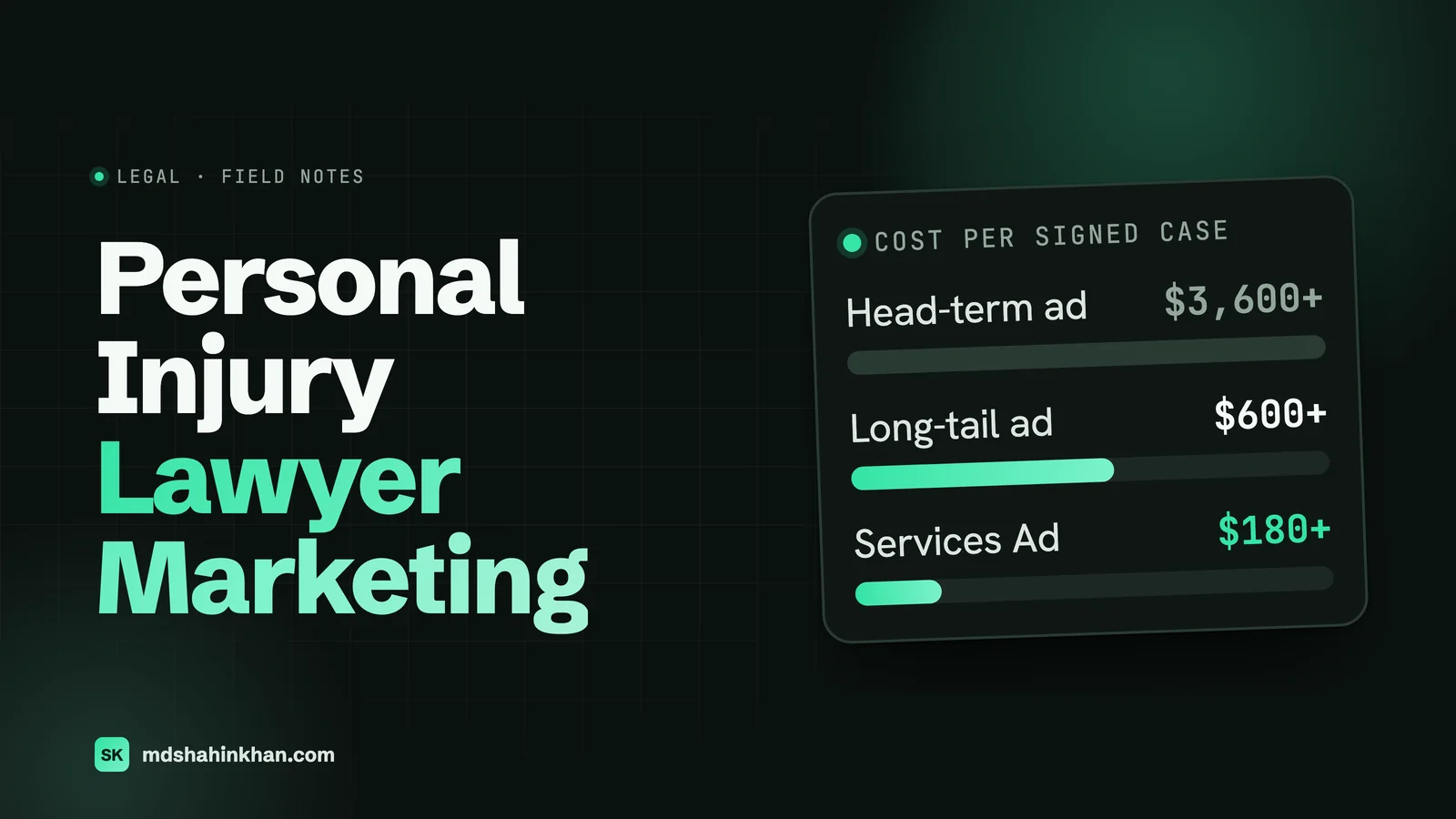
| Cost per signed case at one in three | $3,600 to $10,800 | $600 to $2,700 | $180 to $750 |
| Fit for a small firm | Only with a case value that justifies it and a landing page that converts | Yes, tightly targeted | Yes, first |
Three rules follow from the table:
- Local Services Ads before Search ads. Get Google Screened (background check, licence verification, insurance), fill the profile completely, answer every lead inside minutes, and keep the review count growing; LSA ranking weights responsiveness and reviews heavily.
- Search ads only on terms you can land. A separate landing page per campaign (car accident, not the homepage), the phone number and form above the fold, call tracking, and exact-match or phrase-match keywords with a negative list that grows weekly. Broad match on “lawyer” in a metro is how $10,000 disappears in a fortnight.
- Measure cost per signed case, not cost per lead. A channel that produces cheap leads nobody can reach is worse than a channel with expensive leads that sign. The intake section explains why the same leads convert at wildly different rates between firms.
Budget guidance for a two-to-five-lawyer firm: $2,000 to $5,000 a month on LSAs plus long-tail Search once the website is ready, reviewed every month against signed cases. Below about $1,500 a month the data is too thin to learn from; above $10,000 you need someone managing it daily.
Intake Speed Is the Multiplier
Everything above produces a phone call or a form submission. What happens in the next five minutes decides whether it becomes a case.
The pattern I see on law firm sites is a form that emails one inbox, which someone checks between meetings. The lead came in at 6:40 pm from a person sitting in an urgent care waiting room; by the time the firm calls at 9:30 the next morning, they have signed with the firm whose intake specialist called at 6:43. The firm with the slower callback then concludes that “web leads are low quality”. They are not; they are just gone.
What a fast intake setup looks like:
- Every form notifies three places at once: the intake inbox, a shared text alert, and the case-management system (Clio, Lawmatics, Filevine, or whichever the firm uses), so nothing depends on one person’s inbox.
- A written callback standard: five minutes during office hours, thirty minutes outside them. Someone owns evenings and weekends, in-house or through an answering service that is trained on your intake script and can schedule a consultation rather than only take a message.
- Call tracking numbers per channel (website, LSA, Search ads, GBP) so you know which channel produced each signed case and can recover calls that were missed.
- A four-field form: name, phone, what happened (a short dropdown of case types), and when it happened. Anything longer loses the person on the phone in the waiting room. The confirmation says exactly what happens next and when.
- Text-back on missed calls. A missed call gets an automatic text within a minute (“This is [firm]. Sorry we missed you. Reply here or we will call you back within 15 minutes.”).
- A weekly intake review: leads by channel, time to first contact, consultations booked, cases signed. Ten minutes on a Monday.
On the sites I have measured this on, moving from next-morning callbacks to a five-minute standard changed the signed-case rate more than any change to the site itself. It is the reason I put intake ahead of SEO in the list of where a small firm wins.
What the Website Has to Do
The site is the landing point for every channel above, so it has to do a short list of things well. The full spec is in law firm website design; the personal-injury-specific points are these.
- Phone and “Free case review” in the header on every page, both tap targets, with a bar pinned to the bottom of the screen on phones.
- One page per case type and one per city, structured as above, linked from a menu that a stressed person can use with a thumb.
- A results page and live Google reviews next to every form.
- Speed that passes Core Web Vitals on a phone: main content painted inside 2.5 seconds, taps answered inside 200 milliseconds, nothing shifting as it loads. That means no video backgrounds, images sized for the screen, one font family, and no chat widget loading before the page is interactive. A slow site on a hospital wifi is a lost case.
- Spanish pages if the market has Spanish speakers, written by a person, on their own URLs, with a Spanish-speaking intake path behind them. This is one of the most under-served segments in PI marketing in many US metros.
- Accessibility built in (contrast, labels, keyboard focus, alt text), both because injured people include people with disabilities and because law firms get demand letters over inaccessible sites.
- Tracking that survives privacy settings: server-side or first-party call tracking, form events into GA4, and a monthly report that shows signed cases by channel, not sessions.
A small firm can have all of this on WordPress for the price of a few clicks on the head terms. I built the law firm pages I offer around exactly this list.
The 90-Day Plan
For a two-to-five-lawyer firm with one person part-time on marketing and a budget of $3,000 to $6,000 a month all in.
| Weeks | Do | Spend |
|---|---|---|
| 1 to 2 | Fix intake first: three-way form notifications, text-back on missed calls, the five-minute standard, call tracking numbers, the weekly review sheet. Claim and complete the Google Business Profile; start the review routine. Apply for Local Services Ads (the screening takes two to four weeks). | Mostly time; call tracking $50 to $150 |
| 3 to 4 | Audit the site against the list above; fix speed and the header; write the results page; rewrite the two most important case-type pages to the six-part structure. | Developer time $1,000 to $3,000 if the site needs work |
| 5 to 8 | Publish four long-tail case-type pages and two city pages; switch LSAs on with a daily cap; ask every settled client for a review. | LSAs $1,500 to $3,000 a month |
| 9 to 12 | Four more case-type pages, two more city pages; start one long-tail Search campaign with its own landing page; first monthly review of cost per signed case by channel; decide what to scale. | Search ads $1,000 to $2,000 a month |
By the end of the quarter the firm has ten to twelve pages that can rank, a review count that is climbing, a lead channel it controls (LSAs), a small paid test with real numbers, and an intake process that turns leads into consultations the same day. The next quarter is more of the same with the numbers to guide it, and that is what the big firms cannot copy cheaply: a small firm’s pages are written by the lawyer who takes the cases, and its callback is a person, not a queue.
Frequently Asked Questions
How Much Do Personal Injury Lawyers Spend on Advertising?
Collectively, a great deal. The American Tort Reform Association estimates about $4 billion was spent on legal services advertising in the United States in 2025, across more than 30 million ads, with television the largest share and personal injury and mass tort firms the biggest spenders. For an individual small firm, a workable range is $2,000 to $6,000 a month once the website and intake are in order, spent on Local Services Ads and tightly targeted search ads and reviewed monthly against signed cases. The large television firms spend hundreds of thousands a month; competing with them on the same terms is not a strategy for a small firm.
How to Market a Personal Injury Law Firm?
Fix intake first, so every lead gets a callback within minutes. Then build one page per case type and one per city you serve, each written for the person who was just hurt, with your state’s rules, your results, and answers to the questions people ask. Grow Google reviews steadily, run Local Services Ads with a daily cap, and add search ads only on long-tail terms with their own landing pages. Measure cost per signed case by channel every month and move money towards what signs.
Is Doing Local SEO Worth It for Personal Injury Attorneys?
Yes, and for a small firm it is the part of SEO most likely to pay. The map results appear for almost every “lawyer near me” and “[case type] lawyer [city]” search, they favour proximity, review velocity, and a complete profile over domain authority, and they are where a firm with one office and 150 fresh reviews can sit above a television firm. The work is a complete Google Business Profile, a review routine, city pages that are genuinely about each place, and consistent name, address and phone details across directories.
What Is the Typical Cost of SEO for a Law Firm?
Agency retainers for legal SEO commonly run $2,000 to $10,000 a month, with personal injury at the top of that range in large metros. A small firm can do the highest-return parts for less: a developer to fix the site’s speed and structure ($1,000 to $5,000 once), a writer or the attorney producing two to four case-type or city pages a month ($500 to $2,000), and the firm’s own time on reviews and the Google Business Profile. What you should not pay for is “link building packages”, monthly “SEO reports” with no page-level plan, or content written by someone who has never read your state’s negligence rules.
What Is the 80/20 Rule for Lawyers?
Roughly 80 percent of a firm’s revenue comes from about 20 percent of its clients, referral sources, or case types, and 80 percent of results come from 20 percent of the effort. For personal injury marketing the useful version is: find the two or three channels and case types that produce most of your signed cases, and put most of next quarter’s budget and pages there. Tracking cost per signed case by channel is how you find the 20 percent.
What Not to Say to a Personal Injury Lawyer?
Nothing; a lawyer needs the full, honest story, including the parts that seem to hurt the case, because the insurer will find them anyway. What a client should avoid is giving a recorded statement to the other side’s insurer, posting about the accident or their recovery on social media, or accepting an early settlement offer before talking to a lawyer. For a firm’s website this question is a gift: a short page answering it, in plain words, ranks and reassures the person searching at exactly the moment they are deciding whom to call.
How Much of a $25,000 Settlement Will I Get?
It depends on the fee agreement and the costs, so the honest answer on a firm’s website is a worked example rather than a number. Personal injury fees are usually contingent, commonly 33 to 40 percent of the recovery; case costs (filing fees, records, experts) and any medical liens are then paid from the remainder. On a $25,000 settlement with a 33 percent fee, $1,500 in costs, and $4,000 in medical liens, the client would receive about $11,000. Firms that explain this arithmetic openly on the case-type pages get more signed clients, not fewer, because the person searching this question is deciding whether a lawyer is worth it.
If you want your firm’s site and intake checked against this plan, book a free 30-minute call. You leave with a written three-step plan, whether or not we work together. Related: SEO for lawyers, the one-page law firm marketing plan, law firm website design, what I build for law firms.