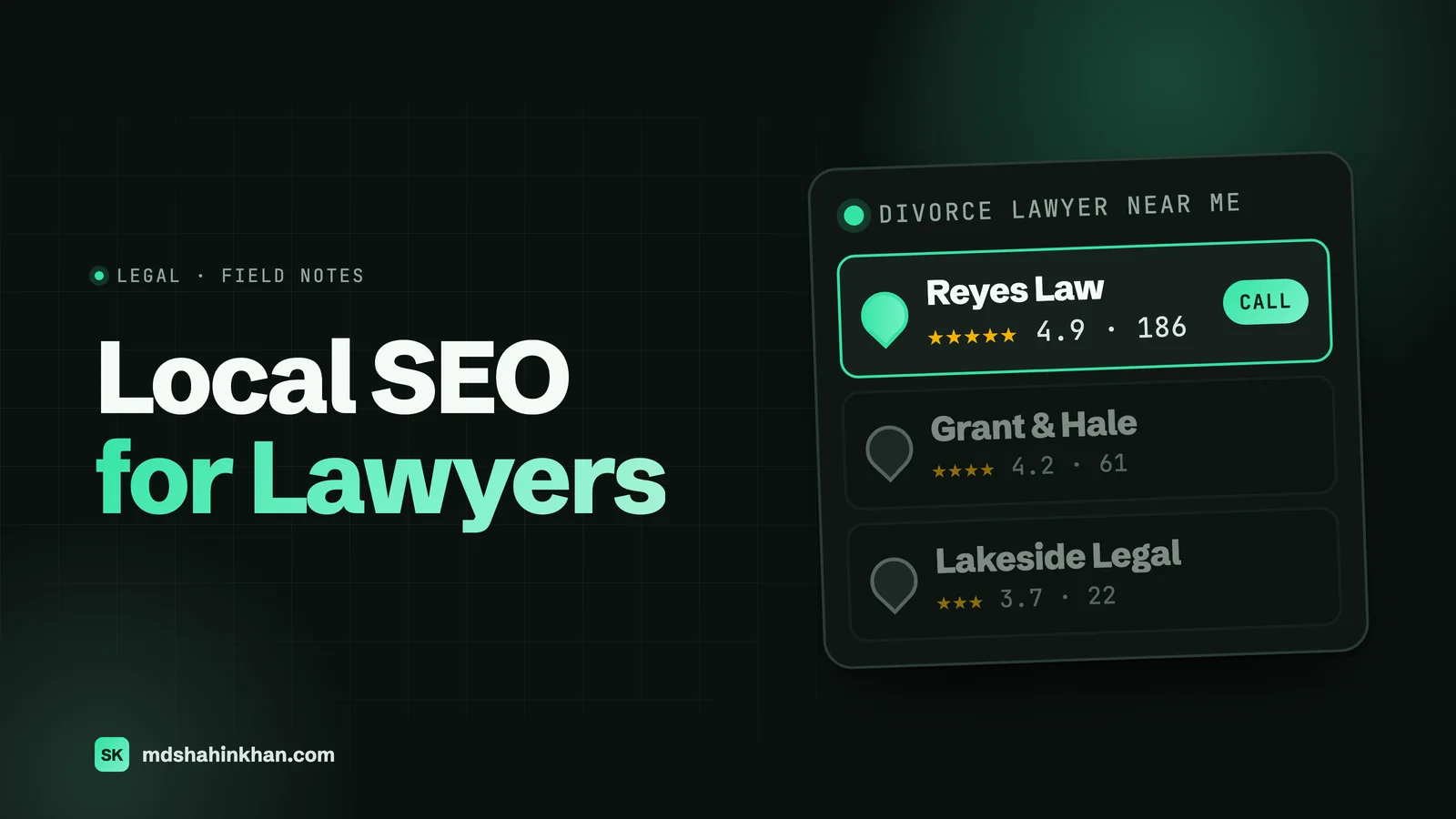
Local SEO for lawyers is the work of getting your firm into the three-business map that Google shows when someone searches for a lawyer near them. Google picks those three firms on relevance (does your profile match the practice area searched), distance (how close you are to the searcher) and prominence (how well known you are, mostly reviews and links). A small firm wins it with a correctly set up Google Business Profile, a steady stream of genuine reviews, consistent listings on legal directories, and a website with a clear page for each practice area.
My main guide to SEO for lawyers covers the whole picture: site structure, practice-area pages, attorney bios, content and technical work. This article goes deep on the local part, the map pack, because for most small firms that is where the calls come from. It covers the rules Google applies to law firm profiles that most guides skip, what Google and the bar allow on reviews, what to do with more than one office, and how to measure what the map actually brings in.
Why the Map Pack Matters Most for a Law Firm
People looking for a lawyer search with their location built in, either by typing “near me” or by searching from their phone where Google already knows where they are. For those searches the map pack sits above the regular results, and on a phone it can fill the whole first screen.
Here is how many people search each month in the US with “near me” in the query, from Ahrefs data I pulled for this article:
| Search | US searches a month |
|---|---|
| personal injury lawyer near me | 78,000 |
| car accident lawyer near me | 49,000 |
| divorce lawyer near me | 26,000 |
| lawyer near me | 22,000 |
| estate planning attorney near me | 18,000 |
| bankruptcy attorney near me | 17,000 |
| criminal defense attorney near me | 16,000 |
| immigration lawyer near me | 16,000 |
| real estate attorney near me | 16,000 |
| family lawyer near me | 12,000 |
| dui lawyer near me | 9,500 |
| employment lawyer near me | 4,100 |
| workers comp lawyer near me | 3,300 |
| probate lawyer near me | 3,200 |
| custody lawyer near me | 1,900 |
And those are only the searches with “near me” typed out. Every “divorce lawyer” searched on a phone in Tampa is treated as local too. For practice areas where clients hire someone close by, which is most of them, the map pack is the first thing they see.
How Google Picks the Three Firms
Google says it ranks local results on three things:
- Relevance: how well your profile matches the search. This is mostly your categories, services and the words on your website.
- Distance: how far your office is from the person searching, or from the place they named.
- Prominence: how well known you are. Reviews (how many, how recent, how good), links to your website and mentions across the web all feed it.
Distance is the one owners underestimate. You cannot rank in the map pack across a whole metro from one office; the map strongly favours firms near the searcher. That is why a firm can be first on the map from its own office and invisible from a neighbourhood fifteen minutes away. You improve what you can control (relevance and prominence) so your radius grows, and you use your website’s pages to reach the areas the map will not.
It is also why checking your ranking by searching from your own desk is misleading. You are standing next to your office.
What Google Allows on a Law Firm Profile
Google has specific rules about who can have a profile and what it can say. Breaking them is the most common reason I see a firm’s profile suspended, and a suspension takes the firm off the map entirely until it is sorted out.
The address must be a real, staffed office. Google’s guidelines say a virtual office, a rented mailing address you do not work from, is not eligible. A co-working space only qualifies if the office has clear signage, receives clients during business hours and is staffed by your firm during those hours. A P.O. box never qualifies.
The name is your real name. Google’s rules say the profile name must match the name you use on your signage, website and letterhead, with no taglines, phone numbers, web addresses or locations added. “Smith Law” is fine. “Smith Law, Best Car Accident Lawyer Tampa” is exactly what gets profiles suspended, even though you will see competitors doing it.
Individual attorneys can have their own profiles. Google allows a separate profile for an individual practitioner who deals with the public and can be contacted at the office during stated hours. For a solo practitioner whose practice carries a brand name, Google asks for a single profile named in the format “Brand: Practitioner name”. For a firm with several attorneys, each public-facing attorney may have a profile as well as the firm.
Whether that is a good idea is a judgement call. Attorney profiles can collect their own reviews and show up for searches on the attorney’s name, but they also compete with the firm’s profile for the same searches and split your reviews. For most small firms I would put the effort into one strong firm profile and let attorney bios on the website carry the individual names.
Home-based practices that meet clients elsewhere can be set up as a service-area business with the address hidden. Be aware that a profile without a visible address rarely ranks as well in the map for searches near you.
Categories and Services
The primary category is the single strongest relevance signal on the profile. Choose the most specific one that describes most of your work. Google’s legal categories include, for example, Personal injury attorney, Family law attorney, Divorce lawyer, Criminal justice attorney, DUI attorney, Estate planning attorney, Bankruptcy attorney, Immigration attorney, Employment attorney and Real estate attorney, alongside the general Attorney, Lawyer and Law firm. Start typing in the category field to see the exact names available.
- Primary category: the practice area that brings most of your fees. A firm that is 80% personal injury should not use “Law firm” as its primary.
- Secondary categories: your other genuine practice areas. Do not add categories for work you do not do; it dilutes relevance and invites edits.
- Services: add each practice area and the main matter types within it (car accidents, truck accidents, slip and fall) with a short, plain description. Google reads these.
- Attributes: free consultation, languages spoken, online appointments, wheelchair access. Fill in whatever is true.
- Website link: point it at the page that matches the primary category if the profile is for a single-practice firm, otherwise the homepage. Add tracking parameters so you can see these visits separately in analytics (more on that below).
Reviews: What Google and the Bar Allow
Reviews are the biggest prominence signal you control and the thing prospective clients read before they call. They are also where law firms get into trouble, because two sets of rules apply.
Google’s rules ban offering anything in exchange for a review, discouraging negative reviews, and asking only the clients you expect to be happy (sending satisfied clients to Google and unhappy ones to a private form is known as review gating, and Google prohibits it). Google also says staff should not be given review quotas. What Google does allow is simply asking clients for an honest review.
The bar’s rules add another layer. ABA Model Rule 7.2(b) says a lawyer should not give anything of value to a person for recommending the lawyer’s services, with narrow exceptions such as nominal thank-you gifts that are not meant as payment. Your state has its own version of the rule, and some states have issued opinions about client reviews and testimonials, so check yours before you set up the routine. Never write a review for a client or edit what they send.
The routine that works, and that fits both sets of rules:
- Ask every client at the same moment, usually when the matter closes well, whether or not you expect a glowing review.
- Send one short text or email with the direct link to your review form (you get it from your Business Profile under “Ask for reviews”).
- Give one person the job, usually the office manager, and check the numbers monthly.
- Reply to every review, good or bad, briefly and without confirming any detail of the representation. Client confidentiality applies to review replies too; “thank you for your feedback, please call the office so we can talk” is enough for a negative one.
Steady beats bursts. A firm that gets two genuine reviews a week for a year looks very different to Google, and to clients, than one that got fifty in a month and then stopped.
Directories and Citations That Matter for Lawyers
A citation is any listing of your firm’s name, address and phone number on another site. For lawyers a handful matter far more than the hundreds of generic directories some packages sell:
- Your state bar’s directory, which also proves you are licensed.
- Avvo, Justia, FindLaw and Martindale-Hubbell, the main legal directories. Avvo alone is searched about 9,100 times a month in the US, so clients use it directly.
- Apple Business Connect and Bing Places, so the firm shows correctly on iPhones’ Maps app and in Bing.
- Yelp and the local chamber of commerce.
The rule is consistency: the same firm name, address and phone number, written the same way, everywhere. Keep a spreadsheet of every listing with its login, and update all of them in one afternoon whenever you move or change numbers. A firm that moved offices and left its old address on Avvo and FindLaw sends Google mixed signals for years.
The Website’s Part
The map pack is driven by the profile, but your website feeds its relevance and prominence, and it does the job the map cannot: ranking for areas beyond your radius.
- One page per practice area, with the city in the heading and first paragraph, written for how clients actually search. My guide to law firm website design shows what goes on each page.
- Location pages only where you have a real reason: an office there, a courthouse you appear in, clients you serve there. Each needs its own content (the court, the local process, directions, results from that area where your bar rules allow). Twenty copies of the same page with the city name swapped help no one.
- Your address, phone and hours in the footer as text, matching the profile exactly.
- LegalService or Attorney schema on the homepage and contact page, with the address, phone, hours and the areas you serve.
- A contact page with an embedded map and parking or entrance directions.
If you are on a builder like Wix or Squarespace and cannot build the practice-area structure cleanly, my comparison of Wix, WordPress and Squarespace covers when it is time to move.
More Than One Office
Each office that is staffed during business hours and receives clients can have its own Business Profile. Each one then needs:
- its own phone number (a local number for that office, not the head office line),
- its own page on the website, linked from that profile, with that office’s address, hours, attorneys and directions,
- its own reviews, asked for by the staff at that office.
A “satellite office” that is really a meeting room you use twice a month does not meet Google’s rules, and it is a common reason for suspensions. If you meet clients somewhere occasionally, say so on the website and leave it off Google Maps.
Local Services Ads: The Paid Shortcut
Google’s Local Services Ads for lawyers appear above the map pack with a “Google Screened” badge. You pay per lead (a call or message) rather than per click, and Google checks your license and runs a background check before you can advertise. They are often the fastest way for a new or newly moved firm to appear above the map while the profile builds reviews.
Two things to know: your reviews and responsiveness affect how often the ads show, and lead quality varies by practice area and market, so track which leads become clients before you raise the budget. My article on personal injury lawyer marketing goes through how the paid options compare for a PI firm.
Measuring What the Map Pack Brings In
If you cannot see what the map brings in, you cannot tell whether the work is paying off. Four things to set up once:
- The Performance view in your Business Profile shows calls, website clicks, direction requests and the searches that found you, month by month.
- Tracking parameters on the profile’s website link (for example
?utm_source=google&utm_medium=organic&utm_campaign=gbp) separate profile visits from other Google traffic in your analytics. - Call tracking, if you use it, with the tracking number as the profile’s primary phone and your main office number as the additional phone, so the listing stays consistent with your directories.
- A grid rank check once a month. Rank-tracking tools that check your map position from a grid of points around your office show your real radius, which one search from your desk never will.
Then ask the question that matters: how many signed clients came from Google this month? Intake should ask every new client how they found you.
What Local SEO Costs a Law Firm
A 2026 local SEO pricing guide from SEO.com puts agency retainers at $501 to $3,000 a month, with most small businesses around $1,000, and one-off projects at $500 to $5,000. Full law firm SEO retainers, covering content and links as well as local work, commonly run $2,000 to $5,000 a month, and more in competitive personal injury markets (the sources are in my SEO for lawyers guide).
For a small firm, most local SEO is setup plus a routine:
| Part | Who | Time or cost |
|---|---|---|
| Profile setup, categories, services, photos | You or your developer | A one-off few hours |
| Directory clean-up and consistency | You, your developer or a one-off project | A one-off day, then an hour a year |
| Practice-area and location pages on the site | Your developer | Part of the website build |
| Review routine and replies | Office manager | About an hour a week |
| Monthly check of calls, clicks and grid rankings | You or your developer | An hour a month |
What a retainer buys, in a competitive city, is link building and content volume on top of that. I would get the setup and the review routine right first, measure for three months, and then decide whether the numbers justify one. My law firm marketing plan shows where local SEO sits next to referrals and paid ads.
A 30-Day Local SEO Plan for a Small Firm
Week 1: the profile
- Claim and verify the Business Profile at your staffed office address.
- Fix the name to match your signage, with nothing added.
- Set the most specific primary category and your genuine secondary categories.
- Add every practice area as a service with a plain description.
- Add hours, attributes, the website link with tracking parameters, and 10 to 20 real photos.
Week 2: consistency
- List every directory where the firm appears and correct the name, address and phone.
- Claim and complete your state bar, Avvo, Justia, FindLaw and Martindale-Hubbell profiles.
- Set up Apple Business Connect and Bing Places.
Week 3: the website
- Check each practice-area page names the city and matches how clients search.
- Put the address, phone and hours in the footer, exactly as on the profile.
- Add LegalService schema and an embedded map on the contact page.
Week 4: reviews and measurement
- Check your state bar’s rules, then start the review routine with one owner.
- Reply to every existing review.
- Record this month’s calls, website clicks and direction requests as your starting point.
- Run a grid rank check to see your real radius.
If your firm is missing from Google altogether, not just from the map, start with why a website does not show up on Google instead. And for how the same approach works outside legal, my local SEO guide for small businesses is the general version.
Frequently Asked Questions
How Much Does a Local SEO Cost?
A 2026 pricing guide from SEO.com puts local SEO retainers from agencies at $501 to $3,000 a month, with most small businesses around $1,000, and one-off projects at $500 to $5,000. For a law firm, much of the work is a one-time setup plus an in-house review routine, so a small firm can spend far less than a retainer by paying for the setup and running the routine itself.
What Is the Typical Cost of SEO for a Law Firm?
Published 2026 guides put most law firms between $2,000 and $5,000 a month for full SEO with an agency, solo and small firms at $1,500 to $4,000, and competitive personal injury markets at $5,000 and up. Local SEO on its own costs less, because the profile, directories and review routine are mostly setup and in-house time.
What Is the 80/20 Rule for Lawyers?
In local search, the 20% of the work that brings 80% of the results is a correctly categorised Business Profile, a steady flow of genuine reviews and a clear website page for each practice area. Most of what gets sold on top (hundreds of directory listings, weekly posts, generic blog content) moves the needle far less than those three.
Can a Law Firm Use a Virtual Office for Its Google Business Profile?
No. Google’s guidelines say a virtual office or a mailing address you do not work from is not eligible. A co-working space only qualifies if the office has clear signage, receives clients during business hours and is staffed by your firm during those hours. Profiles at ineligible addresses are a common reason law firm listings are suspended.
Should Each Attorney Have Their Own Google Business Profile?
Google allows it for attorneys who deal with the public and can be reached at the office during stated hours. For most small firms I would focus on one strong firm profile, because attorney profiles compete with it for the same searches and split the reviews. A solo practitioner with a brand name should use a single profile named “Brand: Attorney name”.
How Long Does Local SEO Take for a Law Firm?
Profile fixes such as categories, services and name corrections can change your map visibility within weeks. Building the reviews and prominence to hold a top-three spot in a competitive city takes months of steady work, and the distance factor means no firm ranks everywhere. Measure monthly from the start so you can see the trend.
If you want your firm’s map pack presence reviewed, book a free 30-minute call and I will look at your profile and website with you and tell you what I would fix first, whether or not we work together. You can also see how I build websites for law firms.