Dental implant marketing works when it answers the questions implant patients research for weeks before they call: what it costs, whether they are a candidate, how long it takes, and who they can trust. That means one page per treatment with real prices and financing, strong reviews and local visibility, focused Google Ads, and fast follow-up on every enquiry.
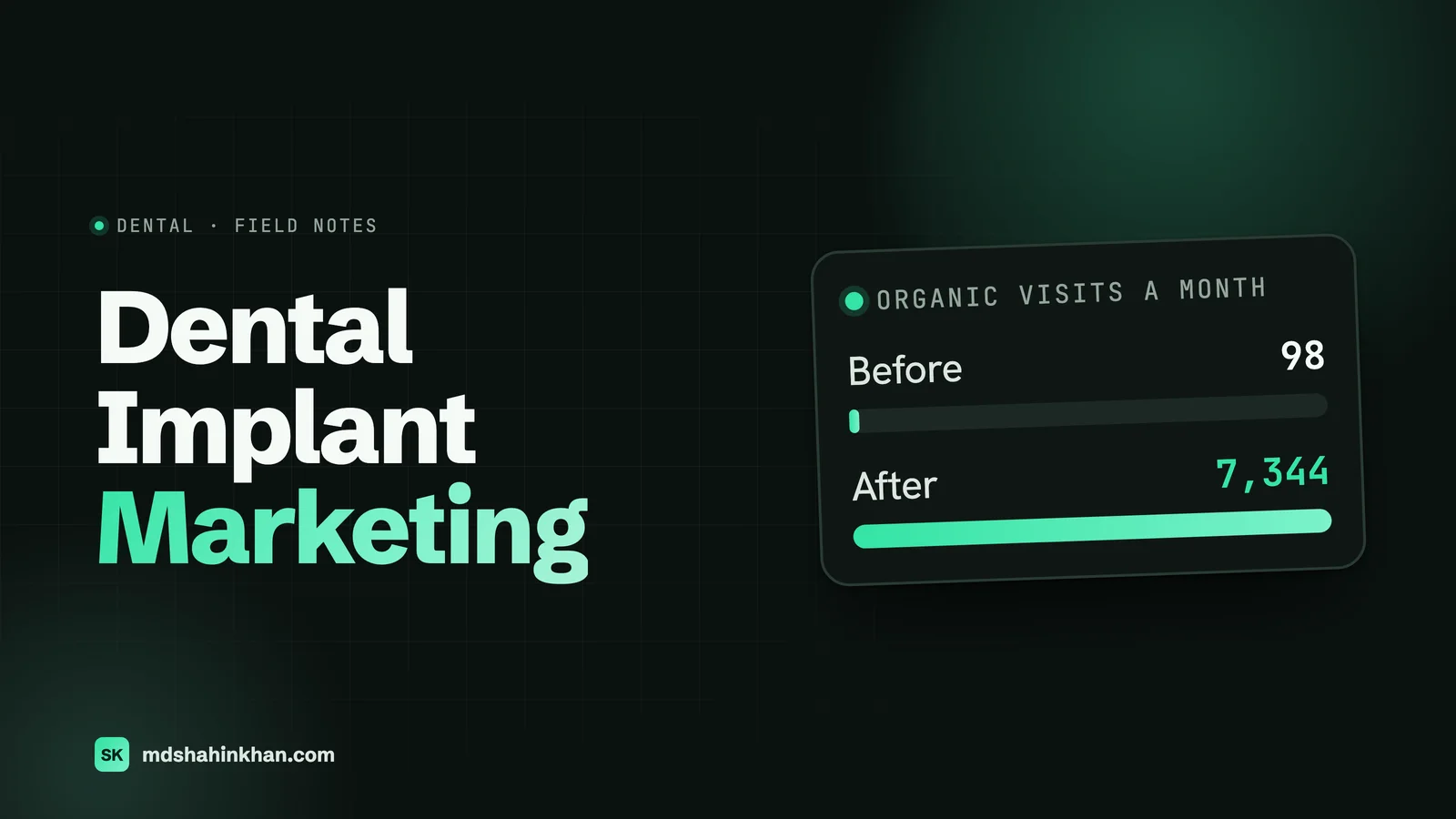
I build websites for dental practices, and the project I can show in the most detail is an implant practice: over about two years its organic visits went from 98 a month to 7,344, roughly 75 times more, by Ahrefs’ estimate. I cover the foundations every practice needs in my guides to dental SEO and dental marketing strategies. Implants are different: high fees, long decisions and fierce local competition, so this guide covers what implant patients search for, what worked on that practice, and the pages, ads, reviews and follow-up that turn research into booked consultations.
What Implant Patients Search For
Before an implant patient calls, they search. A lot. These are US monthly search volumes from Ahrefs for the way patients phrase it:
| What patients type into Google | Searches a month (US) |
|---|---|
| dental implants near me | 82,000 |
| full mouth dental implants | 74,000 |
| all on 4 dental implants | 45,000 |
| dental implants cost | 41,000 |
| how much are dental implants | 26,000 |
| snap in dentures | 6,100 |
| teeth in a day | 3,800 |
| single tooth implant cost | 3,500 |
| same day dental implants | 3,400 |
| affordable dental implants near me | 2,900 |
| all on 4 dental implants cost | 2,700 |
| implant supported dentures | 2,600 |
| implant dentist near me | 2,500 |
| how long do dental implants last | 2,300 |
| dental implants vs dentures | 1,700 |
| dental implants for seniors | 1,600 |
Source: Ahrefs Keywords Explorer, US, October 2026.
Three things stand out. Price is everywhere: “cost”, “how much” and “affordable” together make up well over 70,000 searches a month. Full-arch treatment (full mouth, All-on-4, teeth in a day, snap-in dentures) is searched far more than single implants. And the audience is large: the American College of Prosthodontists puts the number of Americans missing at least one tooth at 120 million, with more than 36 million missing all their teeth.
Why Implant Marketing Is Different
General dental marketing fills hygiene appointments. Implant marketing sells a treatment that costs thousands, sometimes tens of thousands, to a patient who is often nervous, often older, and usually comparing several practices. That changes the job:
- The decision takes weeks. Patients read, compare and come back several times before they call. Your site has to help on the first visit as much as the last.
- Price is the first question. A page that says “call for pricing” sends the researcher to the practice that publishes a range.
- Trust carries the decision. Reviews that mention implants, real before-and-after photos, the dentist’s training, and a clear explanation of the procedure do more than any slogan.
- Every enquiry is valuable. One full-arch case can be worth more than a year of hygiene visits for a family, so a missed call or a slow reply costs real money.
What Worked on a Real Implant Practice
This is the practice from my dental implant case study, an established implant practice in a large US metro (I do not name clients). When we started, the website had a handful of pages, one generic services page, no pages for the surrounding communities, and templates heavy enough to fail Core Web Vitals on mobile. Organic search brought a few dozen visits a month; paid ads carried almost all new enquiries, which is an expensive way to run an implant practice.
What I built, through a US agency partner:
- One page per treatment, more than twenty in all. Single and multiple implants, full-arch restorations, extractions, and the cosmetic and restorative work around them. Each page follows the same template: who it is for, what it costs, how the procedure works, recovery, and a FAQ written from the questions the front desk actually hears.
- A Cost and Financing hub above the treatment pages, because price is the first thing most implant patients search for.
- Ten location pages for the communities patients travel from, each with directions, travel time, the treatments most requested from that area and local reviews, not copies with a town name swapped.
- Structured data in the templates (Dentist, LocalBusiness, Service and FAQ), so every new treatment page gets it automatically.
- Speed. Correctly sized WebP images, unused scripts removed, a CDN with full-page caching. Mobile passed all three Core Web Vitals after the rebuild.
- An implant eligibility quiz as the main call to action, with a consultation offer beside it, click-to-call on mobile, and GA4 events for calls, forms and quiz completions.
The result, by Ahrefs’ estimate of US organic traffic between January 2023 and March 2025: from under 100 visits a month to 7,344, roughly a 75 times increase, with the equivalent paid-search value of that traffic reaching about $11,500 a month and more than thirty treatment and location pages ranking. Organic search became the practice’s main channel, and the office manager has added pages since without a developer.
None of that was clever. It was structure: a page for every question, prices on the page, and a site fast enough that patients stay.
One Page per Treatment
Google matches a search to a page. If “all on 4 dental implants” lands on a general implants page, a competitor with an All-on-4 page will usually outrank you, and the patient will not find their answer. These are the treatment pages most implant practices need:
| Page | What patients search | What the page must answer |
|---|---|---|
| Single tooth implant | single tooth implant cost, dental implants near me | Candidacy, steps, timeline, price range, implant vs bridge |
| Full arch / All-on-4 | all on 4 dental implants, full mouth dental implants, teeth in a day | Who it suits, one-day vs staged, price per arch, financing |
| Implant dentures | snap in dentures, implant supported dentures | Removable vs fixed, comfort, cost compared with dentures |
| Same-day implants | same day dental implants | Who qualifies, what “same day” really includes |
| Bone grafting and sinus lift | (often found from the implant pages) | When it is needed, added time and cost |
| Implants vs dentures | dental implants vs dentures | An honest comparison table, cost over 10 years |
| Cost and financing | dental implants cost, how much are dental implants | Ranges by treatment, what changes the price, financing |
Each page follows one structure: a short answer at the top, who it is for, what happens step by step, recovery, the price range and financing, real before-and-after photos with consent, reviews that mention the treatment, the dentist’s training, a FAQ, and a clear next step. The page layout itself is covered in my dental website design guide.
Publish Prices and Financing
Patients are going to compare prices whether you publish them or not. NewMouth’s 2026 cost guide, built from Delta Dental, Aspen Dental and CareCredit data, puts a single implant with crown at $3,000 to $5,600, All-on-4 at $11,600 to $27,500 per arch, and a full mouth at $38,600 to $90,000, with extractions, grafting and sedation often billed separately. Your own ranges, stated honestly, do three things: they filter out people who were never going to proceed, they reassure the ones who can, and they rank for the 70,000 a month of cost searches.
A good cost page shows:
- A range per treatment, and what moves a case from the bottom to the top of it.
- What is included: consultation, scan, implant, abutment, crown or arch, follow-up visits.
- Financing, with your financing partner’s name and how to apply.
- Insurance: what is usually covered and what is not.
One caution on financing. If an ad or page states a monthly payment, federal lending rules (Regulation Z) can require further terms, such as the APR and repayment period, to be shown just as prominently. Use the wording your financing partner approves rather than writing “from $199 a month” yourself.
Google Business Profile and Reviews
“Near me” searches show a map pack of three practices above the regular results, so your Google Business Profile matters as much as your website:
- Add implant services to the profile, each with a short description, and choose the most accurate primary category.
- Post real photos of the dentist, the team, the surgical room and the scanner.
- Ask every implant patient for a review once the result is in, and make it easy with a direct link. Reviews that mention the treatment (“my All-on-4”, “my implant”) help both rankings and the next patient’s decision.
- Reply to every review without confirming anyone is a patient. In 2019 a Dallas dental practice paid $10,000 to settle with the HHS Office for Civil Rights over review replies that disclosed patient details. Thank the reviewer and invite them to call.
The local SEO for dentists guide covers the profile in full.
Location Pages for Where Patients Travel From
Implant patients will travel further than hygiene patients for the right practice; on the case-study practice they came from across the metro and beyond. They search with their own town’s name, not yours. A page for each nearby community, with directions, travel time, the treatments people from there ask about and reviews from patients in that area, lets you appear for those searches. On the case-study practice, ten location pages were part of the first phase. Thin pages with a town name swapped do the opposite: they look like spam to Google and to patients.
Google Ads for Implants
Ads are the fastest way to appear while your pages are still climbing. The click costs vary more than most practices expect. Ahrefs’ average US cost-per-click estimates for patient searches:
| Search | Avg. cost per click (US) |
|---|---|
| implant dentist near me | $7.00 |
| teeth in a day | $7.00 |
| dental implants financing | $6.00 |
| all on 4 dental implants | $4.00 |
| implant supported dentures | $3.00 |
| same day dental implants | $2.50 |
| full mouth dental implants | $1.10 |
| dental implants near me | $1.00 |
Source: Ahrefs, US, October 2026. These are averages; in large metros competitive implant terms can cost much more.
What makes implant ads work:
- Separate campaigns by treatment (full arch, single implant, dentures), each sending clicks to its own treatment page, never the home page.
- Negative keywords from day one: free, cheap DIY, dental school, jobs, courses, and anything for implants you do not offer.
- Track calls and consultation requests, not clicks, and judge each campaign by cost per consultation and cases started.
- Answer the phone. Ads bring calls at times the front desk is busy; an unanswered call from an implant ad is the most expensive call you never got.
Photos, Testimonials and Video Within the Rules
Implant marketing leans on proof, and proof comes with rules:
- Written authorization first. Under HIPAA, using a patient’s photos, name or story in marketing needs their written authorization. Keep the signed form on file.
- Real photos only. Your own cases, unretouched, with the same lighting before and after. Stock “after” smiles damage trust when patients notice, and some state dental boards restrict misleading images.
- No fake or bought reviews. The FTC’s rule on consumer reviews and testimonials, in force since October 2024, bans fake reviews, reviews bought on condition that they are positive, and undisclosed reviews from staff.
- Video works. A two-minute video of the dentist explaining the procedure, and a consented patient story, answer the fear question better than any text. Caption it.
My guide to HIPAA and your dental website covers forms and data on the site itself.
From Enquiry to Consultation
Marketing creates the enquiry; the practice turns it into a consultation. This is where a lot of implant marketing money is quietly lost:
- Reply fast. Call back web enquiries within minutes during opening hours. The patient has usually contacted more than one practice.
- Offer a clear first step. A consultation with a 3D scan, a stated price (or free), and what the patient will leave with: a treatment plan and a written cost.
- Use a short eligibility quiz as a softer first step for people who are not ready to call. It was the main call to action on the case-study practice.
- Follow up the undecided. An implant consultation that did not book a treatment is not a lost lead. A call a week later, then a helpful email, then a check-in a month on.
Measuring What Works
Track each channel by consultations and cases started, not clicks:
- Ask every new patient how they found you and record it in the practice software.
- Track calls and forms by source: call tracking numbers on ads, tagged links on your Google Business Profile, GA4 events for forms, calls and the quiz.
- Calculate cost per consultation and cost per case started for each paid channel.
- Compare with the value of a case. A channel that costs a fraction of one case per case started is worth keeping.
What to Spend
There is no official number. Dental marketing advisers commonly quote 3 to 5 percent of collections for an established practice and 6 to 10 percent for a new or fast-growing one, and implant practices in competitive cities can sit at the top of that range because implant ad clicks cost more. Spend on the website and pages first: they keep working after the budget stops, which is exactly what happened on the case-study practice.
A 90-Day Plan
Days 1 to 30: foundations
- Publish a Cost and Financing page with real ranges and your financing partner
- Build or rewrite the single implant and full-arch pages using the template above
- Add implant services, photos and a review link to your Google Business Profile
- Set up call tracking and GA4 events for calls, forms and consultation requests
Days 31 to 60: reach
- Add implant dentures, same-day and implants vs dentures pages
- Start one Google Ads campaign for full-arch treatment, sending clicks to the full-arch page
- Ask every implant patient from the last year for a review
- Record a short video of the dentist explaining the procedure
Days 61 to 90: depth
- Add location pages for the three communities most patients travel from
- Add consented before-and-after cases to the treatment pages
- Set up a follow-up sequence for consultations that did not book
- Review cost per consultation by channel and move budget to what works
Frequently Asked Questions
Are Dental Implants Becoming Less Popular?
No. US searches for “dental implants” averaged about 254,000 a month between October 2025 and September 2026, against about 151,000 a month four years earlier, roughly 1.7 times more, according to Ahrefs. Searches for full-arch options such as All-on-4 and full mouth implants are also large, which suggests demand is growing rather than falling.
How Much Does Dental Marketing Cost?
Dental marketing advisers commonly quote 3 to 5 percent of collections for an established practice and 6 to 10 percent for a new practice or a competitive market. Implant marketing sits at the higher end because implant ad clicks cost more. Website and treatment pages are a one-off investment that keeps working; ads stop the day the budget does.
How Do I Get More Dental Implant Patients?
Publish a page for each implant treatment with real prices and financing, strengthen your Google Business Profile with implant services and reviews, add pages for the communities patients travel from, run focused Google Ads to those pages, and reply fast to every enquiry with a clear consultation offer and follow-up.
Should I Publish Dental Implant Prices on My Website?
Yes, as ranges. Patients search for implant costs tens of thousands of times a month, and a page with honest ranges, what is included and financing options both ranks for those searches and filters out people who were never going to proceed. Explain what moves a case up or down the range.
Do Google Ads Work for Dental Implants?
Yes, when each campaign targets one treatment, sends clicks to a matching treatment page, excludes irrelevant searches, and is judged by consultations and cases started rather than clicks. Ahrefs puts average US clicks for terms like “implant dentist near me” around $7, and more in big cities.
How Long Does Implant SEO Take?
On the case-study practice, the growth built over about two years, with steady gains along the way rather than a sudden jump. New treatment pages on an established site can start ranking within a few months; a new practice in a competitive city should plan on ads for the first year while the pages build.
If you run an implant practice, my page on websites for dental practices shows how I build for dentists, and my local SEO guide covers how the site and the map pack work together.
If you want to know which implant pages your site is missing, book a free 30-minute call and I will go through it with you, whether or not we work together.