Family law marketing works when a firm shows up for local searches like “divorce lawyer near me”, has one clear page for each situation (divorce, uncontested divorce, custody, support, mediation), explains fees honestly, protects people’s privacy and safety, answers fast, and earns referrals from therapists, mediators and financial planners. Then it measures cost per signed client.
I build websites for law firms, and family law is unlike any other practice area I look at. People arrive scared, often searching in private, and sometimes in danger. The other spouse may contact the same firm. Most marketing guides treat it like any other legal niche. This one covers the parts that are specific to family law. For the foundations every firm needs, start with my guides to SEO for lawyers and local SEO for lawyers.
What People Search For When a Marriage Ends
The CDC counted 662,950 divorces and annulments in 2024, and that leaves out five states that don’t report, including California. Behind those numbers are searches like these (US monthly volumes from Ahrefs):
| What people type into Google | Searches a month (US) |
|---|---|
| divorce lawyer near me | 27,000 |
| divorce attorney near me | 23,000 |
| family law attorney near me | 14,000 |
| family lawyer near me | 13,000 |
| uncontested divorce | 11,000 |
| custody lawyer | 6,600 |
| how to file for divorce | 5,900 |
| child custody lawyer near me | 5,500 |
| how much does a divorce cost | 4,500 |
| divorce mediation | 4,200 |
| child support lawyer near me | 2,000 |
| divorce lawyer free consultation | 500 |
Two things stand out. Most of the demand is local and urgent, so the map pack and your Google Business Profile matter more than blog traffic. And people search by situation: uncontested divorce, custody, mediation. A single “Family Law” page can’t answer all of those.
Who Ranks for “Divorce Lawyer” in 12 Cities
In November 2026 I pulled page one of Google (US) for “divorce lawyer” plus a city in Columbus, Tucson, Raleigh, Omaha, Knoxville, Spokane, Albuquerque, San Antonio, Boise, Richmond, Des Moines and Tulsa.
| Who ranked | Results (of 88) | Where |
|---|---|---|
| Local law firms | 58 (66%) | Every city |
| Justia | 11 | 11 of 12 cities |
| One national family law firm’s city pages | 7 | 7 of 12 cities |
| Super Lawyers | 6 | 6 of 12 cities |
| Reddit threads | 4 | 4 of 12 cities |
| Others | 2 | 2 of 12 cities |
Local firms hold most of page one, which is good news: this is a winnable search for a small firm. It also means your Justia profile is likely to be seen, because Justia’s city page ranks almost everywhere.
Then I read the firm pages that ranked. Of the 58, 33 could be read by my script (the others blocked automated requests). I checked the page’s code, so a widget that loads later could be missed.
| On the ranking page | Firms | Share |
|---|---|---|
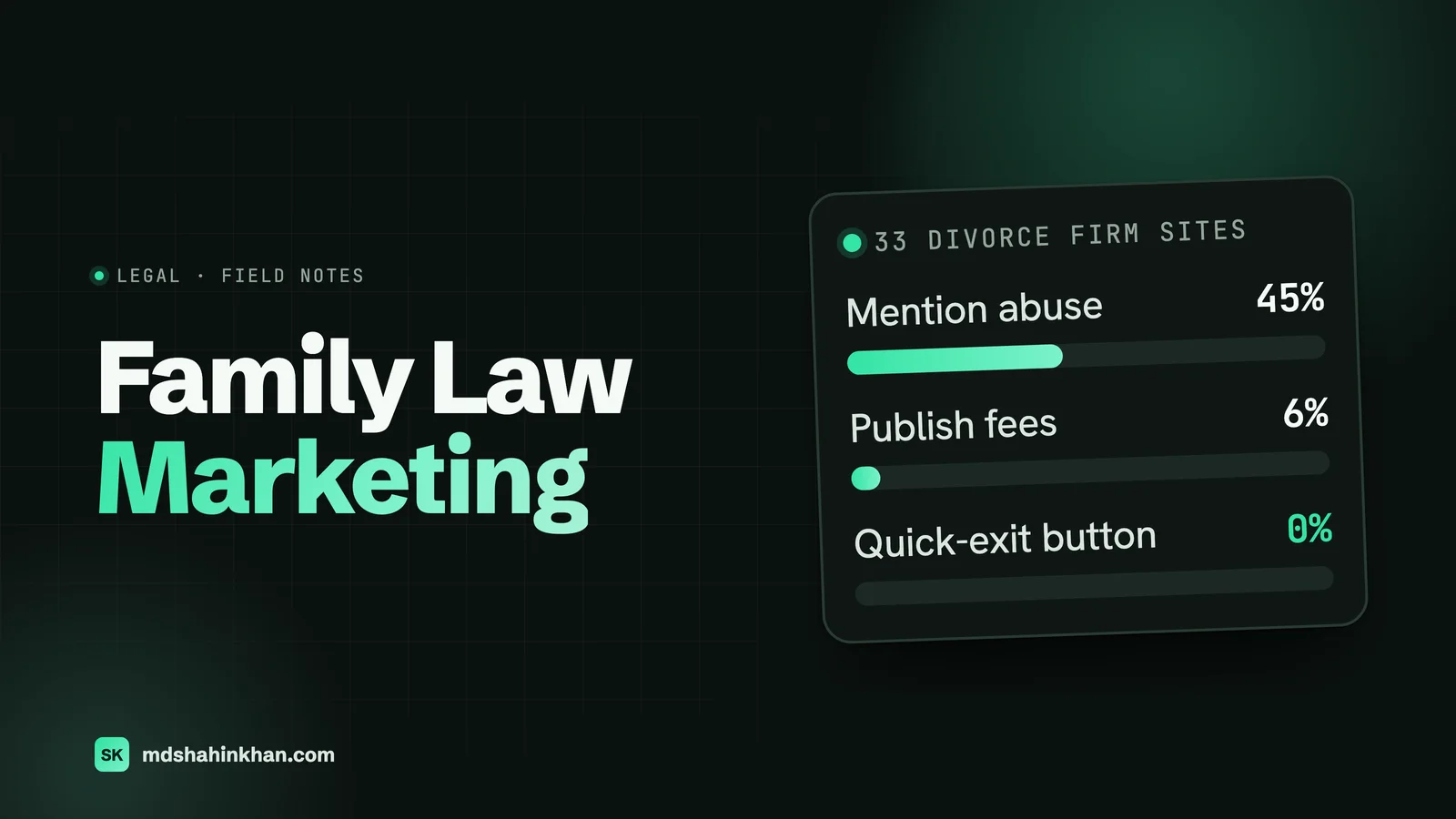
| Mentions domestic violence or protective orders | 15 of 33 | 45% |
| Quick-exit button | 0 of 33 | 0% |
| Offers a free consultation | 6 of 33 | 18% |
| Publishes any of its own fees | 2 of 33 | 6% |
| Online booking tool or link | 4 of 33 | 12% |
| Chat tool | 9 of 33 | 27% |
| Mentions Spanish | 2 of 33 | 6% |
Also, 4 of the 27 pages showing a phone number in the code didn’t make it tappable on a phone. These are firms already on page one, and most of those gaps are cheap to close.
The Pages a Family Law Site Needs
One page per situation, each written for the person living it. This is the core of family law SEO, and it’s most of what “web design for a family lawyer” comes down to.
| Page | What it must answer |
|---|---|
| Divorce | How it works in your state, how long it takes, what happens first |
| Uncontested divorce | Whether they qualify, the steps, the fee if you offer a flat one |
| Contested divorce | When court is likely, what to expect, how you prepare |
| Child custody | How your state’s courts decide, what a parenting plan covers |
| Child support and spousal support | How amounts are worked out, how to change them |
| Mediation and collaborative divorce | Who it suits, the cost difference, your role |
| Modifications | When orders can change after a divorce |
| Protective orders | What to do now, how to reach you safely (see the safety section below) |
| Fees and consultations | How you charge, what a first meeting costs and covers |
| Attorney profiles | Real photos, experience in family court, how they work with clients |
Write in plain words, and be careful with tone: no winning-at-all-costs language unless that’s truly your practice. Many people want a calm exit, not a fight. A page on the state’s actual process, with the local court named, also does more for rankings than generic advice. My guide to law firm website design covers layout, speed and the contact form.
If you serve Spanish speakers, a real Spanish version of your main pages is one of the cheapest advantages available: only 2 of the 33 firms mentioned Spanish at all. I cover how to do this properly in my guide to immigration lawyer marketing.
Explain Your Fees, Even If You Don’t List Prices
“How much does a divorce cost” gets 4,500 searches a month, yet only 2 of the 33 firms published anything about their own fees. One stated its consultation fee and usual retainer range; another gave a starting price for collaborative divorce. Everyone else leaves that question to someone else’s website.
You don’t need a price list. You do need a page that says:
- What a first meeting costs and what it covers. If it’s free, say so. If you charge, explain why.
- How you bill: hourly with a retainer, flat fee for some matters, or both.
- What moves the cost up or down: contested issues, children, property, how much goes to court.
- A range where you honestly can, such as a flat fee for an uncontested divorce.
This filters out people you can’t help and builds trust with the ones you can. Any number you publish still has to be accurate and not misleading under your state’s rules.
Safety and Discretion
This is the biggest gap I found. Nearly half of the firm pages mention domestic violence or protective orders, and not one has a quick-exit button. Someone reading your page may be sharing a phone or a computer with the person they’re afraid of.
A website can’t make anyone safe, and it shouldn’t pretend to. The National Network to End Domestic Violence is direct about this: a quick-exit button “does not delete the current website from the browsing history“, and their advice to organizations is “don’t give a false sense of security”. The National Domestic Violence Hotline warns that “internet usage can be monitored and is impossible to erase completely.”
What I’d build on a family law site, with that in mind:
- A quick-exit button on protective order and domestic violence pages, which replaces the page with a neutral site, plus one plain sentence saying it doesn’t clear browser history, and a link to the Hotline.
- A “safest way to reach you” question on the contact form: call, text or email, the best time, and whether it’s safe to leave a message.
- No automated follow-up until the person has confirmed how to contact them. An automatic text that says “Thanks for contacting us about your divorce” can do real harm on a shared phone or plan.
- Neutral wording in everything automated: email subject lines, calendar invitations, appointment reminders and the name on your text messages.
- No ad tracking on protective order pages. It adds risk and adds little.
The Hotline and the National Network to End Domestic Violence write their guidance for support organizations, not law firms, so treat this as sensible practice rather than a legal standard.
Conflict Checks Start Before the Consultation
In family law, the other side may call you too. Under Rule 1.18 (this is Minnesota’s version; most states have one), a lawyer who receives information from a prospective client “that could be significantly harmful to that person” can be barred from representing the other side in the matter. A long web form can cause that problem before anyone at the firm has spoken to the person.
Your website can help:
- Ask for the other party’s name on the form, clearly labelled as being for a conflict check, and put it where intake staff see it first.
- Keep the first form short. Name, contact details, safest way to reach you, type of matter, other party’s name.
- Tell people not to send case details yet. One line above the message box does it: “Please don’t include details of your situation until we’ve confirmed we can help.”
- Have a process for the consultation request, so the conflict check runs before a lawyer reads or hears the details.
Check your state’s version of the rule, and have your ethics contact look at the form wording. You know this rule better than I do; my point is that the form is where it starts.
Google Business Profile, Reviews and Directories
Google Business Profile. With 27,000 monthly searches for “divorce lawyer near me”, this is your most valuable free listing. Pick “Family law attorney” or “Divorce lawyer” as the primary category, add each service, use your real firm name, and add real photos of the team and office. My guide to local SEO for lawyers goes through this step by step.
Reviews. These are harder in family law: people don’t want a divorce attached to their name in public. Ask every client at the end of the matter, and tell them they can use initials or a first name. Don’t offer anything in return, and don’t write reviews for them.
Replying to reviews. A divorce client’s unhappy review is a tempting thing to answer, but ABA Formal Opinion 496 says a lawyer can’t reveal information about the representation in a reply, and that a negative review alone doesn’t trigger the self-defense exception. Keep replies short and general, and offer to talk privately. Some states differ, so check yours.
Directories. Complete your Justia profile first, since it ranked in 11 of the 12 cities. Then Avvo and your state bar directory. Super Lawyers is by selection, so you can’t simply sign up. And watch Reddit threads for your city: 4 of the 12 cities had one on page one. Don’t post about your own firm there, but read what people say about local lawyers. It’s free client research.
Google Ads and Local Services Ads
Paid search is the fastest way to reach people who need a lawyer this week, and divorce has rules most guides don’t mention.
Google treats divorce as a sensitive category. Its personalized advertising policy lists “Divorce services” under relationship hardships. Customer Match, your own data segments and lookalike segments aren’t supported for these ads. Its customer data policy lists “divorce or marital separation” among the categories whose conversions can’t be used for enhanced conversions. Neither page names law firms specifically, so assume they apply and ask Google if you’re unsure. What this means in practice:
- Search campaigns on local keywords are the core: “divorce lawyer [city]”, “custody attorney [city]”.
- Don’t plan on uploading client lists or retargeting people who visited your divorce pages.
- Measure in your own intake records as well as Google’s conversion reports.
- Send clicks to the matching page, not your homepage: custody ads to the custody page.
Costs. Ahrefs lists average US clicks of about $3 to $4 for terms like “divorce lawyer near me” and “custody lawyer”, and $40 for the marketer’s own phrase “family law marketing”. Treat those as rough averages. Your city and competition set the real price, and Google’s Keyword Planner gives a free local estimate.
Local Services Ads. “Family lawyer services” is a listed category, and you’re charged for each valid lead, not per click. You’ll need state bar license checks for each family lawyer in the firm, owner identity verification and professional liability insurance. Two recent changes: the Google Verified badge replaced Google Screened, and LSAs are moving into Google Ads as Performance Max campaigns with pay-per-lead goals. That rollout started in August 2026 with home-service trades, and legal wasn’t in the first group, so check your own account for what applies.
Facebook and Instagram are weaker for urgent demand. People don’t scroll Instagram looking for a divorce lawyer, and a divorce ad seen on a shared device or by a spouse is a real concern. Use them for education and community presence, not as your main source of clients.
Answer Fast, or Someone Else Will
Clio’s 2019 Legal Trends Report ran a secret-shopper test on law firms, including family law matters: only 56% answered the phone, and 60% didn’t respond to email at all. Reports on the 2024 edition suggest it got worse, with 40% answering the phone and 67% not replying to email. The 2019 report also found that 42% of consumers say that if they like the first lawyer they speak with, they won’t need to speak with any others.
For a family law firm that means:
- A person or a good answering service on the phone, during and after business hours.
- A same-day reply to every form, using the contact method the person chose.
- Online booking for a first consultation, once the conflict check is built in. Only 4 of the 33 firms offered it.
- A short script for intake staff: listen first, confirm the safest way to reach them, run the conflict check, then book.
Fixing this costs less than any ad campaign, and it makes every other channel work harder.
Referrals: Therapists, Mediators and Financial Planners
Family law has referral sources most practice areas don’t. People often talk to someone else before they call a lawyer:
- Marriage and family therapists and individual counselors
- Mediators, who need lawyers to review agreements
- Financial planners and divorce financial analysts
- Other lawyers who don’t do family law: estate planning, criminal defense, injury, real estate
- Clergy, school counselors and doctors who hear about these situations first
Give them something useful: a short plain-language guide they can hand out, and a direct number. Have lunch, send a thank-you, and refer work back where it’s appropriate. You can’t pay for a recommendation, so keep referral relationships free of money (more on that below). My law firm marketing plan has a simple way to schedule this outreach.
The Rules: 7.1, 7.2, 7.3 and Your State Bar
You know professional conduct rules better than I do, so here is just what affects marketing decisions. Most states base their rules on the ABA Model Rules, but they differ, so read your own. The quotes below come from state versions.
- Rule 7.1: nothing false or misleading. New York’s version: “A lawyer shall not make a false or misleading communication about the lawyer or the lawyer’s services.” That covers case results, “best divorce lawyer” claims and fee statements.
- Rule 7.2: paying for marketing. You may pay the reasonable costs of advertising and website designers. You may pay for leads “as long as the lead generator does not recommend the lawyer”, in the words of Minnesota’s comment. You can’t pay someone for recommending you.
- Specialist claims. Don’t say or imply “certified specialist” unless a body your state recognizes has certified you, and name it. Some states require more: Minnesota requires a statement that you’re not certified when that is the case.
- Rule 7.3: solicitation. You can’t solicit by live person-to-person contact when money is a significant motive. Cold-calling someone you found in a court filing is the obvious example. Check whether your state also limits written contact after a filing. Marketing vendors are covered too: ABA Formal Opinion 501, as reported, reaches solicitation by “marketing firms hired by the lawyer”.
- States change these rules. New York dropped its “Prior results do not guarantee a similar outcome” requirement and its “Attorney Advertising” label requirement effective June 1, 2026, though it says lawyers may still want to use the disclaimer. A guide from three years ago may be wrong for your state today.
Measuring Cost per Signed Client
Clicks and calls don’t tell you much. Track each channel through to signed clients:
| Channel | Cost | Consultations | Signed clients | Cost per signed client |
|---|---|---|---|---|
| Google Ads | ||||
| Local Services Ads | ||||
| Organic search and map pack | ||||
| Directories | ||||
| Referrals |
To fill that in:
- Ask every new contact how they found you, and record it in your intake system.
- Use a tracking number per channel if your state and your call-recording setup allow it, and don’t record calls without following consent rules.
- Tag every link in ads and directories so analytics shows the source.
- Add the fee when a matter is signed, so you can compare channels by revenue as well as head count.
Because Google limits measurement for divorce conversions, your own intake records are the source you can trust.
A 90-Day Plan
Days 1 to 30: fix what’s already losing clients
- Make every phone number tappable and test the site on a phone
- Add the conflict check and “safest way to reach you” to the contact form
- Review all automated emails, texts and reminders for neutral wording
- Set up after-hours answering and a same-day reply rule
- Complete Google Business Profile and Justia
Days 31 to 60: build the pages
- Write pages for divorce, uncontested divorce, custody, support and mediation
- Publish a fees and consultations page
- Add a quick-exit button and safety note to protective order pages
- Start asking every closing client for a review
Days 61 to 90: widen the reach
- Test a small Search campaign on local divorce and custody terms
- Check Local Services Ads eligibility
- Meet five therapists, mediators or financial planners
- Set up the cost per signed client table and review it monthly
Frequently Asked Questions
What Are Some Effective Marketing Ideas for a Lawyer?
For a small firm, the most effective ideas are the plain ones: a complete Google Business Profile, one clear page per service, a steady flow of client reviews, quick answers to every enquiry, and referral relationships with people who see your clients first. Add focused Search ads for urgent demand. For family law, explaining your fees and making contact safe also set you apart, because few firms do it.
What Is the 80/20 Rule for Lawyers?
It’s the general idea that roughly 80% of results come from about 20% of the effort or clients. In marketing, it’s a reminder to find the few referral sources, pages and campaigns that bring most of your signed clients and put your time there. That’s why tracking cost per signed client matters more than counting clicks.
How Do Divorce Lawyers Get Clients?
Mostly through local Google searches, referrals from past clients and other professionals, and directories like Justia. Firms that rank for “divorce lawyer near me”, answer quickly and explain their fees tend to win those people. Paid Search fills the gaps while organic rankings build.
Should a Family Law Firm Offer Free Consultations?
Either approach can work, as long as you’re clear about it. Only 6 of the 33 firm pages I checked offered a free consultation. A free first call brings more enquiries and needs a good screening process; a paid consultation brings fewer, more committed people. Whichever you choose, say so on your website, because 500 people a month search specifically for free consultations with a divorce lawyer.
Do Google Ads Work for Divorce Lawyers?
Yes, for people searching right now, if each campaign targets a clear local search and sends clicks to a matching page. Google lists divorce services as a sensitive category, so you can’t rely on customer lists, lookalike audiences or enhanced conversion measurement. Track signed clients in your own intake records.
Does a Family Law Website Need a Quick-Exit Button?
No rule I found requires one, but it’s a sensible addition on pages about protective orders and domestic violence. None of the 33 firm pages I checked had one. Add a short note that it doesn’t clear browser history, since safety organizations warn that a button alone can give a false sense of security.
If you run a family law practice and want a site built around these situations, my page on websites for law firms shows how I work with firms, and my local SEO guide explains how your site and the map pack work together.
If you’d like me to check your contact form, your fee page and how your site looks on a phone, book a free 30-minute call and I’ll go through it with you, whether or not we work together.