Orthodontic marketing works when a practice earns referrals from general dentists and existing patients, ranks locally for “orthodontist near me”, speaks separately to parents, teens and adults, answers the cost question openly, and makes it easy to book a first visit. Then it measures cost per case start, because a full consult schedule means little if few of those consults start treatment.
I build websites for dental practices, and orthodontics is its own kind of marketing problem. Treatment takes a long time and costs thousands of dollars, the person paying is often different from the person wearing the braces, and general dentists and aligner brands are now competing for the same patients. This guide covers what’s specific to orthodontics. For the wider picture, see my guides to dental marketing strategies and local SEO for dentists.
Where New Patients Actually Come From
Start with the data most marketing guides skip. In the American Association of Orthodontists’ economic survey (2022 data), referrals from general dentists stayed at 41% of new patients, and referrals from existing patients at 35%. The remaining share wasn’t broken down in the report I read, so I won’t guess how much of it is online.
That means about three in four new patients in the survey came through a person’s recommendation. So marketing has two jobs:
- Keep referrals flowing from dentists and patients.
- Make sure referred people choose you when they look you up, because a referred parent still checks your website, your reviews and your price.
What People Search For
For the share that starts on Google, these are the searches (US monthly volumes from Ahrefs):
| What people type into Google | Searches a month (US) |
|---|---|
| invisalign cost | 69,000 |
| orthodontist near me | 66,000 |
| clear aligners | 41,000 |
| braces near me | 33,000 |
| how much are braces | 24,000 |
| how much does invisalign cost | 24,000 |
| invisalign near me | 24,000 |
| braces cost | 12,000 |
| adult braces | 9,900 |
| invisalign for teens | 3,400 |
| free orthodontic consultation | 3,200 |
| braces vs invisalign | 2,800 |
| when should kids get braces | 2,200 |
Cost questions sit right at the top, alongside “near me” searches. Adults and parents search differently, too, which matters for your pages.
What’s on 52 Page-One Orthodontist Websites
In November 2026 I pulled page one of Google (US) for “orthodontist” plus a city in 12 places: Columbus, Tucson, Raleigh, Omaha, Knoxville, Spokane, Albuquerque, San Antonio, Boise, Richmond, Des Moines and Tulsa. Orthodontic practices held 78% of the results, and Yelp appeared in 11 of the 12 cities. Then I read the homepages of the practices. Of 71, my script could read 52 (the rest blocked automated requests or failed to load).
| On the homepage | Practices | Share |
|---|---|---|
| Invisalign or clear aligners | 51 of 52 | 98% |
| Adults mentioned | 49 of 52 | 94% |
| Financing or payment plans mentioned | 45 of 52 | 87% |
| Teens mentioned | 40 of 52 | 77% |
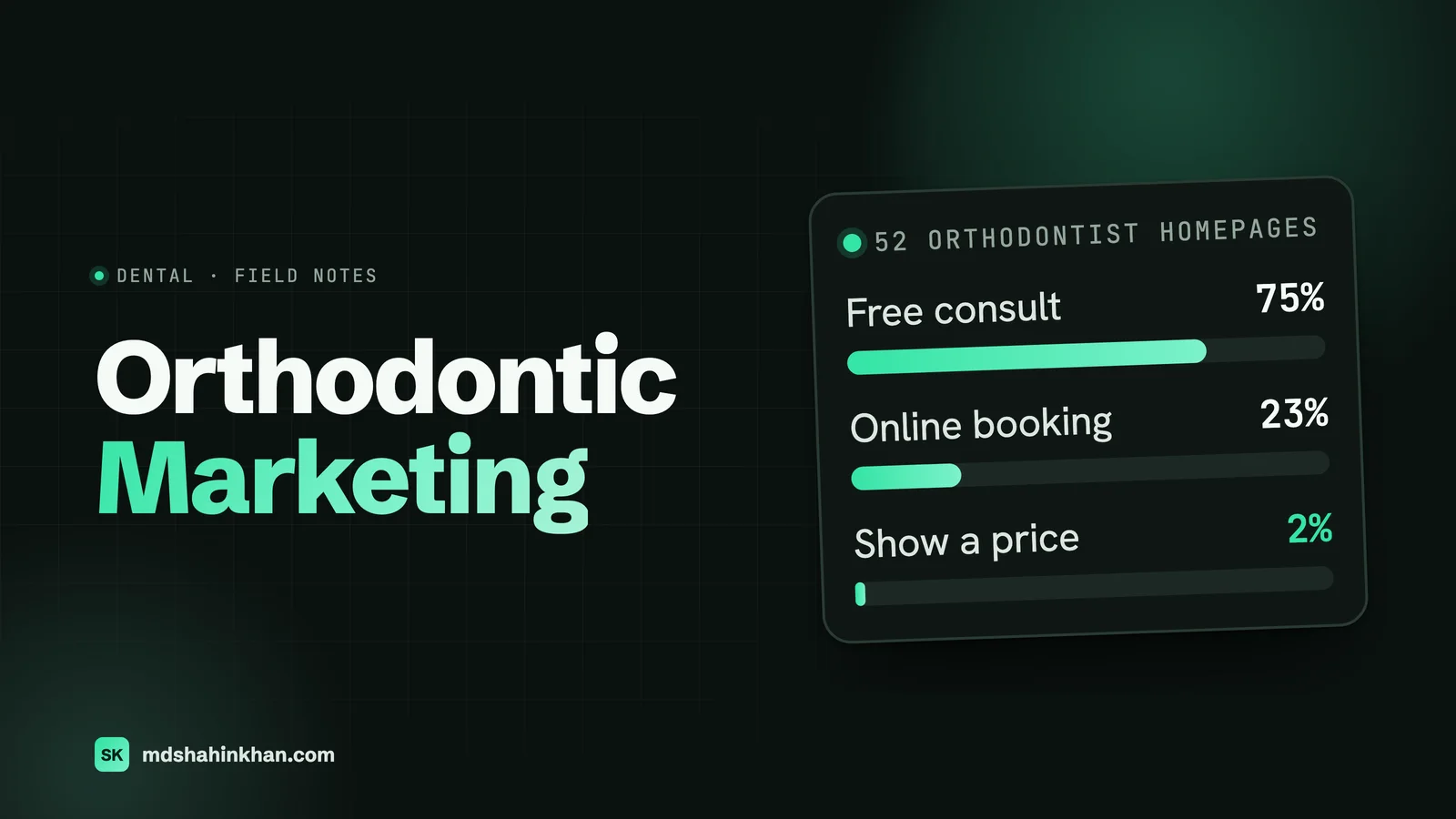
| Free consultation or exam | 39 of 52 | 75% |
| Referring dentists mentioned | 30 of 52 | 58% |
| Before-and-after or smile gallery | 24 of 52 | 46% |
| First visit by age 7 mentioned | 13 of 52 | 25% |
| Online booking tool or link | 12 of 52 | 23% |
| Virtual consult or remote assessment | 12 of 52 | 23% |
| Spanish mentioned | 6 of 52 | 12% |
| Actual treatment price shown | 1 of 52 | 2% |
I only checked the homepage code, so a cost page deeper in the site or a tool that loads later wouldn’t count. Three more practices advertised a dollar discount. Even so, the pattern is clear. A free consultation and financing are now the expected offer, so they won’t set you apart. What’s rare is a straight answer on price, a way to book without a phone call, and a clear message about when a child should first be seen.
Three Audiences, Three Messages
Most orthodontist homepages speak to everyone at once. Each of these groups has a different worry:
| Audience | What they worry about | What to give them |
|---|---|---|
| Parents of children 7 to 12 | “Is it too early? Will you push treatment we don’t need?” | A page on first visits. The AAO recommends a first check-up with an orthodontist by age 7. Explain that many children only need monitoring. |
| Parents of teens | Cost, how long it takes, whether their teen will keep up with it | Clear cost guidance, a braces vs Invisalign comparison, what appointments look like around school |
| Teens | How it looks, what they can eat, sports and music | Short videos, real teen patients (with authorization), a choice of options. Parents still pay, so keep the booking path aimed at them. |
| Adults | “Am I too old? Will it look odd at work?” | Their own page and photos of adult patients. The AAO says 1 in 3 orthodontic patients are adults, and its latest survey puts US adult patients at about 1.91 million, up from 1.64 million in 2022. |
On the website, give each group its own page, with direct links from the homepage: “For my child”, “For my teen”, “For me”. 94% of the homepages mention adults, but a mention isn’t a page. “Adult braces” gets 9,900 searches a month, and an adult landing on a homepage full of teenagers may simply leave.
Show a Price, or at Least a Range
This is the easiest advantage I found. “Invisalign cost” and “how much are braces” together get more than 90,000 searches a month, and 1 of 52 homepages showed a real price.
Patients will find numbers anyway. Guardian’s dental insurance guide (updated May 2026) gives $3,000 to $7,500 for metal braces and $3,000 to $7,000 for aligners. Invisalign’s own cost page says “pricing is independently determined by the doctor”. The AAO gives no dollar range. Without your numbers, a parent is comparing you with a national figure and guessing.
A good cost page has:
- Your typical range for braces and aligners, and a sentence on what moves a case up or down
- What’s included: records, retainers, follow-up visits, repairs
- How insurance works at your practice
- How payment plans work, with real terms (see the next section)
- A worked example, clearly labelled as an example
It should also be linked from your homepage and your main menu. A cost page that nobody finds has the same effect as no page.
Financing Ads: The Rule Most Practices Miss
87% of the homepages mention financing, and none of the marketing guides I read mentions the rule behind it. “Braces from $79 a month” looks harmless. Under Regulation Z, stating “the amount of any payment” in an ad for credit is a triggering term, and the ad must then also state the down payment, the repayment terms and the annual percentage rate. “Monthly payments to suit your needs” doesn’t trigger it, because it states no amount.
Two things catch practices out:
- “Interest-free” doesn’t take a plan out of the rule. Regulation Z’s definition of a creditor covers credit with a finance charge, or credit payable by written agreement in more than four installments, when it’s extended often enough. The AAO says plans typically run 12 to 24 months, which is well past four installments.
- It isn’t only lenders. The rule says all persons must comply when they advertise credit that requires these disclosures, so a practice promoting a third-party lender can be covered too.
I’m a web developer, not a lawyer, and I couldn’t find anything from the regulator naming orthodontists specifically. The practical advice: use the exact wording your financing partner has approved, or ask your attorney to review your payment-plan page and ads before you publish a monthly figure.
Win Referrals From General Dentists
With 41% of new patients coming from general dentists, this is your largest single source. Yet many of these relationships run on habit. 58% of the homepages mentioned referring dentists at all.
- Build a “For Dentists” page: an online referral form, how to send records, how quickly you’ll see the patient, and who to call.
- Report back every time. A short update with the treatment plan and a thank-you keeps you in mind. Make it easy for your team to do from a template.
- Send patients back. Say clearly that they stay with their general dentist for checkups and cleanings. This is the worry that stops many dentists referring.
- Visit in person. Bring lunch, and introduce your treatment coordinator to their front desk.
- Don’t pay for referrals. Keep it to thank-you notes and shared continuing education, and check your state’s rules.
As more general dentists offer aligners themselves, some of these relationships will change. An honest conversation about which cases you each want works better than pretending it isn’t happening.
Patient Referrals and Reviews
Existing patients bring 35% of new patients, and teens and parents talk.
- Make referring easy. A simple card or text with your booking link. Ask when braces come off, the happiest moment in treatment.
- Check the rules before offering rewards. Some marketing guides suggest gift cards for referrals. State rules on rewarding patient referrals vary, so check yours first.
- Never reward a review. Google’s policy bans discounts or free services in exchange for reviews, and the FTC’s review rule bans rewards that depend on a review being positive. One guide on page one for this topic recommends offering “free treatments or discounts”. Don’t.
- Reply without confirming treatment. My guide to dental social media marketing has a safe template and the penalties practices have paid for getting this wrong.
General Dentists and Mail-Order Aligners
Patients now choose among an orthodontist, a general dentist offering aligners, and mail-order brands. Your website should explain the difference plainly, without running anyone down.
The specialist difference. The ADA Code of Ethics says general dentists announcing services in a specialty area “shall also state that the services are being provided by general dentists”. Some states go further: Texas requires a general dentist advertising orthodontics to disclose “general dentist” in a font at least as large as the service. If you’re a specialist, say so clearly, and explain in plain words what the extra years of training mean for a patient.
Mail-order aligners. SmileDirectClub, which said it had served over 2 million people, closed abruptly in December 2023, and the AAO noted that most of its patients hadn’t had an X-ray or in-person exam. The FDA says it “has not authorized clear aligners that are marketed directly to consumers without supervision”. A short, calm page on “What if I started with a mail-order aligner?” helps those people and can bring you real cases.
Invisalign pages. With 98% of practices mentioning it, a logo won’t set you apart. Show your own aligner cases, explain who isn’t a good candidate, and compare braces and aligners honestly (“braces vs Invisalign” gets 2,800 searches a month).
Free Consultations and Booking
75% of the homepages offer a free consultation or exam, so it’s now the minimum. What sets you apart is what happens around it:
- Say what the visit includes: how long it takes, whether X-rays are included, whether you’ll leave with a price.
- Keep “free” honest. The FTC’s guide on the word “free” says the conditions of a free offer must be stated clearly at the outset, and an asterisk footnote doesn’t count. If records are free only when treatment starts, say so up front. The guide doesn’t mention dentists, so this is my reading of it. Some states add their own rules: Florida’s law requires a specific statement on ads for free or discounted exams.
- Let people book online. Only 23% of the homepages had a booking tool or link, and parents often think about this after work, when your front desk has gone home.
- Offer a remote first step. Also 23%. A photo-based assessment or virtual consult lowers the barrier for a nervous adult or a busy parent. It doesn’t replace an exam, so don’t imply it does.
- Make everything work on a phone, especially tap-to-call and the booking form. My guide to dental website design goes through the details.
Photos of Minors
Before-and-after photos are the most persuasive thing an orthodontist has, and many of them show children. A HIPAA authorization is needed, and for a minor it’s generally signed by the parent or other personal representative, with state law deciding the details. Full-face photos are a listed HIPAA identifier, so removing the name doesn’t make a smile photo anonymous.
In practice:
- Keep a signed authorization on file that names the photos and where they’ll appear, including social media.
- Include the teen in the conversation, even when a parent signs. A 13-year-old may feel differently at 17.
- Have a way to take photos down quickly if someone asks.
- Show adults too. An adult patient is more convinced by another adult’s result.
My guide to a HIPAA-compliant dental website covers the rest of the website side.
Ads and Social Media
Google Ads catch people searching now. Ahrefs lists average US clicks of about $3.50 for “braces near me”, $4.50 for “orthodontist near me” and $6 for “invisalign near me”. Treat those as rough averages, since your city sets the real price. Run separate campaigns for braces, Invisalign and adults, and send each one to its matching page, not the homepage.
Facebook and Instagram suit parents and adults in your area. Pew’s 2026 figures show Facebook reaches 78% of adults aged 30 to 49, the age of most parents paying for braces. Instagram and TikTok are strongest among adults under 30; Pew’s figures don’t cover under-18s. Posts showing your team, the office and real results with authorization work well. My dental social media guide has a weekly plan.
Community and schools. Sponsor a local team, give talks at schools where they welcome it, and hand out mouthguards at games. These put your name in front of parents and teens, and they’re hard to measure, so ask “how did you hear about us” on every new patient form.
Measuring Cost per Case Start
A full consult schedule can hide a weak website or a weak consult. Track each step:
| Channel | Cost | Booked consults | Show rate | Case starts | Cost per case start |
|---|---|---|---|---|---|
| Dentist referrals | |||||
| Patient referrals | |||||
| Google Ads | |||||
| Facebook and Instagram | |||||
| Organic search and map pack |
Two practical notes:
- Ask how they found you, and record the answer in your practice software. Referred people often check you on Google first, so analytics alone will credit the wrong channel.
- Look at consult-to-start by source. If dentist referrals start treatment far more often than ad leads, that tells you where the next dollar should go.
A 90-Day Plan
Days 1 to 30: fix the basics
- Complete your Google Business Profile and Yelp listing, with braces and Invisalign as services
- Make phone numbers tappable and add online booking
- Review payment-plan wording against Regulation Z with your financing partner or attorney
- Put a signed photo authorization process in place, including minors
Days 31 to 60: build the pages
- Write a cost page with real ranges
- Add pages for children, teens and adults, linked from the homepage
- Add a “For Dentists” page with an online referral form
- Write a braces vs Invisalign comparison
Days 61 to 90: grow referrals and test ads
- Visit your top 10 referring dentists, and five who don’t refer yet
- Set up a review request at debond
- Test small Google Ads campaigns for one treatment at a time
- Start the cost per case start table and review it monthly
Frequently Asked Questions
What Are Some Effective Marketing Ideas for Orthodontics?
The most effective ideas are close to home: a “For Dentists” page with an online referral form, a review request at debond, a cost page with real ranges, separate pages for parents and adults, and online booking. Add local search ads for one treatment at a time. These work because referrals and local searches bring most new patients.
How Much Does Dental Marketing Cost?
It depends on your city, your goals and how much you do in-house, and I haven’t found a reliable published benchmark. Figures like “3 to 7% of revenue” appear in vendor articles without a source. Start with the low-cost work (profile, website pages, referrals, reviews), then set an ad budget you can measure by cost per case start.
What Are the Current Trends in Orthodontics?
More adults, more aligners and more competition. The AAO says 1 in 3 orthodontic patients are adults, and its latest survey reports record patient numbers. General dentists now offer aligners widely, and the closure of SmileDirectClub in 2023 and the FDA’s statement on unsupervised aligners have made supervised care a stronger message.
How Do Orthodontists Get More Patients?
Mostly through people: in AAO survey data, general dentists account for 41% of new patients and existing patients for 35%. Strengthening those relationships usually pays back faster than ads. After that, rank locally for “orthodontist near me”, answer cost questions on your website, and make booking easy on a phone.
Should Orthodontists Publish Prices?
I think so, at least as a range with an explanation of what moves it. “Invisalign cost” gets 69,000 searches a month, and only 1 of the 52 homepages I checked showed a price. A range filters out poor fits and builds trust. If you publish monthly payments, check the Regulation Z disclosure rules first.
At What Age Should a Child First See an Orthodontist?
The American Association of Orthodontists recommends a first check-up by age 7. Only 25% of the homepages I checked mentioned it. For a practice, a clear “first visit” page reassures parents that an early visit usually means monitoring, and it starts the relationship years before treatment.
If you run an orthodontic practice and want a site built around how parents, teens and adults actually decide, my page on websites for dental practices shows how I work, and my local SEO guide explains how the site and the map pack work together.
If you’d like me to look at your cost page, your booking path and what your homepage says to each audience, book a free 30-minute call and I’ll go through it with you, whether or not we work together.